O, the vanity!
Also, Blogspot.com has now made sharing your favorite Tarquin Tar postings so much easier! Just use any of the share buttons now located at the bottom of every post.


My fiancée and I have recently started attending local estate auctions in order to get some nice furniture for our new home. At our first estate auction, I successfully bid on two boxes of antiquarian books (yeah, I know: not furniture...). The experience was quite different from what I’ve written on previously in regards to attending a book auction. At the estate auction, the choices in terms of books were far more limited; however, because fewer people there were interested in books at all (they were mostly bidding on the furniture, art, furnishings, and jewelry) the price was ridiculously reasonable. This week’s book is one of the items acquired for Tarquin Tar's Bookcase from my prevailing bid.


The book is a first edition of Churchyard Literature: A Choice Collections of American Epitaphs, with Remarks on Monumental Inscriptions and the Obsequies of Various Nations, written by John R. Kippax and published by the eminent firm S. C. Griggs and Company of Chicago in 1877. The book was printed by the Chicago firm of Blakely & Brown (founded in 1871 by Connecticut native Charles Franklin Blakely). A second edition was published by Singing Tree Press of Detroit in 1969, a third by Corner House of Williamstown, MA in 1978, and a fourth by Heritage Books of Bowie, MD in 1994.


Dealers online list the first edition as “collectible” and price it from between $18 and $63 (an association copy signed by the author is being sold for $125). In other words, even at its cheapest valuation, this one book (out of two boxes of approximately 40 books) is worth (at retail) about one-third of what I got the lot for at auction. At its highest valuation (sans autograph) it’s worth more than what I paid for the entire lot.
Kippax (1849-1922) was a member of a nineteenth-century archaeological society, which was his justification for authoring the book -- his first publication; he is perhaps better known, however, for his later interest in various fields of science.

The record of his publications suggests an eclectic range of interests over his lifetime. In 1880 Duncan Brothers of Chicago published Kippax’s A Hand-book of Diseases of the Skin and their Homeopathic Treatment (further editions from other publishers followed in 1884 and 1890) and in 1884 Gross & Delbridge of Chicago published his Lectures on Fevers: Delivered at the Chicago Homeopathic Medical College.


Homeopathy remained Kippax’s interest throughout the 1880s and 1890s. In 1910, however, he released a book titled Comets and meteors, and in 1914 G. P. Putnam’s Sons of New York published his richly illustrated book on astronomy, The Call of the Stars: A Popular Introduction to a Knowledge of the Starry Skies. I’ve had difficulty finding good biographical information about John Kippax, but it seems from the history of his publications that he was a man of many different studies.


The book is bound in red cloth with some ornate black decorations on the cover and gilded decoration (now faded) on the spine. The pages measure 12.5cm x 18cm and are of a slightly heavy stock that has faded a bit with age. Preliminaries include four blank flyleaves (the first conjugate with the front pastedown), a frontispiece (graveyard scene before a church and the last three lines from Longfellow’s 1842 poem “The Goblet of Life”), the title page with copyright on the verso, the dedication (incorporating a quote from Robert Blair’s 1743 poem “The Grave”), the table of contents, and a two-page preface signed “J. R. K.” and dated “Oak Park, Nov. 5, 1876.” The pagination of the book silently incorporates everything from the title page onward, running [1]-[10].


The contents of the book include an Introduction on the history and aesthetics of graveyard epitaphs and obsequies (pp. 11-35); epitaphs on eminent personages (pp. 37-63); admonitory epitaphs (pp. 65-86); devotional epitaphs (pp. 87-102); adulatory, laudatory, and bombastic epitaphs (pp. 105-128); professional epitaphs (pp. 129-145); ludicrous, eccentric, and ridiculous epitaphs (pp. 147-165); punning and satirical epitaphs (pp. 167-176); miscellaneous epitaphs (pp. 177-198); and an index to names, places, and subjects in the book (pp. 199-213). Four blanks end the book.


The unusually large number of blanks at the start and finish of the book -- seemingly such a waste of paper -- perhaps were to encourage readers to jot down their own discoveries of interesting or moving graveyard literature. Having grown up in Salem, MA and wandered many an old and peculiar cemetery, I can recall coming across a number of haunting (and some humorous) inscriptions dating back to the 1600s. The examples that Kippax provides of what he terms “grave literature” are quite diverse, but the reader (well, at least, this reader) is drawn especially to the numerous examples of witty and humorous epitaphs (see the images throughout this post). The form of the genre -- pithy couplets that often have to stretch to rhyme with an odd last name -- makes it ripe for the set-up and delivery of punchlines, one-liners, and word-play. I suspect there’s also a certain element of catharsis in laughing in the presence of death; to mitigate, or at least manage, the haunting mystery of the inevitable demise that awaits us all, we take comfort in the macabre juxtaposition of the grave and the jest.


There are no reader’s marks in the copy, but it was evidently well-read: the outside of the spine has split toward the bottom, revealing the discarded paper used in the binding of the book (not enough text is visible to make out what precisely was used). There are a couple of penciled dealers’ marks on the recto and verso of the front flyleaf and in the lower inside corner of the penultimate flyleaf. The recto of the front fly also bears two stickers that offer a clue as to the book’s past. In the middle of the page is a simple bookplate bearing the name “H. H. Player”. I’ve found a gentleman named Henry H. Player who lived on Queen Street in Middlesex in England around 1847, but that may be too early a date for this book. Besides, I suspect this copy hasn’t left the United States.


In the lower inside corner of the same page there’s a store sticker for W. A. Butterfield of 59 Bromfield Street in Boston, MA. In addition to retailing books, Butterfield was a publisher from 1904 until at least 1919, specializing in literature (particularly Shakespeare and works related to the Bacon-Shakespeare lunacy) and the arts, nature, and local history. As a large majority of the epitaphs recorded in Kippax’s book are from the northeastern United States -- and New England in particular -- it would presumably have fit rather well into the store’s stock in the early years of the twentieth century.


Perhaps it’s because I’m an identical twin, but I’ve always been drawn to books in sets.
Yesterday, my fiancée and I visited Grey Matter Books in Hadley, one of the region’s newest used bookstores. They had a number of sets for sale -- modern and antiquarian. I noticed also, however, a number of “broken” sets. In some cases the broken set was complete but for one missing volume; in other instances, only one volume of the set was present.
Typically I wouldn’t buy a broken set. Something about the incompleteness seems depressing to me. Nonetheless, I ended up buying a single volume from an eight-volume set; only the one volume was available. It was a good price, though, and the owner even knocked it down a bit for me. The set is a standard and essential reference tool for my field and I figure I can just add to it over time: if I serendipitously find the other volumes in the future as I browse bookstores, I’ll gradually complete the set. It will be useful, but filling in the gaps in a broken set in this way is never completely satisfying; a set of specific copies that were printed and then sold together as one unit seems to belong together perpetually. Even though they’re in stand-alone volumes, only together do they make up one whole book. The volumes in a set have a history together, like a family.

This week’s book is an orphan from a set of five volumes (actually “ten volumes in five”, according to the title page): volume one from The Diary of Samuel Pepys, With selections from his correspondence, and an introduction to each volume. The work is a modern-spelling edition prepared by Professor Henry Morley (1822-1894) and published by The Cassell Publishing Company of 31 East 17th Street (Union Square) in New York. There’s no date on the volume, but Morley only became a professor after 1865 and Cassell was only known as “The Cassell Publishing Company” after 1888. Dealers online vary from 1880 through 1900. The first edition (issued in ten separate volumes), however, was published by Cassell in 1887; the volumes of the first edition are in yellow boards and bear black printed decorations. This volume is from the second edition and is bound in dark blue cloth boards with faded gilt titling on the spine.

After the half-title and title page there appears Morley’s general introduction (pp. [5]-9) and the “Preface to the Original Edition” (pp. [11]-14), signed “Braybrooke” (that is, Richard Neville, Lord Braybrooke) and dated “Audley End, May 14, 1825”. The first two years of the diary (1660-1661) run from pp. 15-192. There then follows an internal title page for the next “volume” (covering 1662-1663) and the pagination re-starts. Morley’s introduction for the second half runs from pp. 5-8 [should be 3-6] and the diary runs from pp. 9-192 [should be 7-189]. The error in paginating the second half suggests that, in making the “two volumes in one”, the printer simply followed the set-up of the original ten volume version (in which the 1662-1663 volume begins with a half-title and title page, thus justifying the start of Morley’s introduction on p. 5 instead of p. 3).


There is no evidence of ownership or use, with the exception of four pencil underlines in Morley’s introduction to the second half. The printing was generally well executed, though a few errors slipped in, including a missing possessive apostrophe in the running title on p. 47 of the first half and the slippage of type at the end of a line on p. 169 of the second half. The book was machine-printed and may be expressed collationally as 12o: [#1] [“A-33”16] - “F-33”16 [“A-41”15] - “F-41”16 [π2]: $1. The paper is a sturdy stock that took the bite of the type fairly well but is beginning to discolor a bit with age; there are no watermarks, but there are 3cm horizontal chain-lines. The pages measure 11cm x 16.5cm. Overall, with the exception of a slightly splitting spine (internally) and some of the usual bumps to the boards, it is in good condition: no tears, no folds or bends, and no pronounced staining or foxing.

Samuel Pepys (1633-1703; above) is sometimes referred to as the first “blogger”, but there is a crucial difference: Pepys’s diary was intensely personal and private. In order to keep prying eyes from reading it, he went so far as to write the entire document in a shorthand of his own invention. The details it contains are often scandalous, embarrassing, and even potentially politically dangerous. Today’s bloggers often include such content in their own writing, of course, but with the point of stirring up trouble. Pepys was writing for himself; bloggers (trust me) write for everyone else. Pepys was a minor official of Restoration England; in 1672, after years of service in the Admiralty, he was appointed secretary of that department, and in 1684 he was made president of the Royal Society. But he is today best known for his remarkable diary; spanning the years 1660 (the year Charles II was restored to the throne of England) up to 1669, Pepys’s diary gives an almost daily glimpse into the world of Restoration London.

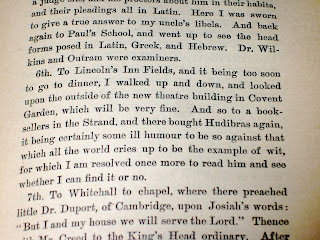
From domestic politics to social affairs, from local gossip to global commerce, from personal habits to international diplomacy, from literary trends to theatre news, Pepys offers modern readers access into a world that is remarkably familiar but at the same time intensely foreign. Following the publication of the first “translation” of the manuscript (Braybrooke’s in 1825), the diary has remained a staple item of literary studies and history through over 250 modern editions and at least one movie version.

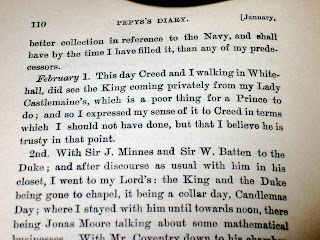
As I mentioned, having an orphaned volume always generates a sense of incompleteness. Flipping through the pages of my one volume from the Pepys diary, however, and following the numerous day-to-day threads he weaves through his record, I feel a particularly strong disconnect when I reach the final page -- as if reading only the first four years of the diary and then suddenly coming to an unresolved halt at the end of 1663 not only cuts my reading experience off, but actually preternaturally shortens Pepys's life itself.


The Malone Society was founded in 1906 with a mission to make rare and unique materials essential to the study of English Renaissance drama more accessible to scholars and the public. Its history is one of prestigious and superlative scholarly research. Every year for the past century the Society publishes anywhere from one to six editions of manuscript or obscure printed plays, theatrical records, and other relevant documents. In order to ensure the material is as useful as possible for scholarly purposes, these editions always avoid heavy editorial intrusions: a brief (anywhere from one page to twenty or so) textual introduction is followed by a record of collations of extant copies and then the text itself, either as a diplomatic reprint (for manuscript plays and for printed plays up until the past few decades) or as a photographic facsimile (for most printed plays published by the Society in the past few decades). The books’ familiar tan cloth binding, plain and unadorned but for black lettered titles on the spine, should be immediately familiar to anyone in my field; they are a staple and necessity for studying English dramatic literature and theatre history.


This week’s book is the Malone Society’s centennial edition for the years 2007-2008. It is volume 172 in the Malone Society Reprints series and presents a full-color, 1:1-scale photographic reproduction of the elegant scribal-copy manuscript of John Fletcher’s The Woman’s Prize, or The Tamer Tamed (1611) held by the Folger Shakespeare Library in Washington DC (MS J.b.3). The edition was attentively prepared by Meg Powers Livingston and checked for accuracy by two of the Society’s most prestigious elder scholars, G. Richard Proudfoot and Henry R. Woudhuysen. The book was published for the Malone Society by Manchester University Press and printed by Alden HenDi of Oxfordshire.
Fletcher’s play is a sequel to Shakespeare’s The Taming of the Shrew, but in it the tables are turned: following the death of his first wife, Katherine, Petruchio marries Maria, who “tames” her brat of a husband by -- Lysistrata-like -- leading the women of the play in withholding sex from their husbands until the men change their ways. It was likely written in 1611, but it underwent quite a bit of revision and changes due to censorship; in 1633, after first having performance of the play blocked by the Master of the Revels (the government official responsible for censoring and licensing all public plays) because of perceived indecencies in it, the King’s Men were finally allowed to stage it and The Taming of the Shrew together before King Charles and the queen at St. James’s Palace. According to the Master of the Revels, Shrew was “liked”; Tamer was “well liked”.

The play was quite popular on the Jacobean and Caroline stage and was also frequently performed on the Restoration stage as well, often in repertory with Taming of the Shrew (in 1667, in fact, John Lacy revised Shakespeare’s play to make it a better fit with Fletcher’s). After a prolonged absence from the stage, it was most recently performed (again, in repertory with Shrew) by the Royal Shakespeare Company in 2004.
Livingston dates the manuscript of the play to anytime between 1611 and 1623. It differs from the 1647 folio in several ways, including in textual changes that were no doubt due to the 1633 revisions demanded by the Master of the Revels. The hand is an elegant, clear, and rather large italic, making it much easier to read than most early modern play manuscripts (which are usually scribbled in English secretary hand). Care has been taken with this copy and the scribe (probably a professional) has dutifully corrected mistakes as he worked. Later hands have also made some annotations and changes as well. The dignity and beauty of the work suggests that the fair copy was made as a presentation gift for someone of importance. Livingston demonstrates that the cuts and wording in the stage directions point to a playhouse manuscript as the scribe’s copy-text (that is, the scribe copied his work from a manuscript that had been actually used for performance).


The contents of the Malone Society edition begin with Livingston’s introduction (p. v-xxviii), which includes: information on the manuscript’s modern provenance (v-vi), the play’s authorship (vi-vii) and date (vii-viii), the manuscript’s physical characteristics (viii-x) and its corrections and annotations (x-xiii), a comparison to the printed folio versions of the play in 1647 and 1679 (xiii-xx), dating of the manuscript itself (xx-xxi), and a statement of editorial conventions and acknowledgements (xxi). Following the introduction are several appendices: a list of corrections made by the original scribe of the manuscript (xxiii), a list of differences between the manuscript and the 1647 folio that can be attributed to censorship imposed on the play’s oaths, ribaldry, and profanity by Henry Herbert, Master of the Revels, in 1633 (xxiv-xxv), and a table cross-referencing the through-line numbering system of the edition to the page numbers and signatures of the 1647 folio and the act/scene/line marks of Fredson Bowers’s modernized edition of 1966.


Each page of the facsimile provides the full-color image of the manuscript page in the center, with through-line numbers marked every ten lines printed in the inner margin and the folio pagination centered in the bottom margin. The manuscript is a total of 52 folio leaves (103 pages; the verso of the final leaf is blank, but Livingston includes it in the reproduction anyway; one leaf, no. 22, is interleaved and pasted in, perhaps to replace a gross error in the transcription [left]) measuring 19.7cm x 29.5cm. The paper in the book is a very high-quality glossy stock; the pages measure 26.5cm x 35.5cm. The binding is the usual Malone Society tan buckram publisher’s cloth, with the title of the play in black letters on the spine.
As a member of the Malone Society, I receive the annual publications directly from the publisher. Inserted into my copy is a letter from the then-newly installed U.S. Secretary-Treasurer for the Society, Professor Eric Rasmussen of the University of Nevada, Reno. The letter briefly introduces the volume and indicates Rasmussen’s pleasure that distributing the volume to the U.S. members is his “first act as incoming U.S. Secretary-Treasurer”.

The edition has been received very enthusiastically by scholars in the field. The following notice is from the Malone Society website:

[The edition has been] enthusiastically reviewed in the TLS by Laurie Maguire, who noted that 'The reader can enjoy flicking back and forth from Powers's descriptions and analysis to the high-quality pictorial evidence' and predicted that the continuing adaptability of the Society in the digital age 'points towards several more Society centenaries'. William Proctor Williams has also praised this volume (‘a magnificent facsimile') and the work of the Society: ‘So where does the Malone Society stand in the age of the pixel? … I submit that no matter how good the resolution is on your computer screen, … the Malone Society Reprint is a superior and more scholarly useful item than the digital form. … I trust that some reviewer a hundred years from now will get the same pleasure from reviewing the Society's bicentennial volume as I had reviewing The Woman's Prize ' (Notes and Queries , 57 (2010), 136-8).

The enthusiasm for high-quality photographic editions of manuscript plays is not an understatement. With the wide-spread use of digital resources such as Early English Books Online and Literature Online it has become relatively easy for scholars around the world to access and work with rare printed materials from the early modern period. To work with manuscripts however -- which are, by definition, unique -- it has always been necessary to either travel to the library holding the document (almost always in the UK, though the Folger and the Huntington in California have some) or rely on a diplomatic transcript (nearly always from the Malone Society). Photographic reproductions of manuscripts from the period have suffered from camera technologies insufficiently subtle and sophisticated to capture the nuances of color, tone, impression, texture, etc. that embed important material evidence into the physical object of the text. High-resolution digital photography is beginning to make those problems obsolete, and the ability to zoom and navigate those images on a computer screen should revolutionize the study of early manuscripts: not only does it democratize scholarship by making those unique materials accessible to thousands, if not millions, of users, but it also helps ensure the preservation and longevity of the materials themselves by reducing the need for users to actually handle the document.


Williams’s suggestion that Malone Society reprints, in book form, will always be “superior and more scholarly useful” than digital facsimiles seems purely optative -- conservative thinking from a scholar very firmly (and professionally) entrenched in print culture. Certainly there is a need for full-color, scale reproductions of manuscript plays in print; there is a permanence to the book-form of the edition that digital technologies -- so often changing and going out of date -- have yet to successfully replicate. But as the next generation of scholars begins to populate academia -- a generation of scholars who are intensely digital natives -- the use of digital media to advance the centuries’ old mission of critical inquiry and analysis will evolve and improve. The goals of the scholarship will change little; the tools that make the realization of those goals possible, however, will change radically.


My collection consists mostly of books or pamphlets, though, as I’ve noted in the past, I occasionally end up with non-book items that are fascinating pieces of textual history. While I was in Maine this week to visit with family and enjoy some vacation time, my grandfather gave me some fascinating new items for my collection. This week’s entry features one of those items.
The object is a lithograph map of Finhaut, an idyllic mountain municipality in southwestern Switzerland, on the French border (approximately 4o 30’ - 4o 40’ latitude and 46o 3’ - 46o 7’ longitude). The map shows the surrounding district of Saint-Maurice, part of the Valais canton (cantons are the equivalent of states in Switzerland). I’m not an expert on map-collecting, but cartography is one of those fascinating cousin-disciplines to bibliography that always repays study and I’ve enjoyed trying to find out some more about this unique specimen.

The map was printed on a sturdy paper stock and then cut into eight separate pieces, each measuring 10.5cm x 16.5cm. These pieces were then glued to a piece of gray canvas measuring 34.5cm x 45cm and the edges of the canvas folded over the outer edges of the paper to more firmly secure and protect them. The canvas is still in good shape (though a bit water-stained in places) and it has served its purpose well: the folds in the map are still intact, whereas a paper map of the same age would likely be torn and frayed. The upper left piece bears the heading “Section 1, B1.XXII.” and the upper right reads “Blatt 525” (“Plate 525”), indicating that the map was removed from a larger book (presumably an atlas, but I haven’t been able to identify it).
In the lower right there is a small circular blind stamp bearing the Swiss cross in the center, surrounded by the words “ Eidgenössisches Militaire Archiv” (“Federal Military Archives”).

The map was based on the observations and notes of one H. L’hardy (a box in the upper right corner reads “Aufnahme von H. L’hardy”, or “Recording of H. L’hardy”) and printed by noted Swiss lithographer and cartographer Rudolf Luezinger (1826-1896).

According to Bernhard Jenny and Stefan Räber of the Swiss Institute of Cartography:
Leuzinger [left] was...trained by Jakob M. Ziegler and Johann Ulrich Wurster in Winterthur, Switzerland. He specialized in mountain cartography, working for the Swiss Federal Office of Topography and the Swiss Alpine Club. His pioneering work includes colored shaded relief produced by lithographic printing.
Rudolf Leuzinger is also the author of the hypsometric map “Carte physique et géographique de la France” published in 1880.
Hypsometric maps use different colors to represent the elevation of different terrains. While he did not use this technique for my map, Leuzinger -- one of the earliest map-makers to use hill tone shading -- did draw it to show the topography of the region.

The map bears several dates. Included on the lithographic plate is the notation “Eidg. Stabsbureau 1879.”, indicating that the Eidgenossisches Stabsbureau, or Swiss Federal Office [of Topography], first printed the map in 1879. Stamped beneath that notation is the text “Nachträge 1886” (“Addendum 1886”). On the paper label pasted on the reverse of the top left panel, a light gray pen has inscribed “Finhaut / 1890.” Also written on this label, in a different, more modern hand and in pencil is a dealer’s price (“$8.00”)

Without seeing the original 1879 version, it’s impossible for me to tell what the 1886 addendum might be. One addendum does stand out, however. In the lower right corner of the second piece from the right on the bottom, an owner has made several inked and penciled additions (none in the same hand as the title label on the front of the map).

These additions extend the Swiss-French border southward beyond the scope of the printed map by about one kilometer; they also add the names of two geographic features and their respective heights. The first is largely obscured. The second is the bridle path Col de Balme, at an elevation of 2,202 meters, leading from Chamonix to the Trient Valley.
Using Google Maps’s “Terrain” function, I’ve tried to compare the topography of the region in 1879 (as presented by Leuzinger) with the current lay of the land. Some new towns have appeared, and the names of some physical features have changed. But the two biggest changes are by far the most telling -- both speak to the power of man to alter, both deliberately and inadvertently, the face of the planet.

To the west of Finhaut, just before the French border, Google Maps shows the wide blue expanse of Lac d’Emosson. This two-square mile body of water was formed as a reservoir in 1925. Leuzinger’s map shows only a thin blue river running north to south down a deep valley, surrounded by a light peppering of tiny lakes and ponds.
The other difference is more disturbing. Between the northernmost tip of that valley and the peak of Mont Ruan, Leuzinger has drawn an oblong 1.5-square mile blue and white expanse labelled “Glacier des Fonds”. The glacier is completely missing from the Google Maps view in 2010.


