Showing posts with label poetry. Show all posts

Sunday, December 5, 2010

Rest in Peace, Henry Hubbell


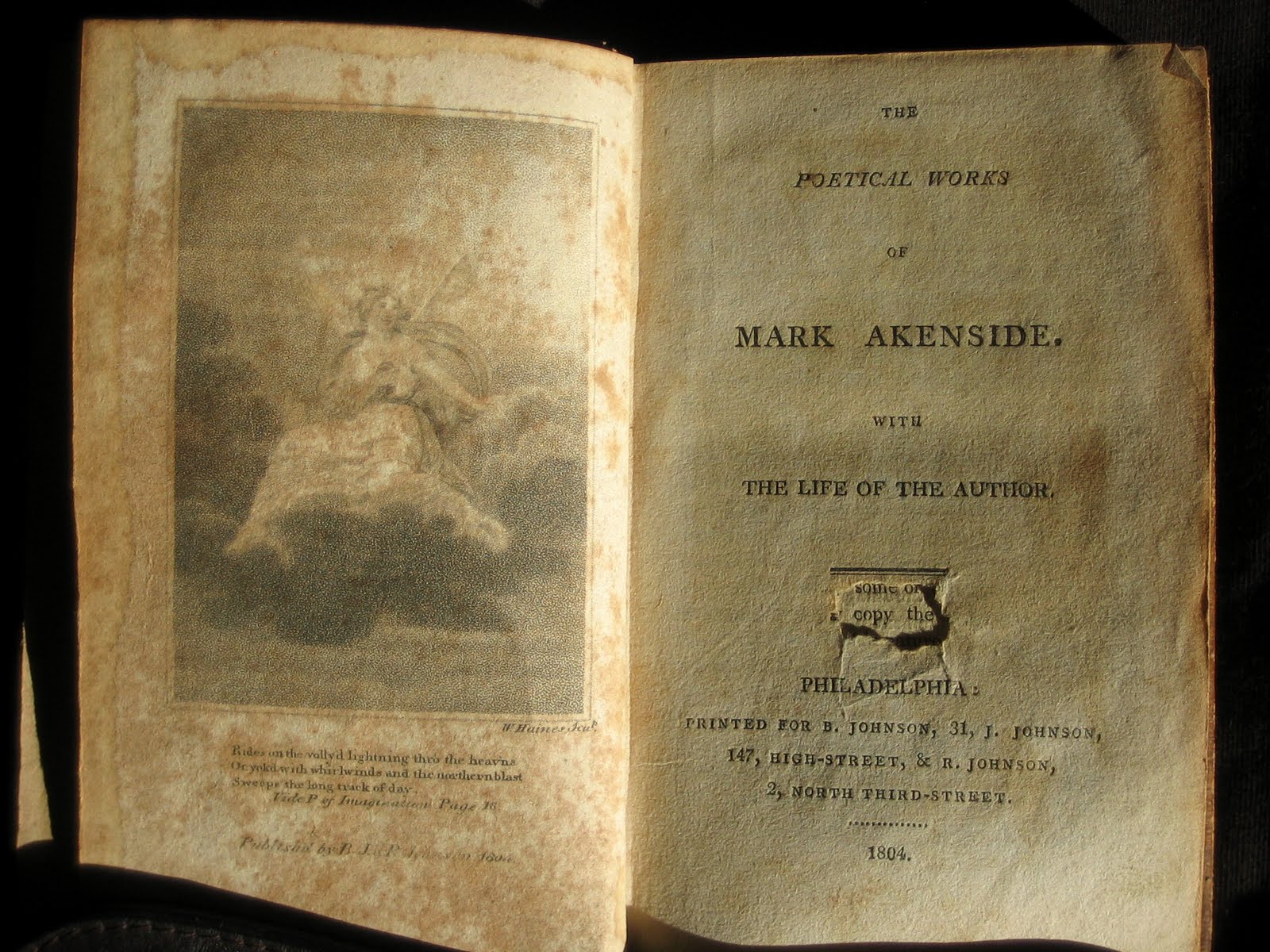
This week’s book was part of a mixed “pick” lot I obtained at an ephemera auction back in October. The book is volume two of The Poetical Works of Mark Akenside. With The Life of the Author; it was published in Philadelphia, 1804, by Benjamin Johnson (31 High Street), Jacob Johnson (147 High Street), and Richard Johnson (2 North Third Street). It was printed by Benjamin.

Benjamin Johnson (1776-?), fifth of Anne Alexander and Abel Johnson’s fifteen children (possibly sixth: he and his brother Joseph were twins), was publishing and selling books in Philadelphia as early as 1792 and continued up until 1807. In 1795, his older brother Jacob entered the trade on his own, but, as this book shows, they often collaborated on certain projects (as early as 1802). I can find less information about “Robert Johnson”, though he seems to have still been active as a Philadelphia publisher in at least 1806 and collaborated with Benjamin and Jacob as early as 1805. I can find no immediate evidence that he was related to Benjamin and Jacob.

Akenside (1721-1770; right) was an English physician who found a second calling in the writing of both pastoral and didactic poetry as well as lyrical odes that never really pushed the boundaries or experimented, either metrically or thematically (Edmund Gosse described him as “a sort of frozen Keats”). His early outspoken dissenting political views and non-conformity in the way of religion (he was an Enlightenment era deist) attracted ridicule and scorn from many established writers in English society. But later in his life, his politics changed and he came to embrace the Tory perspective; this conversion earned him favor late in his career and he ended up as personal physician to Queen Charlotte, wife of King George III. He continued to write poetry throughout his life, however, and was still laboring at revising a new version of The Pleasures of Imagination when he died of fever at the age of 49.

The earliest collected edition of Akenside’s poetry was published in two volumes by the Martins at the Apollo Press, Edinburgh, in 1781. All subsequent collections of his poetry were derived from that Apollo edition. A London edition followed from J. Bell in 1782 and an “embellished” edition (that is, containing engravings) from C. Cooke of London in 1795. Further London editions from other publishers appeared in 1805, 1806, 1811, 1818, and throughout the remainder of the nineteenth century, into the early twentieth.

Rather bizarrely, the normally reliable WorldCat catalog reports the first American edition as the jointly published Little, Brown, and Company (Boston) and Evans & Dickerson (New York) of 1854. This is off by half a century. As far as I can tell, the Johnsons’ Philadelphia edition of 1804 is the first American edition of the book (though not the first appearance in America of Akenside’s poetry; according to the holdings of the American Antiquarian Society, his Pleasures of Imagination collection had been published in 1794 and 1795 and his Poems of Established Reputation in 1803). No dealers are currently selling a copy of the Philadelphia edition, so I’m not able to estimate its value. Even more bizarre is that no where can I find evidence that the Johnsons published an accompanying Volume I -- it is not listed on WorldCat, AAS, or Google Books.


The book is bound in tan cloth that has been finished to emulate the look and feel of leather. An elaborate raised decorative pattern is on the front and back boards: at the center, there is a bee hive surrounded by a garland of flowers (a reference, perhaps, to an image that Akenside uses in several of his poems) and surrounded again by laurels (a reference to poetry); atop this device sits the classical figure of the Caduceus (a reference to Akenside’s profession as a medical doctor). The gilded name “Akenside” appears on the spine. There is some chipping and bumping to the edges of the boards; the most egregious damage to the binding, however, is a large chip taken out of the lower portion of the spine (though this does not reduce the binding’s integrity).

The page edges are gilded and each page measures 9cm x 14cm; the paper is of a middling quality and some foxing can be found throughout. The endpapers at front and back are marbled. Collationally it may expressed as 12o: [#3] [*] A6-H6 [I6] K6-N6 [O6] Q6 [π3]: $1 & 2 [3]. In addition to the signature, the first page of each gathering includes “Vol. II.” in the lower inside corner; [I1] erroneously records “Vol. I.”, however. There are no catchwords and no errors in pagination or the running-titles (though the title given on p. 92, 180, and 186 expands the usual formula for the versos -- “Pleasures of” -- and gives “Pleasures of &c.”); “D2” is mis-signed as “L2”. Page numbers appear in the upper outside corner on all numbered pages, with the exceptions of 94, 95, and 98, on which the numbers are centered in square brackets at the top of the page.

The contents begin, after three blanks, with a heavily-foxed illustrated frontispiece (a stippled engraving by W. Haines -- a known Philadelphia engraver and artist whom Benjamin Johnson frequently employed -- illustrating a passage from Book I of The Pleasures of Imagination). Following this: the title-page; an anonymous essay on “The Design” of Pleasures ([3]-8) and the text of the original, 1744 version of Akenside’s long, philosophical poem The Pleasures of Imagination, including Book I (9-33); Book II ([35]-65); and Book III ([67]-92). The second half of the volume contains a revised, or “Enlarged”, version of the poem from later in Akenside’s life; the two texts juxtaposed -- the original and the revised -- makes it possible to see how Akenside’s ideas and language changed over time.

This half begins with a “General Argument” ([93]-95) and then proceeds with a version of Book I dated 1757 ([97]-127), a version of Book II that is undated ([129]-157), a version of Book III dated 1770, the year of Akenside’s death ([159]-180; the final page concludes with a line of asterisks after the text), and then “The Beginning of the Fourth Book”, also dated to the year of Akenside’s death in 1770 ([181]-186, also concluding with a line of asterisks). This is followed by a table of contents (which erroneously assigns the “General Argument” to page 97, while, at the same time, grouping it with the original version of the poem given in the first half of the volume) and Johnson’s simply, unadorned colophon. Throughout, each Book begins with a brief “argument” in prose; the first Book in the first half also begins with a Greek epigram from Epictetus. Line numbers are given every five lines (restarting in each book) and occasional footnotes provide assistance in explaining uncommon allusions (whether these are authorial or editorial is unclear).

Astute readers will note that the shift in pagination style, the modified running-title, and the errors in signatures appear only in the second half of the volume. I suspect that (at least) two different compositors in Johnson’s shop were responsible for assembling the book and the worker in charge of the second half was not fully in step with the worker in charge of the first half (it was not uncommon for printers to split up books into parts to be printed concurrently so that their production could move more quickly).

The title-page of my copy has been purposefully damaged: the “Vol. II.” designation has been carefully torn out. It was done sufficiently long ago that some acid damage from the frontispiece has leeched onto the recto of the leaf behind the title-page. I’m not sure why someone would deface the book like this, but I’m guessing it had something to do with an effort by an unscrupulous dealer to sell the book without revealing that it was part of a broken set. The only other indication that this is part two of two volumes is the “Vol. II.” component of the signatures, noted above. Without seeing that, I wouldn’t have noticed that it was incomplete (though it only contains one of Akenside’s poems); the copy on Google Books has an intact title-page that shows the missing text from my copy.

I’m particularly intrigued by the two bits of marginalia in the book. Both are written in a cursive hand with light pencil. On the recto of the second blank at the front is written:

Henry Hubbell’s Book,

He died June 11th 16yr.

This book given his 9th year to

Martha.

The same hand has written -- very faintly, as if whispering -- vertically up the outer edge of the verso of the third blank at the back of the book:

“Henry suffered but his sufferings are over”

I haven’t had much luck tracking down these individuals, and I’m not even entirely certain about the “16yr.” part of my transcription; the pencil is very faded and the cursive isn’t entirely clear at that point.

Nonetheless, I find this sad, quiet tribute moving: a young boy giving a girl (his sister? a childhood crush?) a small book of poetry and then, upon his too early death, she quietly records his memory into the volume. Though the pencil has faded, along with the story of who these people were, the physical book has become a small memorial or tombstone, marking the passage of a life from long ago.


Saturday, November 20, 2010

Cowboy Poetry and Photos from the Last Days of the Wild West


The intersection of the visual arts with poetry has a rich and complicated history. Truly effective poems are (in my view) a form of visual art as much as verbal art: by evoking concrete and moving sensory images, these poems can create just as specific a visual scene as any painting or photograph. Indeed, by appealing to the unique imagination of each reader, in some ways such poems succeed in creating an even more specific visual scene as any form of visual art could do. Nonetheless, it is not uncommon to see artwork juxtaposed with poetry in collections of verse -- the practice has been around since the very first poems were scribbled down on papyrus, parchment, and vellum.


This week’s book is an example of a poetry book that later had photographs added to it in order to “enrich” the contents.


The title is Sun and Saddle Leather, a collection of twenty-two “cowboy poems” by the famed, first poet laureate of early twentieth-century South Dakota, Charles Badger Clark, Jr. (1883-1957). A legendary outdoorsman, traveler, and speaker, Clark’s poems, articles, pamphlets, novels, and stories gained him fame as the “voice” of the last generation of rugged pioneers of “the Old West”. He lived, wrote, and entertained visitors in a cabin that he himself built, with no running water, heating system, or electricity, surrounded only by the woods of Custer State Park in the Black Hills and by his herd of pet deer.


Clark’s book was first printed by Richard Badger’s Gorham Press of Boston (I can find no evidence that the publisher was related to Charles Badger Clark) in 1915. It was widely-read (though only one copy of this first edition is currently on the market) and eventually a copy reached L. A. Huffman (1854-1931) all the way out in Miles City, Montana.


Huffman had already begun to gain fame for his Western photographs: starting as a post photographer for General Miles’s army at Fort Keogh, by 1916 he had taken six thousand pictures of the people, wildlife, and landscape of the lands surrounding Yellowstone, mostly using “crude cameras” (as Ruth Hill, Richard Badger’s editorial assistant put it) of his own making. To supplement his work as a photographer, Huffman operated a small book, photo, and print-selling business out of his studio.


Huffman was ecstatic about Clark’s poetry and contacted the Gorham Press to order two hundred copies for his own retail sale in Miles City. Badger promptly sent them and then invited Huffman to contribute photographs to the forthcoming second edition (of which Huffman would eventually order five hundred copies to sell). My copy is of this second edition, which Badger published in 1917 and which was simultaneously published in Canada by The Copp Clark Company of Toronto (Badger published another edition in 1919 and again in 1922, followed by later editions from Boston’s Chapman & Grims in 1936 and the Westerners Foundation of Stockton, California in 1962). The title page of the second edition includes Badger's device: a classical figure hauling on a printing press beneath a trellis, over a banner with the words "Arti et Veritati".


The second edition is a slender volume, bound in black paper-covered boards, with a title label in red text on the front board and another on the spine. It run to 60 pages, with the illustrative plates inserted unpaginated and not integral to the gatherings in which they appear.


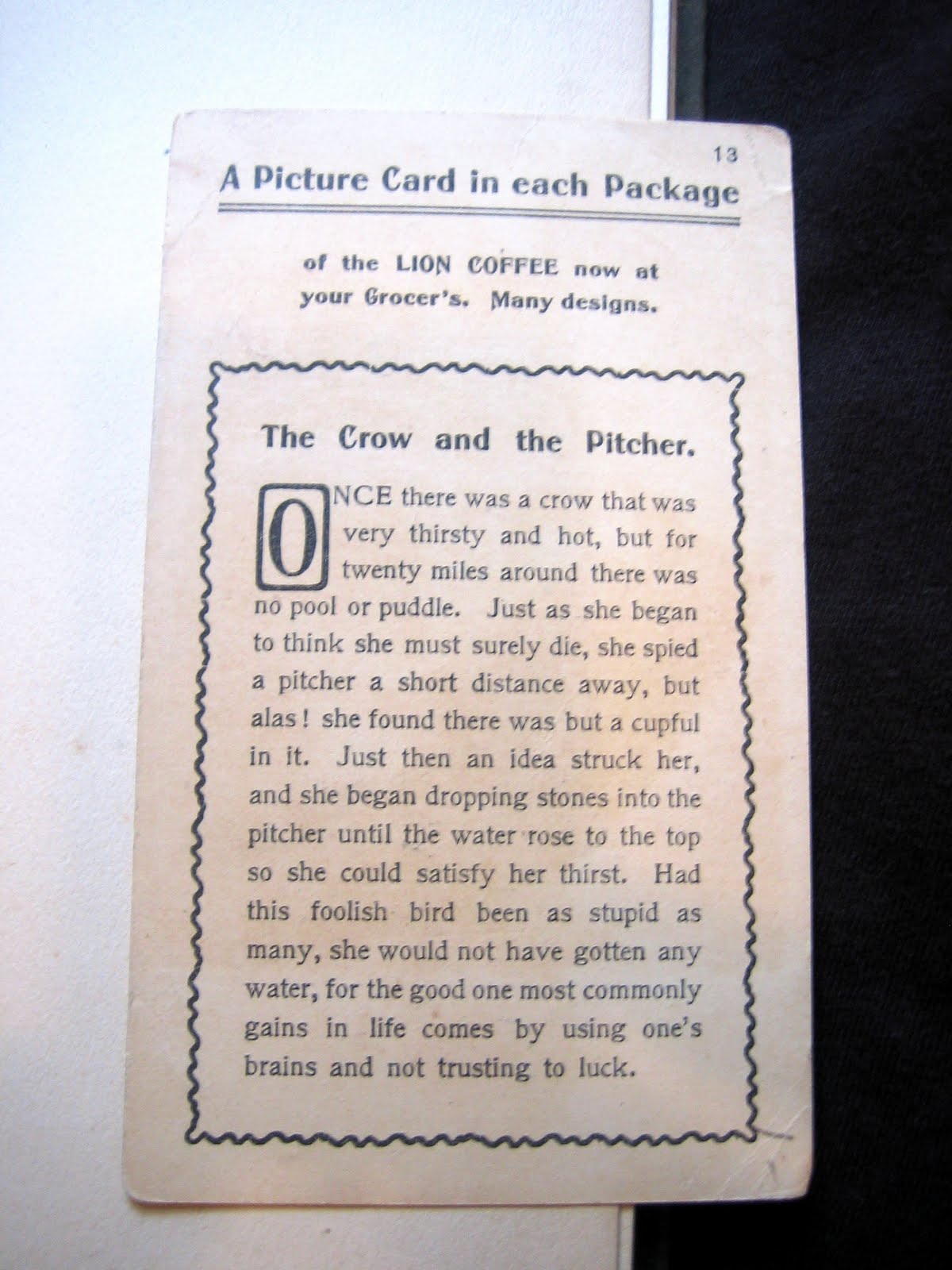
The only evidence of readership in my copy is a piece of ephemera stuck in between the first blank flyleaf and the cover. It’s card #13 of a collectible series of “picture cards” issued by Lion Coffee in the 1960s (manufacturers of products often used such “collect the whole set” ephemera, such as cards, in order to induce people to keep buying their product -- a tactic that McDonald’s Happy Meals and similar products still use). This card features a watercolor on one side and the story of “The Crow and the Pitcher” on the other (the resourceful crow, thirsting for some water, drops stones into the pitcher to raise the water level to the point where she can drink it).


In total, Huffman contributed eight grayscale photographic plates to the new edition (including the frontispiece), each keyed to a specific line or image in one of Clark’s poems. They are almost all wide, sweeping panoramas of the western plains, peppered with the small figures of cattle, men on horseback, and the occasional dog, tree, or similar slight perturbation of the otherwise flat horizon. A few capture action shots of the cowboys in mid-lasso or mid-trot.


Clark’s poems paint concrete pictures of the western landscape and the people and wildlife that populated it in the earliest years of the twentieth century. Though occasionally conventional in its imagery and uninventive in its prosody (heavy doses of the ABABCDCD stanza rhyme scheme), the book strikes a tone that gives one the sense of actually hearing a cowboy speak about what he has seen and experienced on the trail: the language is frequently idiomatic, the references very particular, the spellings often recreate the twang, accent, and peculiar dialect of the Old West.


In many ways, then, Clark’s poems serve as well as any audio recording would in capturing the aural quality of life on the wide and rolling plains of the Dakotas. Having never been out there myself, I don't know how much of this kind of lifestyle and language still survives, but Clark's poems certainly capture a time from the past that may be well on its way to becoming unrecoverable -- if it isn't completely gone already. Combined with Huffman’s early photos of the visual life of the region in the period, the poems of the second edition of Sun and Saddle Leather transport the reader to an entirely different time and place -- which, after all, should be one of the goals of any good book.


Sunday, November 14, 2010

11th-Century Persian Atheism...in Rhymed Quatrains and Goatskin


I’m often surprised and saddened by the depth of ignorance that pervades the public on the subject of atheism or, as it is more accurately known, humanism. In particular, I frequently come up against the common misconception that humanism is a modern construct of western, capitalist culture. This is a patently ridiculous assumption. Indeed, it is clearly and demonstrably wrong: as long as there have been cults of theistic believe there have been schools of atheistic philosophy (even the ancient pantheon of gods was withered by the logic of Lucretius’s De Rerum Natura). Further, one does not need to look only in the west to find a legacy of humanistic thought -- as this week’s book attests.

This week’s book is an exquisitely bound little copy of the Rubáiyát of Omar Khayyám. The poem is given in Edward FitzGerald’s famous translation, first published in March 1859; this copy was published by Thomas B. Mosher (1852-1923) of Portland, Maine in October 1916. This was Mosher’s ninth edition of the Rubáiyát; his preceding editions of the poem appeared in June 1899, September 1899, March 1900, March 1901, October 1902, October 1904, December 1906, and October 1909. This list of dates suggests the popularity of the Rubáiyát with turn-of-the-century New England readers (the periodic gaps between editions are also always telling data points in reconstructing the publication and reception history of a book).

The Rubáiyát is a lyric poem, originally written in Farsi by the great Persian poet, philosopher, and scientist Omar Khayyám (1048-1131; right). In Farsi, the term rubáiyát means “quatrains” and refers to a poem written in four-rhyme, lined stanzas. Most of the 101 stanzas in this poem follow an AABA rhyme scheme, but there are some that adhere to the traditional AAAA scheme. The poem is an elegant meditation upon a number of essential spiritual and theological problems; as the anonymous author of his entry in the Encyclopaedia Britannica notes:

Omar doubts the existence of divine providence and the afterlife, derides religious certainty, and is disturbed by man's frailty and ignorance. Finding no acceptable answers to his perplexities, he chooses to put his faith instead in a joyful appreciation of the fleeting and sensuous beauties of the material world. The idyllic nature of the modest pleasures he celebrates, however, cannot dispel his honest and straightforward brooding over fundamental metaphysical questions.

Khayyám wrote upon this theme of seizing the day in the eleventh century; it had previously been part of ancient Greek and Roman ideologies and it would later be incorporated (often in more extreme forms) in aspects of western humanist philosophies. To Khayyám, the inevitability of death and the lack of any divine oversight or afterlife means that we should live our best and most full lives in the present, and part of that means living responsibly and in tune with those around us and with nature (in Khayyám’s poem, one could argue that the frequent references to the power of wine are actually a metaphor for the intoxicating force of the worldly).


To modern hedonists living in a capitalist consumption-based society, the inevitability of death and the lack of any divine oversight or afterlife means we should do whatever we can or want now, with no regard for others or for nature. I find it fascinating that, though starting from a shared assumption about the nature of our metaphysical universe, the modern and the ancient can diverge so completely. Of course, the religiously dogmatic in either modern America or ancient Persia (or modern Persia, for that matter) would find Khayyám’s philosophies grotesque and even dangerous. I, however, find them moving, compelling, and hopeful.


I also find it amusing that the first English version of this atheistic, poetic critique of religious dogma appeared in 1859: the year in which Charles Darwin published his On the Origin of Species.

Khayyám’s poem was unknown to western readers until its appearance in English in 1859, when Victorian English poet Edward FitzGerald (1809-1893; left) published his rather free and loose translation (contemporary critic Charles Norton described it as “not a translation, but the redelivery of a poetic inspiration”). The publication received little attention until poet Dante Gabriel Rossetti publicly praised it in 1860. Subsequently, its popularity soared. FitzGerald revised his translation and published a second edition in 1868, a third in 1872, and a fourth in 1879. The textual variants between these four editions are substantial, and the study of how and what FitzGerald changed over time has become a subfield of poetry studies in itself. Further complicating the recovery of Khayyám’s original language and ideas, for English readers, are the other translations that followed FitzGerald’s, such as Edward Whinfield’s (1883), Arthur Talbot’s (1908), and, more recently, Richard Brodie’s (2001).

The contents of my copy are as follows: flyleaf, three blanks, half-title with ornaments, full-title with printer’s device and with copyright on verso, table of contents with ornaments, a preface (beginning with an epigram from Thomas Bailey Aldrich) written by scholar and editor Nathan Haskell Dole (1852-1935) originally for Mosher’s 1899 edition (ix-xviii), the poem itself (3-37), Dole’s explanatory notes (41-50), and a glossary of Persian vocabulary and names (53-56). It concludes with two more blanks and the rear flyleaf. The text of the poem also includes periodic commentary footnotes by Dole.

The pages measure 7cm x 13.5cm and are made of a high-quality paper with 3cm horizontal chain-lines and bearing the familiar crowned goat’s head and lettering watermark of the celebrated Dutch firm Van Gelder Zonen (in business from 1784 to 1934; for other uses of Zonen paper, scroll about one-quarter down this page at the website for the International Paper Historians organization). The book was printed in duodecimo format, with no signatures.

The book is in excellent condition, though an early owner did decide to press a three-leaf clover (?) inside the book at the first page of the preface.

As I noted above, the binding is quite beautiful. This past week I attended a fascinating lecture at the Massachusetts Center for Renaissance Studies on the topic of rare and old-book bindings. I learned at that talk that the only commonly-used medium for binding that can be dyed is goat skin, or “morocco”, and therefore, since my book is bound in a red leather, I assume it is morocco. The surface has the usual pebbled texture of morocco bindings. Gilded lettering on the cover identifies the title and translator, and gilding decorates the raised bands on the spine as well. Around the inside edge of the front and back boards there runs a gilded chain-design.

Most fantastic, however, are the pastedowns and end-pages: instead of the usual marbling, these are covered in colorful, cloudy patchwork of pinks, purples, greens, with occasional black lines.

It’s almost like an hallucinated watercolor painting. Interestingly, while the red morocco binding was expertly done, the cutting around the edges of these pages -- both at the front and back of the book -- are rather ragged and uneven. Within the book, between pages 22 and 23, one can see the frayed end of the pink string used to tie the gatherings together in the rebinding.

Interestingly, this kind of rebinding of Mosher titles is not only common, but it has made them highly collectible as well. Mosher was a leading figure in the craft printing movement, and his books were often expertly produced. However, he often issued his books with flimsy covers of Japanese paper -- beautiful and richly colored, but also highly fragile. Over time, these bindings would come apart quite easily. Early owners, therefore, often had Mosher imprints rebound in lavish covers to match the expertly printed text within. Indeed, my copy of the Rubáiyát was originally issued in thin cardboards with a blue paper wrapper (I only know this because book-seller Harry Alter has one listed online and it still has its original binding).

But now it’s time for me to wrap-up this week’s post and, like a good humanist, go take advantage of what may be our last fine-weather day before the depths of the New England autumn finally settle in. Time to seize the day and perhaps follow Khayyám’s advice in stanza 12:

A Book of Verses underneath the Bough,

A Jug of Wine, a Loaf of Bread -- and Thou

Beside me singing in the Wilderness --

Oh, Wilderness were Paradise enow!

Sunday, June 14, 2009

"And now I sit and muse on what may be...": A First Illustrated Edition Longfellow Poem


This time of year sees high school and college graduations all around the country, and it was no different in our neck of the woods. Since so much attention is given to the graduates going through their rite of passage, I decided that with this week’s book I’d turn the attention back to the other players in this annual drama: the parents. The book is, once again, not technically part of my collection, though it does currently reside in Tarquin Tar’s Bookcase.


The book itself is actually a single poem, accompanied by 42 illustrations, and typographically stretched out to fill a whole volume. The poem is The Hanging of the Crane by the American literary icon Henry Wadsworth Longfellow and this was its first appearance in book format, published by the noted Boston firm of James Osgood in 1875 and printed by the Welch, Bigelow & Co. University Press. It had first been published in the March 28, 1874 issue of the New York Ledger, though Longfellow had probably written it for private circulation amongst his acquaintances before that date because it was only through the intervention of his friend Samuel Ward that Robert Bonner, proprietor of the Ledger, bought the manuscript from the poet for the staggering sum of three thousand dollars (nearly $57,000 in modern currency). Today the Osgood edition is not extremely rare, though it is quite collectible; most dealers value it at approximately $40 to $90 (or $200-$400 if signed by the poet). 


The poem appeared in many later editions and anthologies, perhaps the most significant reprinting being the 1907 Houghton Mifflin edition to celebrate the centennial of Longfellow’s birth (Houghton Mifflin was the firm that Osgood’s company eventually became; Osgood itself had previously been the legendary Ticknor and Fields, publishers of nearly every nineteenth century American author of note, including Harriet Beecher Stowe, Ralph Waldo Emerson, Nathaniel Hawthorne, Mark Twain, and Henry David Thoreau). The 1907 edition included illustrations by Florence Swan that were based on the Longfellow’s house on Craigie Street in Cambridge, where Longfellow himself hung his own fireplace crane in 1843.


This copy was rebound after the turn of the century for an early owner, and while some collectors would consider it therefore less valuable I find the binding -- green cloth boards with green leather corners and spine, with gilded edges and elaborate tooling and marbled paper on the inside -- both tasteful and elegant. The rebinding was done by J. W. Meyer & Company, a New York bindery located at 147 West 24th Street in the first decades of the twentieth century and that had gone into business in 1905. Knowing the importance of original bindings, Meyer’s craftsman preserved the original leather exterior of the first binding -- rich green all over with sumptuous illustrations and gilded decoration -- and pasted the cover, spine, and back onto extra leaves at the back of the book. Overall, the book is in excellent condition.


The pages measure 15cm x 21.5cm and, with the exception of the leaves inserted by the second binder (two at the front and five at the back), are of a heavy, almost card-like, stock with brightly gilded edges. Providing a collation of the book is made more complicated than normal for several reasons: it looks as if the sheets were not printed in the customary fashion but were printed with two conjugate leaves (that is, one oblong sheet) impressed at a time and then quired together into two large gatherings; this, however, does not account for the rebinding, which could have resulted in a reconfiguration to the original gatherings (and may explain the apparent loss of a leaf at the start of the book).


Many dealers online describe the book’s construction as octavo, but this seems merely conjectural to me. The pagination of the book reveals that an initial leaf was apparently lost in the rebinding: after the two leaves inserted by the binder, the preliminaries run [iii]-x, with [i-ii] as the missing initial leaf. After the preliminaries there are two unnumbered leaves and then the start of the poem proper, which runs [15]-64. The inserted leaves at the end are also unpaginated. This is the first time I’ve seen a book in which the miniscule Roman numerals used to paginate the preliminaries are continued numerically with the Arabic numerals used to paginate the book’s contents; I don’t know if this was part of this book’s unique design or a regular trait of the printer or publisher’s.


There are no marginalia in the contents of the book, though there is one instance of an owner’s annotation on the recto of the second inserted leaf at the front. A neat italic hand, using dark brown ink, has gifted the book with an amusing little inscription:


November 5th, [19]58

To Finn & Esther and their brood!

A token of thanks for being a real live family for me -- 

An old book for your new home from the boy who wouldn’t stay for dinner, but did stay a month plus.

As Ever

Mike better known as “George”


In addition to the inscription, Mike apparently also removed a previous owner’s bookplate from inside the front cover, where the residue of the label’s glue is still faintly visible.


The book’s preliminaries include a plate showing a dinner party, facing (through an intervening tissue leaf) the title page (with the copyright notice on the verso), followed by four pages of a “List of Illustrations” giving the illustrations’ caption, artist, and page number; after this there is an illustrated half-title followed by the poem itself, divided into its customary 7 sections. All of the engravings were done by the English emigrant poet, political essayist, Chartist, and artist William James Linton and by artist, book designer, and newspaper man A. V. S. Anthony, who also designed the book and supervised its printing. I assume that Anthony was brought into the project by Portsmouth, NH native poet and novelist Thomas Bailey Aldrich, who met Anthony when the two were working at the  New York Illustrated News (Aldrich as editor and Anthony as art manager), though Anthony had a closet relationship with Osgood’s firm in his own right, working as an editor on a youth newspaper the firm published and providing engravings for other books, including John Greenleaf Whittier’s 1870 Ballads of New England. Aldrich is significant because, according to an account given by Aldrich in the preface to the 1907 centennial edition, he was the cause of the poem’s composition:


One morning in the spring of 1874, Mr. Longfellow came to the little home in Pinckney Street [in Boston], where we had set up housekeeping in the light of our honeymoon. As we lingered a moment at the dining-room door, Mr. Longfellow turning to me said, “Ah, Mr. Aldrich, your small, round table will not always be closed. By and by you will find new young faces clustering about it; as years go on, leaf after leaf will be added, until the time comes when the young guests will take fight, one by one, to build nests of their own elsewhere. Gradually the long table will shrink to a circle again, leaving two old people sitting there alone together. This is the story of life, the sweet and pathetic story of the fireside. Make an idyl of it. I give the idea to you.” Several months afterward, I received a note from Mr. Longfellow in which he expressed a desire to use this motif in case I had done no thing in the matter. The theme was one peculiarly adapted to his sympathetic handling, and out of it grew “The Hanging of the Crane”. 


Anthony and Linton’s engravings are based on the work of two artists: painter and book illustrator (often used by Osgood’s firm, including for their 1875 edition of Whittier’s “Mabel Martin”) Mary A. Hallock, whose work supplied 28 of the plates, and the great American landscape painter Thomas Moran, whose work supplied 14. Not surprisingly, nearly all of the landscape and nature illustrations are by Moran; all of the interior and portrait illustrations are by Hallock. Besides that art, the book includes numerous emblematic and ornamental “vignettes” drawn by illustrator (and Civil War veteran, wounded June 14, 1863 during the 133rd Regiment of New York Volunteers attack on Port Hudson, LA) John J. Harley.


The “sweet and pathetic poem of the fireside” (to use the Riverside edition’s description), as suggested by Aldrich’s anecdote, centers around the plight of the empty-nester. It takes as its core motif the old house-warming custom of installing the “crane” (the hinged metal arm that held cooking pots over the fire) into the fireplace; the celebration of the hanging of the crane was symbolic, usually the last preparation before moving in and transforming the house (to use the cliché) into a home. For those of you interested in reading it, the full text is available online.


According to Alma Bount, in her Intensive Studies in American Literature, the structure and evocative mood of the poem is elegantly simple:


Part I is introductory, and represents the poet as remaining after the guests have spoken their good wishes and departed, and as sitting before the fire to dream about the coming life of the family just established. The other six parts contain the six pictures of home life that drift through the mind of the dreamer, and carry the founders of the family in his imagination from youth to old age. The table is represented as the gathering place, partly form the suggestion of Longfellow’s words to Aldrich, and partly because the entire family meets more often at the table than anywhere else. Each picture is preceded by a prelude of six lines. This breaking of the poem by preludes would not be good in a continuous narrative or description, but is an excellent device for keeping separate a series of six pictures scattered over a period of fifty years. (164) 
[The] closing part is remarkable for the way in which it gathers up the earlier parts, and rounds the poem into rhetorical completeness.... The figure in [the final] lines refers to the apparent endlessness of the home the parents have founded, one generation following another in their imagination, through ages to come. (167) The poem as a whole is quiet and meditative -- it is a series of six dream pictures. The poet writes tenderly, as one who has lived through these scenes and loves the memory of them. This poem would earn for Longfellow the title of “Poet of the Home and the Fireside,” if he had no other claim upon it. The poem is true to life, inspires the imagination, and pleases the artistic sense by its beauty of expression. (167-8)