Saturday, November 20, 2010

Cowboy Poetry and Photos from the Last Days of the Wild West


The intersection of the visual arts with poetry has a rich and complicated history. Truly effective poems are (in my view) a form of visual art as much as verbal art: by evoking concrete and moving sensory images, these poems can create just as specific a visual scene as any painting or photograph. Indeed, by appealing to the unique imagination of each reader, in some ways such poems succeed in creating an even more specific visual scene as any form of visual art could do. Nonetheless, it is not uncommon to see artwork juxtaposed with poetry in collections of verse -- the practice has been around since the very first poems were scribbled down on papyrus, parchment, and vellum.


This week’s book is an example of a poetry book that later had photographs added to it in order to “enrich” the contents.


The title is Sun and Saddle Leather, a collection of twenty-two “cowboy poems” by the famed, first poet laureate of early twentieth-century South Dakota, Charles Badger Clark, Jr. (1883-1957). A legendary outdoorsman, traveler, and speaker, Clark’s poems, articles, pamphlets, novels, and stories gained him fame as the “voice” of the last generation of rugged pioneers of “the Old West”. He lived, wrote, and entertained visitors in a cabin that he himself built, with no running water, heating system, or electricity, surrounded only by the woods of Custer State Park in the Black Hills and by his herd of pet deer.


Clark’s book was first printed by Richard Badger’s Gorham Press of Boston (I can find no evidence that the publisher was related to Charles Badger Clark) in 1915. It was widely-read (though only one copy of this first edition is currently on the market) and eventually a copy reached L. A. Huffman (1854-1931) all the way out in Miles City, Montana.


Huffman had already begun to gain fame for his Western photographs: starting as a post photographer for General Miles’s army at Fort Keogh, by 1916 he had taken six thousand pictures of the people, wildlife, and landscape of the lands surrounding Yellowstone, mostly using “crude cameras” (as Ruth Hill, Richard Badger’s editorial assistant put it) of his own making. To supplement his work as a photographer, Huffman operated a small book, photo, and print-selling business out of his studio.


Huffman was ecstatic about Clark’s poetry and contacted the Gorham Press to order two hundred copies for his own retail sale in Miles City. Badger promptly sent them and then invited Huffman to contribute photographs to the forthcoming second edition (of which Huffman would eventually order five hundred copies to sell). My copy is of this second edition, which Badger published in 1917 and which was simultaneously published in Canada by The Copp Clark Company of Toronto (Badger published another edition in 1919 and again in 1922, followed by later editions from Boston’s Chapman & Grims in 1936 and the Westerners Foundation of Stockton, California in 1962). The title page of the second edition includes Badger's device: a classical figure hauling on a printing press beneath a trellis, over a banner with the words "Arti et Veritati".


The second edition is a slender volume, bound in black paper-covered boards, with a title label in red text on the front board and another on the spine. It run to 60 pages, with the illustrative plates inserted unpaginated and not integral to the gatherings in which they appear.


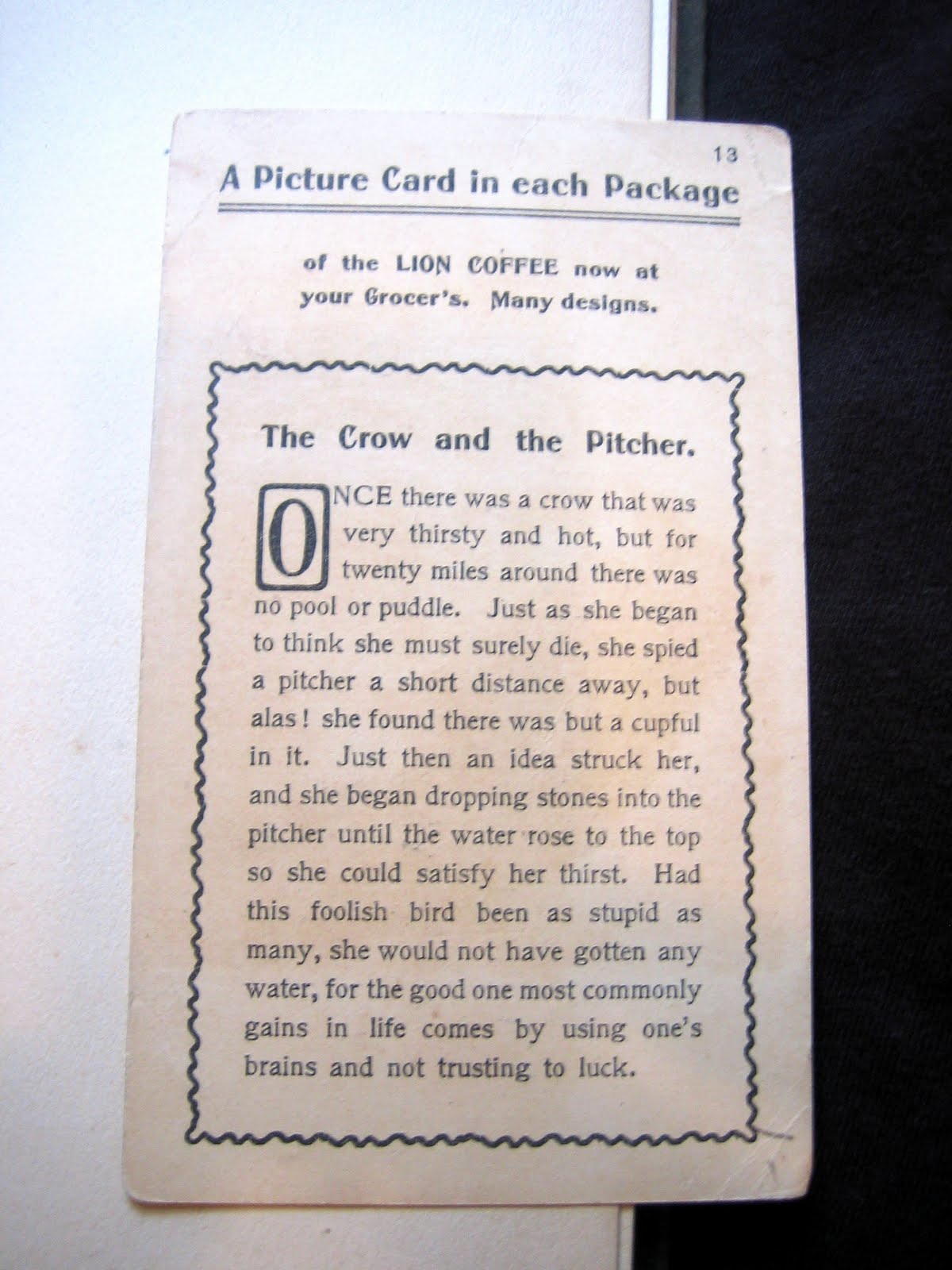
The only evidence of readership in my copy is a piece of ephemera stuck in between the first blank flyleaf and the cover. It’s card #13 of a collectible series of “picture cards” issued by Lion Coffee in the 1960s (manufacturers of products often used such “collect the whole set” ephemera, such as cards, in order to induce people to keep buying their product -- a tactic that McDonald’s Happy Meals and similar products still use). This card features a watercolor on one side and the story of “The Crow and the Pitcher” on the other (the resourceful crow, thirsting for some water, drops stones into the pitcher to raise the water level to the point where she can drink it).



In total, Huffman contributed eight grayscale photographic plates to the new edition (including the frontispiece), each keyed to a specific line or image in one of Clark’s poems. They are almost all wide, sweeping panoramas of the western plains, peppered with the small figures of cattle, men on horseback, and the occasional dog, tree, or similar slight perturbation of the otherwise flat horizon. A few capture action shots of the cowboys in mid-lasso or mid-trot.


Clark’s poems paint concrete pictures of the western landscape and the people and wildlife that populated it in the earliest years of the twentieth century. Though occasionally conventional in its imagery and uninventive in its prosody (heavy doses of the ABABCDCD stanza rhyme scheme), the book strikes a tone that gives one the sense of actually hearing a cowboy speak about what he has seen and experienced on the trail: the language is frequently idiomatic, the references very particular, the spellings often recreate the twang, accent, and peculiar dialect of the Old West.


In many ways, then, Clark’s poems serve as well as any audio recording would in capturing the aural quality of life on the wide and rolling plains of the Dakotas. Having never been out there myself, I don't know how much of this kind of lifestyle and language still survives, but Clark's poems certainly capture a time from the past that may be well on its way to becoming unrecoverable -- if it isn't completely gone already. Combined with Huffman’s early photos of the visual life of the region in the period, the poems of the second edition of Sun and Saddle Leather transport the reader to an entirely different time and place -- which, after all, should be one of the goals of any good book.


Sunday, November 14, 2010

11th-Century Persian Atheism...in Rhymed Quatrains and Goatskin


I’m often surprised and saddened by the depth of ignorance that pervades the public on the subject of atheism or, as it is more accurately known, humanism. In particular, I frequently come up against the common misconception that humanism is a modern construct of western, capitalist culture. This is a patently ridiculous assumption. Indeed, it is clearly and demonstrably wrong: as long as there have been cults of theistic believe there have been schools of atheistic philosophy (even the ancient pantheon of gods was withered by the logic of Lucretius’s De Rerum Natura). Further, one does not need to look only in the west to find a legacy of humanistic thought -- as this week’s book attests.

This week’s book is an exquisitely bound little copy of the Rubáiyát of Omar Khayyám. The poem is given in Edward FitzGerald’s famous translation, first published in March 1859; this copy was published by Thomas B. Mosher (1852-1923) of Portland, Maine in October 1916. This was Mosher’s ninth edition of the Rubáiyát; his preceding editions of the poem appeared in June 1899, September 1899, March 1900, March 1901, October 1902, October 1904, December 1906, and October 1909. This list of dates suggests the popularity of the Rubáiyát with turn-of-the-century New England readers (the periodic gaps between editions are also always telling data points in reconstructing the publication and reception history of a book).

The Rubáiyát is a lyric poem, originally written in Farsi by the great Persian poet, philosopher, and scientist Omar Khayyám (1048-1131; right). In Farsi, the term rubáiyát means “quatrains” and refers to a poem written in four-rhyme, lined stanzas. Most of the 101 stanzas in this poem follow an AABA rhyme scheme, but there are some that adhere to the traditional AAAA scheme. The poem is an elegant meditation upon a number of essential spiritual and theological problems; as the anonymous author of his entry in the Encyclopaedia Britannica notes:

Omar doubts the existence of divine providence and the afterlife, derides religious certainty, and is disturbed by man's frailty and ignorance. Finding no acceptable answers to his perplexities, he chooses to put his faith instead in a joyful appreciation of the fleeting and sensuous beauties of the material world. The idyllic nature of the modest pleasures he celebrates, however, cannot dispel his honest and straightforward brooding over fundamental metaphysical questions.

Khayyám wrote upon this theme of seizing the day in the eleventh century; it had previously been part of ancient Greek and Roman ideologies and it would later be incorporated (often in more extreme forms) in aspects of western humanist philosophies. To Khayyám, the inevitability of death and the lack of any divine oversight or afterlife means that we should live our best and most full lives in the present, and part of that means living responsibly and in tune with those around us and with nature (in Khayyám’s poem, one could argue that the frequent references to the power of wine are actually a metaphor for the intoxicating force of the worldly).


To modern hedonists living in a capitalist consumption-based society, the inevitability of death and the lack of any divine oversight or afterlife means we should do whatever we can or want now, with no regard for others or for nature. I find it fascinating that, though starting from a shared assumption about the nature of our metaphysical universe, the modern and the ancient can diverge so completely. Of course, the religiously dogmatic in either modern America or ancient Persia (or modern Persia, for that matter) would find Khayyám’s philosophies grotesque and even dangerous. I, however, find them moving, compelling, and hopeful.


I also find it amusing that the first English version of this atheistic, poetic critique of religious dogma appeared in 1859: the year in which Charles Darwin published his On the Origin of Species.

Khayyám’s poem was unknown to western readers until its appearance in English in 1859, when Victorian English poet Edward FitzGerald (1809-1893; left) published his rather free and loose translation (contemporary critic Charles Norton described it as “not a translation, but the redelivery of a poetic inspiration”). The publication received little attention until poet Dante Gabriel Rossetti publicly praised it in 1860. Subsequently, its popularity soared. FitzGerald revised his translation and published a second edition in 1868, a third in 1872, and a fourth in 1879. The textual variants between these four editions are substantial, and the study of how and what FitzGerald changed over time has become a subfield of poetry studies in itself. Further complicating the recovery of Khayyám’s original language and ideas, for English readers, are the other translations that followed FitzGerald’s, such as Edward Whinfield’s (1883), Arthur Talbot’s (1908), and, more recently, Richard Brodie’s (2001).

The contents of my copy are as follows: flyleaf, three blanks, half-title with ornaments, full-title with printer’s device and with copyright on verso, table of contents with ornaments, a preface (beginning with an epigram from Thomas Bailey Aldrich) written by scholar and editor Nathan Haskell Dole (1852-1935) originally for Mosher’s 1899 edition (ix-xviii), the poem itself (3-37), Dole’s explanatory notes (41-50), and a glossary of Persian vocabulary and names (53-56). It concludes with two more blanks and the rear flyleaf. The text of the poem also includes periodic commentary footnotes by Dole.

The pages measure 7cm x 13.5cm and are made of a high-quality paper with 3cm horizontal chain-lines and bearing the familiar crowned goat’s head and lettering watermark of the celebrated Dutch firm Van Gelder Zonen (in business from 1784 to 1934; for other uses of Zonen paper, scroll about one-quarter down this page at the website for the International Paper Historians organization). The book was printed in duodecimo format, with no signatures.

The book is in excellent condition, though an early owner did decide to press a three-leaf clover (?) inside the book at the first page of the preface.

As I noted above, the binding is quite beautiful. This past week I attended a fascinating lecture at the Massachusetts Center for Renaissance Studies on the topic of rare and old-book bindings. I learned at that talk that the only commonly-used medium for binding that can be dyed is goat skin, or “morocco”, and therefore, since my book is bound in a red leather, I assume it is morocco. The surface has the usual pebbled texture of morocco bindings. Gilded lettering on the cover identifies the title and translator, and gilding decorates the raised bands on the spine as well. Around the inside edge of the front and back boards there runs a gilded chain-design.

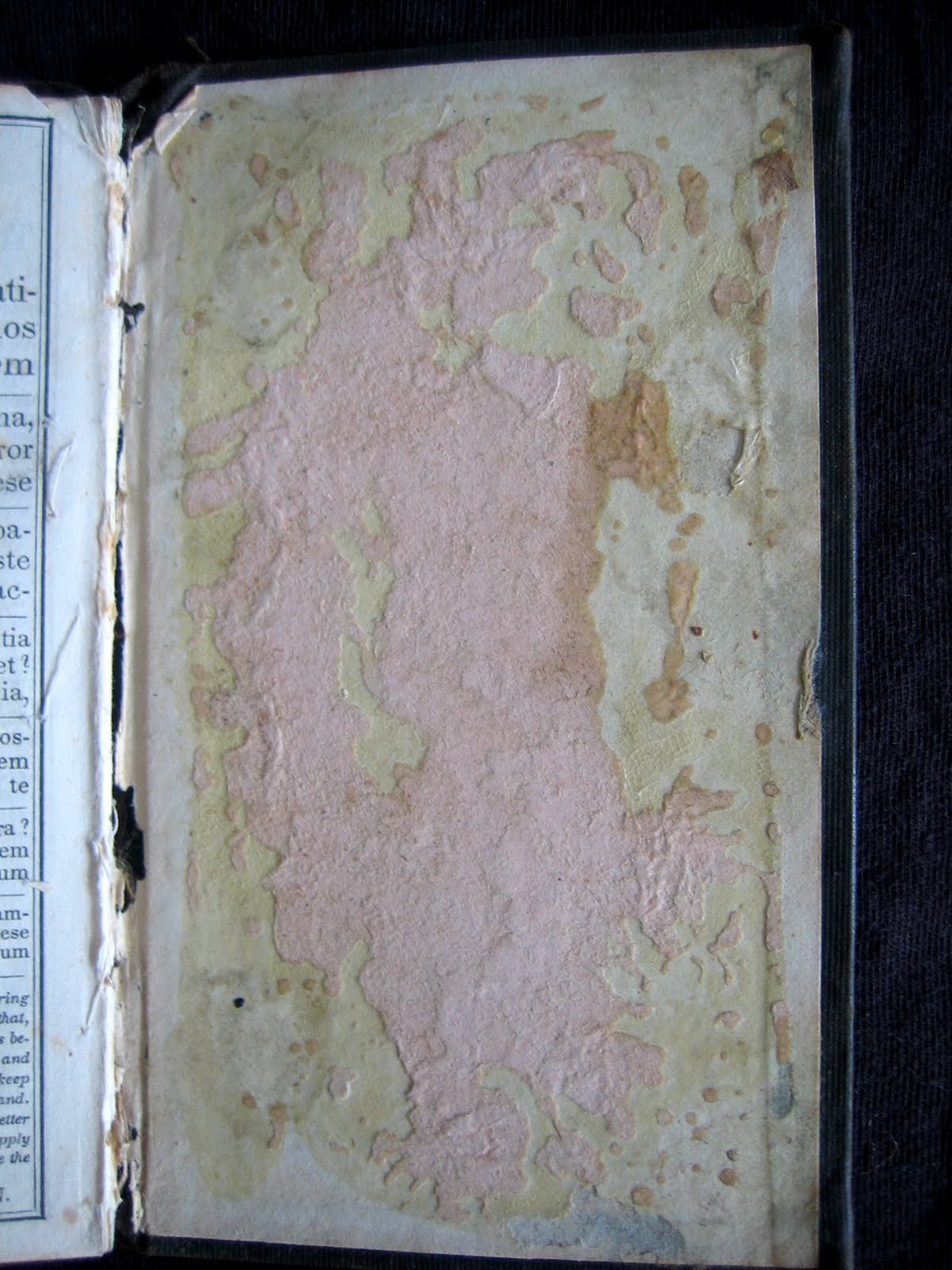
Most fantastic, however, are the pastedowns and end-pages: instead of the usual marbling, these are covered in colorful, cloudy patchwork of pinks, purples, greens, with occasional black lines.

It’s almost like an hallucinated watercolor painting. Interestingly, while the red morocco binding was expertly done, the cutting around the edges of these pages -- both at the front and back of the book -- are rather ragged and uneven. Within the book, between pages 22 and 23, one can see the frayed end of the pink string used to tie the gatherings together in the rebinding.

Interestingly, this kind of rebinding of Mosher titles is not only common, but it has made them highly collectible as well. Mosher was a leading figure in the craft printing movement, and his books were often expertly produced. However, he often issued his books with flimsy covers of Japanese paper -- beautiful and richly colored, but also highly fragile. Over time, these bindings would come apart quite easily. Early owners, therefore, often had Mosher imprints rebound in lavish covers to match the expertly printed text within. Indeed, my copy of the Rubáiyát was originally issued in thin cardboards with a blue paper wrapper (I only know this because book-seller Harry Alter has one listed online and it still has its original binding).

But now it’s time for me to wrap-up this week’s post and, like a good humanist, go take advantage of what may be our last fine-weather day before the depths of the New England autumn finally settle in. Time to seize the day and perhaps follow Khayyám’s advice in stanza 12:

A Book of Verses underneath the Bough,

A Jug of Wine, a Loaf of Bread -- and Thou

Beside me singing in the Wilderness --

Oh, Wilderness were Paradise enow!

Saturday, November 6, 2010

An 1843 Almanac...Almost


This week’s book is, in fact, only part of a book.


The fashion for almanacs can be traced back to Renaissance England, but the peculiar genre gained broad popularity in eighteenth and nineteenth century America. In addition to providing handy guides for daily living (weather and harvest information, news digests, commonly used conversions and calculations, aphorisms and advice, etc.), many almanacs left space for owners to record their own journal-style entries into the calendar pages of the book. For many early Americans, then, the almanac became an essential part of daily life -- a diary, a guidebook, a reference tool, and a icon of personal identity. This also meant, of course, that they were "used up" much more fully and more rapidly than most other books.


This book is part of the legendary printer and up-state New York native Samuel Nelson Dickinson’s 1849 Boston Almanac, which was Number 8 in his annual almanac series; each issue was printed in runs of approximately 100,000 copies. Because almanacs were such small, yet heavily-used books, very few survive to the present (and very few of these are in good or clean condition). It's bound in brown cloth with a gilded decoration on the front cover (the hourglass and scythe that were typical symbols found in most almanacs).


Based at 52 Washington Street in Boston, Dickinson was famed as “one of the first successful job printers in Boston until his premature death in 1848” (Richard Wolfe, Marbled Paper: Its History, Techniques, and Patterns. UPenn Press, 1990. 217.). He supplemented his own printing by patenting and selling devices of his own design, including Dickinson’s Improved Rotary Card Press. He also gained famed and long-lasting reputation for writing the influential A Help to Printers and Publishers and a “specimen book” of typefaces in 1842. Rollo Silver, the only scholar to write a biography of the man (“Flash of a Comet: The Typographical Career of Samuel N. Dickinson”. Studies in Bibliography 31 [1978], 68-89), described him thus:


[H]ere was a man regarded by his contemporaries as one of the best printers in the United States. In addition to his type-foundry, he owned one of the largest printing offices in the country, issued one of the first American technological journals, produced the first American periodical devoted to printing, compiled and printed a well-known series of almanacs, and was astute enough to discover and employ such men as Henry O. Houghton and the two John Wilsons. Unfortunately Dickinson’s career ended in less than twenty years, Perhaps if he had lived long enough to have become venerable, he would have received greater attention from historians of printing. [68]


While his shop, which he first opened in 1829, thrived, Dickinson’s personal life was marred by a succession of tragedies, deaths, and his own terribly poor health. In 1847, unable to keep at work due to his illness, his business of was bought up by Congressman William Damrell, in partnership with Francis Moore of Somerville. The next winter, in December 1848, shortly after setting up the copy for his 1849 Boston Almanac, Dickinson succumbed to “consumption” (tuberculosis) and died. “Constant pursuit of excellence,” summarizes Silver from numerous newspaper accounts of Dickinson’s death, “drained him physically and financially” (89). The Boston Almanac continued to be published each year up until 1894; after that point, it changed names several times, but still remained in print until 1926.

As noted, this specimen is only a fragment of its former self. Gatherings 8 through 11 survive; because it was printed in octavo, this means my copy preserves only pages 89 through 136. It was sold for Dickinson by Thomas Groom & Company on State Street and, in its complete state, would run to 142 pages, including numerous advertisements, illustrations in the calendar section, and a frontispiece engraving of a map of Boston. Online dealer Brian DiMambro currently has a complete copy, in very good condition, up for sale, and the website includes some photos of those pages missing from my copy (including the map of Boston).


My copy, while incomplete, provides a good example of the kind of makeshift binding job printers often resorted to in order to keep up with their high rate of production in the early years of machine printing. Not only are scraps of binding paper evident in the spine, but numerous threads and some bulky string are hanging loose as well. A later owner has evidently attempted to repair the binding by sewing through the cloth spine itself, but this also has come woefully loose. The sewing job is rather haphazard -- as evidenced by the stitches that enter the spine at various angles. Opening up any of the gatherings in the book reveals a tangled mess of the original strings knotted and twisted together with the stab-stitching added by the owner. Whether the extra stitches were added before or after the pages were removed from the book must remain a mystery.


The pages that survive in my copy provide the following contents: 89-126, each page presents an engraved image of a church of Boston along with accompanying history, description, and personnel for the house of worship; 127-133, “General Events”, providing brief descriptions of events in the Boston area (roughly one per week) over the course of the year (most of these focus upon the truly grotesque and horrible: exploding stoves, people getting hit by trains, young boys having their eyes pulled out by leopards at the zoo, hunting accidents, etc. -- since these pages are so few and yet so chock full of oddities, I've included them all in the photographs here); 134, an account of all of the fires that happened in the Boston area in 1842; 135, an advertisement to “literary people, publishers, and booksellers” on behalf of the printer, followed by (on 136) “specimen[s] of book type, from pica to nonpareil” that the printer can provide. There is no marginalia, though it looks like a large sticker of some kind was once attached to the pastedown inside the back cover.


Whoever has dissected this book has done what most people who used to cut up almanacs did: extracted the dated portion for a personal record. Fortunately, they have left my copy with Dickinson’s proud advertisement about his innovative typefaces (a tiny sample from his specimen book of the previous year). As an example of the work of one of nineteenth-century America’s most important printers, this is, in my view, far more important to preserve than the calendar pages of the almanac (which would have been, of course, left largely blank -- without type so the user could write in them as he or she needed). Dickinson's pride at the quality of his craftsmanship, the range of different fonts he has available, and his ability to satisfy the needs of "literary people" are hallmarks of his professionalism as a printer. And while the tattered remnants of this almanac may not, on the surface, suggest as much, the clearly heavy use his books got also stands as a testament to his skills as a seller of books of use to those "literary people".


Sunday, October 31, 2010

Happy Halloween!

No post this week as Tarquin Tar negotiates the irritatingly frustrating world of buying a car. Unlike vintage books, alas, it appears that my old Volvo station wagon does not gain value with age.

Have a fun, safe, and happy Halloween!

Sunday, October 24, 2010

Samuel Hall: Printer-Patriot [part 2]


Since I was back in Salem for the weekend, I thought it would be appropriate to feature another one of my Samuel Hall imprints this week. As I’ve mentioned previously, Hall was the first printer in my hometown of Salem and part of my goal as a collector is to add as many of his Salem publications (particularly from his 1768-1775 tenure in the town) to my bookcase. This was one of his pamphlets from the last few years of his first, pre-war time in Salem. It's sobering to think that all of the equipment on which this imprint was printed -- the presses, the tools, the type -- as well as any unsold copies of it still in the shop were all lost to the fire that destroyed Hall's building in 1774.


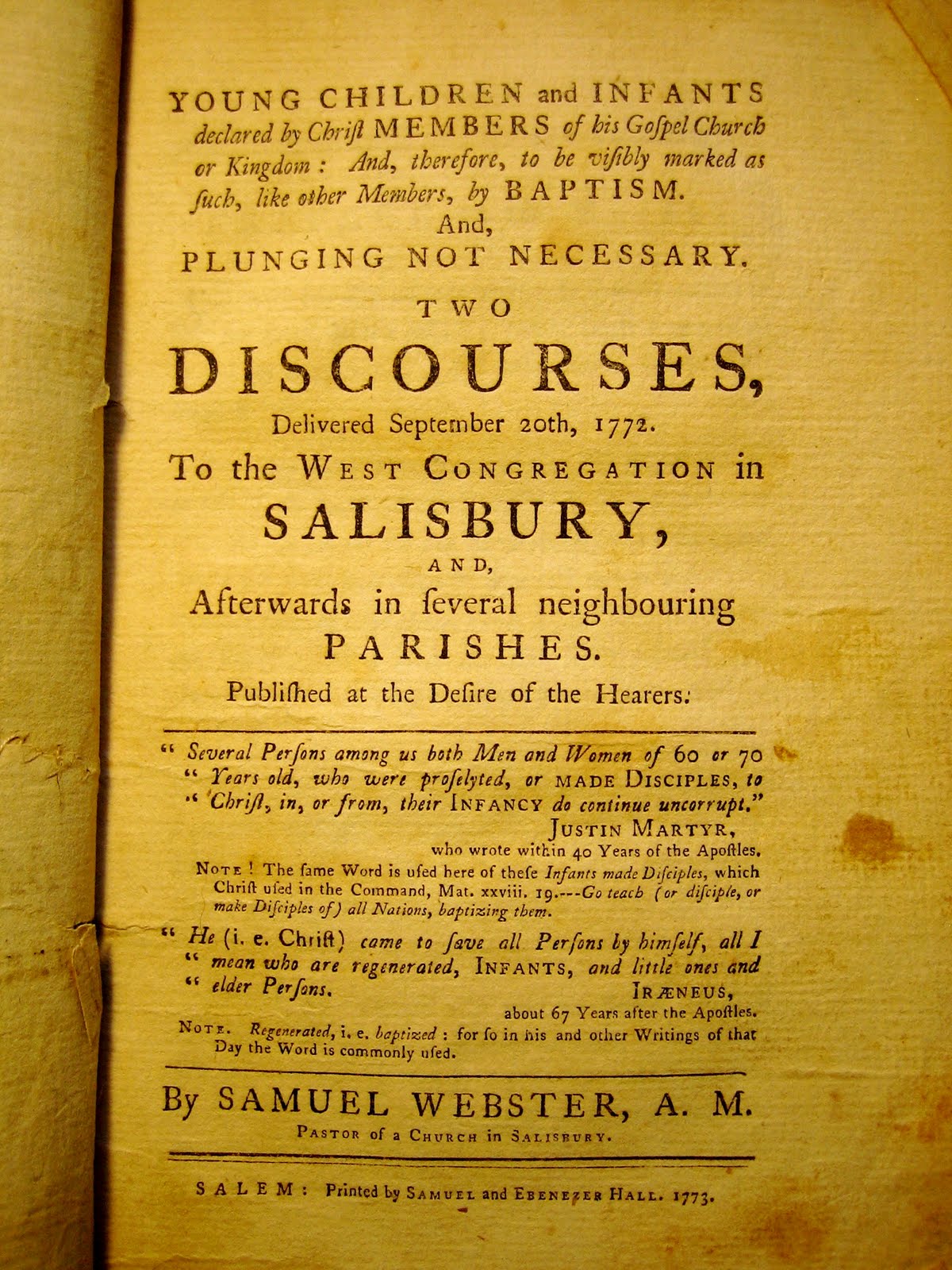
The half-title of this pamphlet reads:


Mr. Webster’s / Two / Discourses, / Upon / Infant-Baptism, / and the / Manner of Baptizing.


The text on the half-title is surrounded above and below by floral line device, not unlike that seen on Hall’s later imprints as well (though a bit more simple in design). There is an elegant brown pen inscription in the upper outside corner: S. Livermore (not a terribly common name in the period; this possibly may have been the famed legal writer and politician Samuel Livermore of New Hampshire). The only other evidence of readership (aside from smudges and wear) is a worn piece of an old newspaper used to mark a place between pages 18 and 19; I cannot, from the text, determine what paper the piece is from, or the date, but a reference to “American vessels” indicates that it was probably post-1776.


A Frankenstein-like stitching repair runs across the mid-page of the half-title. A similar repair using the same kind of white thread was done on pg. 31/2 down the entire length of the leaf. The only other major damage that affects the text is on the final leaf, which has become quite torn and folded from its exposure.


The full title of the pamphlet reads:


Young Children and Infants declared by Christ Members of his Gospel Church or Kingdom: And, therefore, to be visibly marked as such, like other Members, by Baptism. And, Plunging Not Necessary. Two Discourses, Delivered September 20th, 1772. To the West Congregation in Salisbury, and, Afterwards in several neighbouring Parishes. Published at the Desire of the Hearers.


By Samuel Webster, A. M. Pastor of a Church in Salisbury

Salem: Printed by Samuel and Ebenezer Hall. 1773.


In addition, the title-page includes two quotes from patristic commentators (Justin Martyr and Iraeneus) along with glossarial notes on their technical terms. The pamphlet was subsequently reprinted, with no alteration to the contents, by T. and J. Fleet of Boston in 1780.


As with nearly all pamphlets, it was never bound; instead it was stab-stitched through the face of the pages (binding involves sewing outward through the spine fold -- a fine, but important, distinction). Interestingly, the stab-stitching was added after the gatherings had been sewn through the face of the pages with a criss-cross pattern; after this was done, a brown piece of heavy paper was folded over the spine to protect it and then the stab-stitching was done through this piece of paper to hold it all together. I’ve never seen something like this before and I wonder if it was done by Hall or a later seller or owner.


The paper is a soft linen stock typical of the period, but quite foreign to the modern touch; it feels much more like cloth than paper. 3cm vertical chain lines run down the pages; there are no watermarks. The pages measure 14cm x 23cm; I say “approximately” because a good deal of bumping and chipping to the edges of the paper makes it difficult to say for certain. The contents are: [i], half-title and blank verso; [iii], full-title and blank verso; v-vi, Preface to the Reader; 7-54, the contents of the “Two Discourses” (not divided, but run together as one long essay).


As was typical with Hall’s imprints at this time, there are no running-titles; the header only provides the page number, centered and surrounded by parentheses (there are no errors in pagination). Its collation may be described as 4o: [A4]-G3: $1. The missing leaf of the final gathering is not odd and may have once been present as a blank for protecting the exposed text on the verso of G3. The catchwords across the sheets are: often | an | could | runs; | And | Con- [Consider]. With the exception of the final error, there are no errors in either these catchwords or those internal to the gatherings. The type is very clean and simple, showing no substantial damage or ostentatiousness; even the footnotes are all marked with a simple asterisk (a change from his later publications, in which he used a wide variety of symbols). There were no problems with distribution or alignment and only the occasional, very minor inking problems (such as the occasional double-register around page numbers).


The pamphlet’s subject was the contentious question of whether or not children and newborns should be baptized (as most Protestant faiths believed) or whether baptism could only be undertaken by an adult who was fully aware and able to make the choice to be baptized (the position of the Baptists). The schism was a pronounced one and a flood of literature on the subject swamps the shelves of theology libraries; it came to prominence as a problem for debate in the early years of the Reformation in Europe and spread rapidly as a core religious problem. Though there was actually a brief lull in the scope of the debate in the mid to late eighteenth century -- when Webster wrote and delivered his sermon -- it came back in force in the nineteenth century, particularly in the so-called Second Great Awakening in America.


Samuel Webster (1718-1796) was one of ten children of Samuel Webster Senior and Mary Kimball. He rose to prominence in the community of Salisbury and on December 24, 1766 he married Susanna Juell (Jewell) from the neighboring town of Amesbury. He held a masters degree by 1772 and a doctorate by 1792. Webster served as the pastor of the West Church of Salisbury for 55 years at the time of his death. The West Church (better known as the West Parish) had formed in 1716 when residents of the Rocky Hill area voted to split from the town’s only church and form their own (a move undertaken for political and tax-paying purposes as much as convenience or theology).


Webster was a highly prolific writer and published a number of his sermons through Samuel and Ebenezer Hall, including a sermon on “Ministers labourers” given at the First Congregational Church of Temple, New Hampshire on October 2, 1771. He also published sermons on a range of theological, social, and even military topics through Edes & Gill of Queen Street in Boston. Some of his more well-known publications in the period include An Evening’s Conversation Upon the Doctrine of Original Sin, Between a Minister and Three of His Neighbors Accidentally Met Together (Boston: Green & Russell, 1757) a critical retort to Danver pastor Peter Clark’s earlier scriptural exegesis in A Summer Morning’s Conversation (Boston: Edes & Gill, 1759). He also dabbled in natural history and early science -- especially geology -- publishing an article on an “oil-stone found at Salisbury” in the Memoirs of the American Academy of Arts and Sciences in 1783.


In his time, however, Webster was perhaps best known for his work and writing as both a supporter of the break from England and an early abolitionist. On July 14, 1774, on a day “set apart for fasting and prayer, on account of approaching public calamities”, he delivered to his congregation a pro-revolution sermon on “the misery and duty of an oppres’d and enslav’d people”, the print version of which became (after An Evening’s Conversation) his most frequently re-published text (Boston: Edes and Gill, 1774). In his widely-read Earnest Address to My Country on Slavery (1796), Webster republished a sermon he delivered to the Massachusetts legislature on May 28, 1777 (in the midst of the War; this was not the only time Webster was called upon to deliver a sermon to the Great and General Court). In his text, he urged that his fellow Americans, “for God’s sake, break every yoke and let these oppressed ones go free without delay -- let them taste the sweets of that liberty which we so highly prize and are so earnestly supplicating God and man to grant us: nay, which we claim as the natural right of every man” (37-8). It is little surprise that such a politically passionate, pro-revolution man of the cloth should chose to publish with Hall, who was a likewise politically passionate, pro-revolution man of the press.


In 1776, only a few short years after delivering his sermon on child baptism, Reverend Samuel had the chance to put his theories into practice. Twice. On August 19 of that year he performed the double-baptism for his newborn twin children: Betty and John.