Showing posts with label Boston. Show all posts

Sunday, January 30, 2011

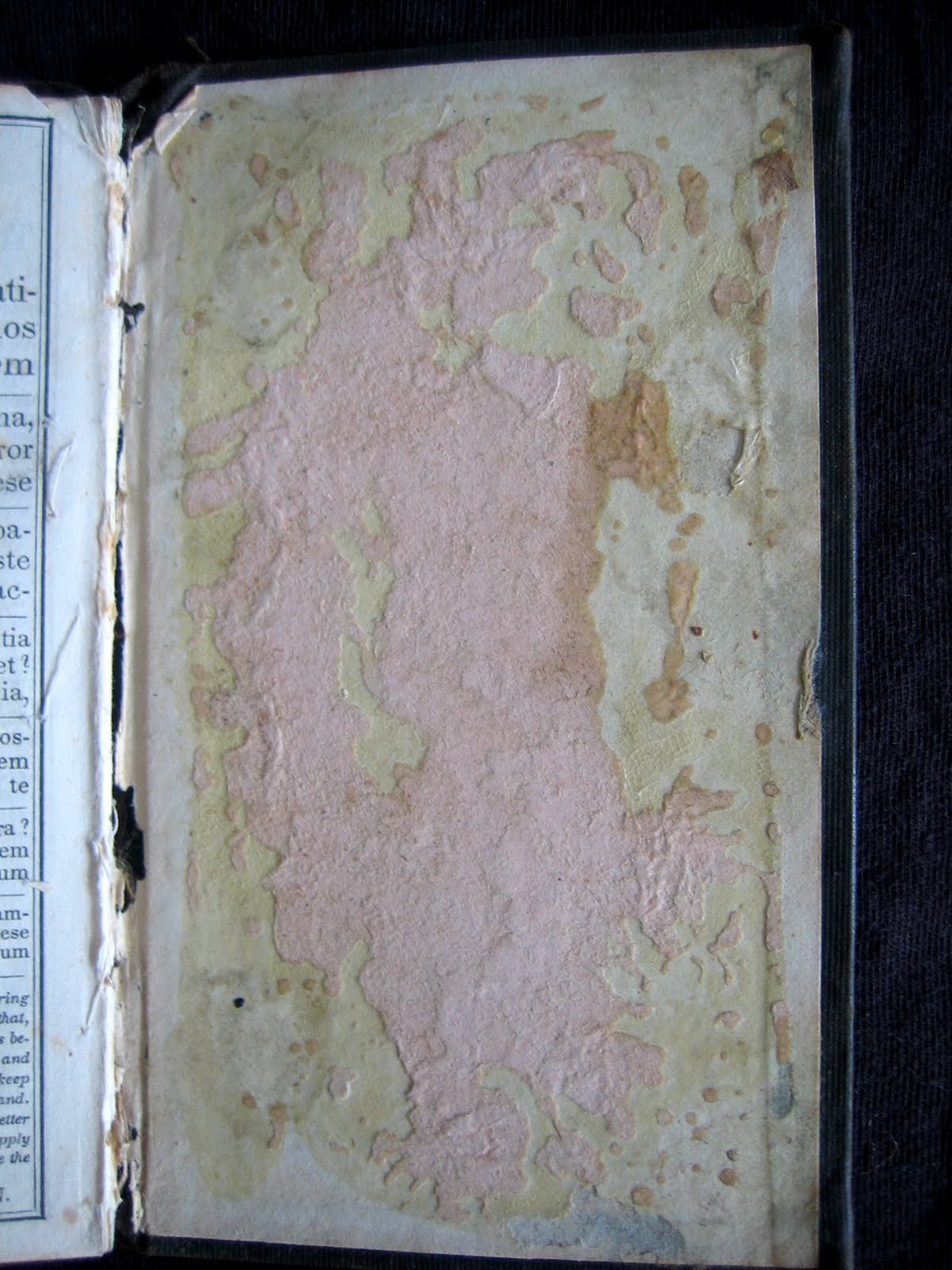
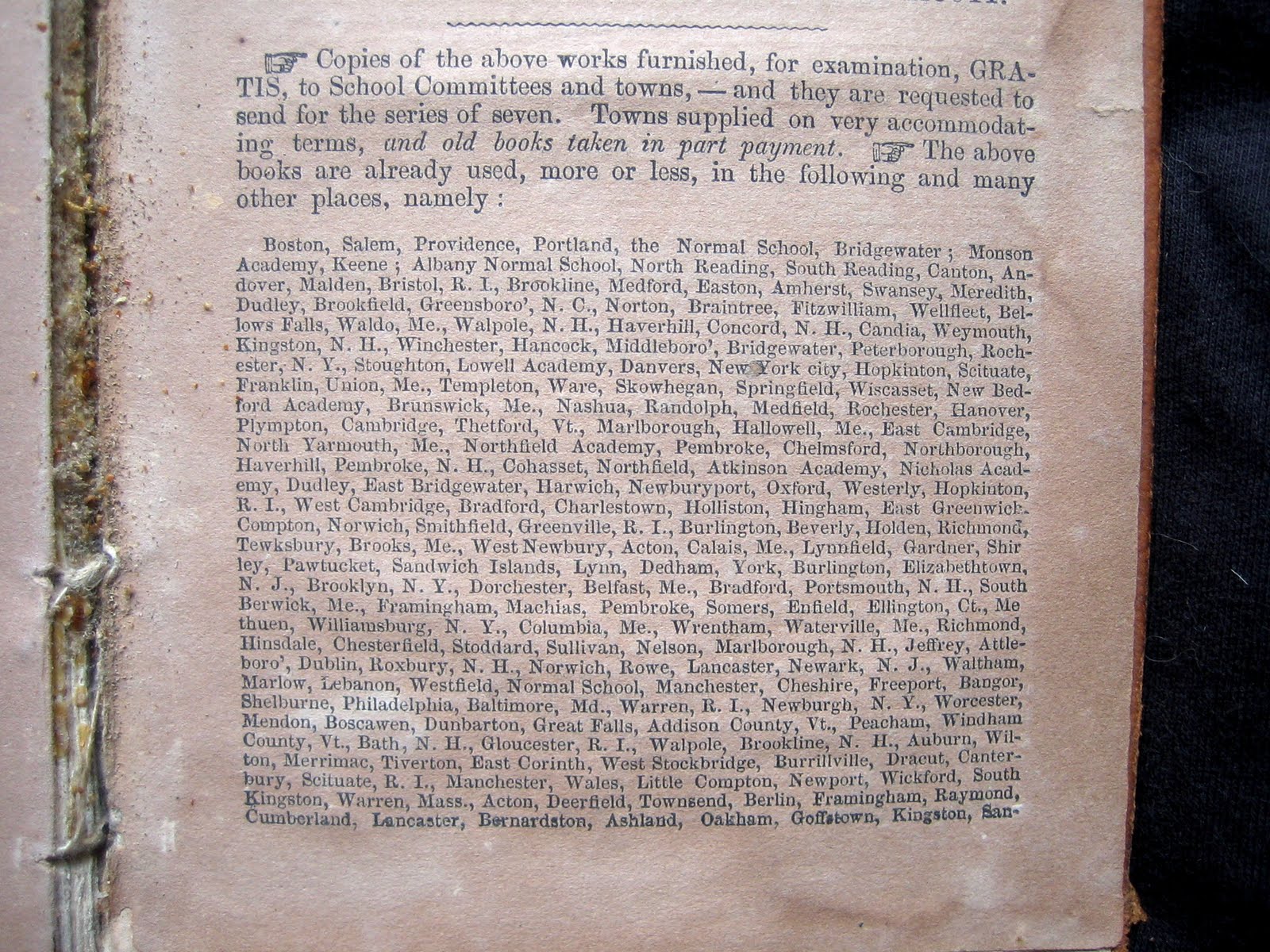
"Please preserve this -- and show it to Teachers."


I have, in a couple of past posts, written about books related to the art of elocution and the complicated practice of capturing in the fixity of print the ephemeral sound of the spoken voice. The skill of public oratory was once a large part of the educational program in America’s public schools. There are still some schools that offer it (or something comparable, like debate) as an elective, and in some colleges the subject is taught (though at least one, I’ve recently learned, is teaching public speaking as an online course...the utility of which I’m afraid I don’t fully grasp).


This week’s book is a mid-nineteenth century textbook designed for use in a “common school” -- the predecessor to the modern public school, attended by students of ages six to fourteen. Though the title-page of mine is missing (more on this below), it is The American Common-School Reader and Speaker: Being a Selection of Pieces in Prose and Verse, with Rules for Reading and Speaking, written by John Goldsbury (author of The Common-School Grammar and teacher at Cambridgeport, MA’s high school) and William Russell (author of numerous elocution textbooks and teacher of elocution at various theological seminaries and schools in Massachusetts and Connecticut).


It was published in massive print-runs (of which this particular copy was around number 66,000) by Tappan, Whittemore, and Mason of 114 Washington Street in Boston. The first edition was published in 1844; subsequent editions (in which mostly the introduction only was revised -- little else was changed) followed from Tappan in 1845 and 1846. For reasons explained below, I think the firm continued reissuing the book -- including back-copies of the first edition -- for at least another decade after its publication. I believe my copy belongs to this category: it seems to be a first edition, but sold by the publisher eleven years after the first edition was actually printed.


Dr. John Goldsbury taught in various schools in Massachusetts (particularly in the Boston and Cambridge area) and New Hampshire (particularly Cheshire County) and was dedicated to advancing new theories of education, particularly in the teaching of grammar and speech. He became most famous for his Exercises and Illustrations on the Black-Board (Keene, NH: George Tilden, 1847), known simply as The Black-Board. In this treatise he expounded upon the usefulness of the blackboard as a teaching tool for disciplines besides mathematics and he called for its inclusion in every public school classroom.


William Russell (1798-1873) was a native of Glasgow, Scotland who came to the United States in 1819 to serve as the head of Chatham Academy in Savannah, Georgia. Several years later he moved to New Haven, Connecticut to teach speech and elocution in some area schools; over the ensuing years he taught in various schools in Massachusetts, Pennsylvania, and New York. He also gave public lectures and instructed preachers at various seminaries, and, from 1826-1829, served as editor for The American Journal of Education. In 1849 he founded a teachers’ institute in New Hampshire and which he moved to Lancaster, Massachusetts in 1853. In his later life, the Massachusetts Board of Education commissioned him as a floating lecturer at the teachers’ institutes around the Commonwealth. His publications were numerous and speak to his field of interest: Grammar of Composition (1823), Lessons in Enunciation (1830), Rudiments of Gesture (1838), The American Elocutionist (1844), Orthophony, or Cultivation of the Voice (1845), Elements of Musical Articulation (1845), Pulpit Elocution (1853), and Exercises in Words (1856). His son, Reverend Francis Thayer Russell (1828-1889) was a childhood friend of Louisa May Alcott, and he continued his father’s passion for education and elocution instruction.


Russell had apparently begun laying the groundwork for the Reader and Speaker several years earlier: in Reverend Ebenezer Porter’s Analysis of the Principles of Rhetorical Delivery, Porter called for the creation of “a schoolbook, containing proper lessons for the management of the voice”, to which -- in the no longer extant second edition (published sometime between 1827 and 1830) he appended the following note:


Since this remark was made in my pamphlet on Inflections, several small works, well adapted to the purpose above mentioned, have been published; and one is now in press, entitled, Lessons in Declamation, by Mr. Russell, of Boston, concerning the utility of which, high expectations are justified by the skill of the author, as a teacher of elocution.

The preface to the Reader and Speaker notes this mention and adds the following explanation for why Russell’s book was never published:


The publication of the book mentioned above, of which the late Dr. Porter had seen the proofs of the first half of the volume, was unavoidably suspended, in consequence of a change of business, on the part of the publishers who had undertaken it. But the substance of that work is embodied in Part I. of this Reader.

The other publisher’s loss was Tappan et al’s gain. Printing textbooks, such as the Reader and Speaker, was (still is) like printing cash -- and Tappan specialized in the genre. At the end of the Reader and Speaker there is an advertising supplement (separately paginated) providing numerous “recommendations” for Russell and Goldsbury’s series of textbooks, written by educators, elected officials, and reverends from around New England. After the recommendations there’s a long list of all the public school systems using the books, a note indicating that free copies can be supplied to school committees, and that other “books for Schools and Academies” can be supplied “at very low prices”. After this there is an ad for “Dunton’s Writing Books” and the note “Please preserve this -- and show it to Teachers.” The ad for Dunton is dated “Boston, 1855”, which is why I believe that my copy of Reader and Speaker was a late issue by the publisher -- though, because the preface is clearly that of a first edition, I think it was a late issue of the first edition of 1844.


An examination of the table of contents gives a good indication of what the book includes: part one (pp. 13-73; evidently mostly by Russell) lays out basic rules of elocution, including pronunciation, emphasis, volume, tone, stress, and so forth (and ending with a plug for Russell’s other textbooks on the subject); part two (pp. 75-428) provides 233 extracts from other writers -- prose, poetry, political speeches, plays, and so forth -- designed as individual lessons on specific qualities of speech. At the end of the book (and not noted in the table of contents) there is an additional section on “Expressive Tones Exemplified in Music”, edited by Lowell Mason (pp. 429-432); because this was apparently a late addition to the book -- several dealers online are apparently lacking it in their copies -- I suspect that my copy was a second printing of the first edition (issued, as noted above, quite a long time after publication). Besides these contents, my copy includes a dedicatory page (“To John Quincy Adams, This Work is, with his permission, Respectfully Dedicated”), the table of contents, and the preface (all this is paginated [iii]-x). Several pages have been removed and are missing; most notably, the title-page, with its advertisement for other books and the copyright notice on the verso, is gone (pp. i-ii) and, as a comparison to the copy on GoogleBooks reveals, the final leaf (pp. xi-xii) of the preface, which would have been conjugate with the title-page. A brief review of the book was written by Samuel Gordon Paley for RhetBlog back in 2006, also giving a quick overview of the book’s contents. Paley’s interest is in the book’s usefulness as a teaching tool for elocution and speech.


I find another value in these old speech-instruction books: they record an (idealized) aural snapshot of a moment in time -- from the kinds of texts used for examples (often patriotic and bombastic, but also touching upon some of the prevalent writers, past and present, familiar to mid-nineteenth century America, from Marlowe and Shakespeare to Clay and Calhoun) to the instructions for how to pronounce individual words or orchestrate a speech. Lacking an audio recording of, for example, a speech by James Polk or Henry Clay in their 1844 contest for President, we can nonetheless get some sense of the acoustic pitch and roll of public oratory from the period by looking at the details of the 1844 Reader and Speaker.


The book is bound in full calf, now soft with age; there’s considerable damage to the spine (top and bottom are gone and the gilt bands are faded almost compeltely) and some chipping and scarring on the boards as well. The pages are 11cm x 18cm and are of a fairly cheap, soft stock; foxing and folding is prevalent throughout. It may be described collationally as 12o: [14] 26-366[: $1 & 2] [π10+1]. The initial gathering is missing its outer leafs (see above); the final, unsigned gathering is the advertising supplement, printed on a brown stock and clearly inserted later, when the book was bound; the final leaf of the supplement is tipped in onto the rear flyleaf. The printing of the book was hastily done: inking in places is uneven (particularly in the running-titles), occasionally an erroneous setting occurs (often there are missing or extra characters; for example, in the title for the final section of the book: Expressive Tones” Exemplified in Music.), and at times the “furniture” (metal blocks of various sizes used to hold and space out the pieces of type when put into the press) were accidentally inked and show in the printing. In terms of its use as a textbook, the publisher has rather confusingly chosen, in the individual lesson extracts, to provide line numbers that re-start, not only with every extract, but even within extracts whenever an extract goes over to another page. Very irritating to try to cite this kind of lineation.


Within the book itself the only marginalia appears on p. 96. This is Lesson XV: “Impressions from History” by Shakespeare editor, professor, and Congressman Gulian C. Verplanck. The passage is “[t]o be marked for Emphasis, by the reader”. A reader has marked the passage with pencil in three places, but not for emphasis. Rather, the reader has, in broad and rather youthful cursive, changed “No, -- Land of Liberty!” to “Our Land of Liberty!”, “Land of Refuge” to “Our Land of Refuge”, and “May peace be within thy walls, and plenteousness within thy palaces” to the more domestic “May peace be within thy walls, and plenteousness within our Homes”. Clearly the changes are for a recitation of some kind and the reader anticipated that his or her audience would respond more favorably to a more specifically patriotic (“our land”) and less aristocratic (not “palaces”, but “homes”) tone.


The hand that made these revisions does not seem to belong to either of the two owners who inscribed the book on the recto of the front flyleaf. Both inscriptions are in a copper ink and cursive hand, though the first seems more firm and certain than the second, which seems more juvenile. The first reads:


Howard P. Marston.

Newmarket

N.H..

1855


The second, directly below it:


William Henry Davis

Bought of H. P. Marston

Sep 2< > 1864


Given that the book was sold by the publisher in 1855 (see above), I would assume that Marston was its very first owner and he bought it in that year. Marston is an old New Hampshire name and appears scattered throughout the state’s history. Possibly, however, he was the Howard P. Marston who was born February 24, 1834 in Woodstock, New Brunswick, Canada; though born in Canada, his parents were American (his father, David Marston, was from Parsonfield, Maine and his mother, Martha Dearborn, from New Hampshire). He married Mary Spencer, of Greenland, New Hampshire (only about 8 miles from Newmarket), in March 1865, which may suggest he was living in New Hampshire at the time. He may have been involved with the fishing industry, for in June 1860 a Howard Marston was one of 58 individuals to petition the New Hampshire state senate opposing “the passage of any law to prevent the netting of smelts in Great Bay” (Journal of the Honorable Senate of the State of New-Hampshire [Concord: Asa McFarland, 1860], 68).


If this is the same man, that would make him 21 years old when he bought and inscribed the book -- too old to be a student in a common school. According to The Marston Genealogy (South Lubec, ME: N. W. Marston, 1888), Howard and Mary ended up in South Berwick, Maine and they had no children (108).


The man to whom Marston sold the book in the year before his marriage is even harder to track down. One possibility is he is the William Henry Davis, Sr. born in Worcester, MA on June 30, 1853 (making him 11 when he bought the book from Marston -- a plausible age for a common-school student). This W. H. Davis ended up in New Hampshire (though I don’t know when) and was a resident of Epping when he passed away in December 1933.


A more likely candidate, however, is William Henry Davis, son of Calvin Davis, of Canterbury, NH and Sarah Lucy, of Nottingham, NH: he was born in Barrington on April 23, 1828 -- making him 36 when he bought the book (again, too old to be a common-school student); but the reason I think him the likely owner is because he and Marston would have crossed paths: this William Henry Davis moved to Newmarket, where he worked as a distributing agent for a company that sold stoves and tinware, and resided there until his death in August 1910. Davis married Lavinia Chapman in October 1853 and they had five children between 1854 and 1869 (the year Lavinia died; the next year Davis remarried to Susan Richardson). Perhaps, then, this explains why Davis bought the book in 1864: one of his children -- probably his eldest, James, who was 10 in 1864 -- needed the book for school, and so the local merchant bought the second-hand textbook from a neighbor, local fisherman Howard Marston. This, of course, would also account for the presence of the third, pencil-wielding hand revising the text of Verplanck’s “Impressions from History": it is the hand, not of Marston or Davis, but young James, preparing a speech for class.

Saturday, November 6, 2010

An 1843 Almanac...Almost


This week’s book is, in fact, only part of a book.


The fashion for almanacs can be traced back to Renaissance England, but the peculiar genre gained broad popularity in eighteenth and nineteenth century America. In addition to providing handy guides for daily living (weather and harvest information, news digests, commonly used conversions and calculations, aphorisms and advice, etc.), many almanacs left space for owners to record their own journal-style entries into the calendar pages of the book. For many early Americans, then, the almanac became an essential part of daily life -- a diary, a guidebook, a reference tool, and a icon of personal identity. This also meant, of course, that they were "used up" much more fully and more rapidly than most other books.


This book is part of the legendary printer and up-state New York native Samuel Nelson Dickinson’s 1849 Boston Almanac, which was Number 8 in his annual almanac series; each issue was printed in runs of approximately 100,000 copies. Because almanacs were such small, yet heavily-used books, very few survive to the present (and very few of these are in good or clean condition). It's bound in brown cloth with a gilded decoration on the front cover (the hourglass and scythe that were typical symbols found in most almanacs).


Based at 52 Washington Street in Boston, Dickinson was famed as “one of the first successful job printers in Boston until his premature death in 1848” (Richard Wolfe, Marbled Paper: Its History, Techniques, and Patterns. UPenn Press, 1990. 217.). He supplemented his own printing by patenting and selling devices of his own design, including Dickinson’s Improved Rotary Card Press. He also gained famed and long-lasting reputation for writing the influential A Help to Printers and Publishers and a “specimen book” of typefaces in 1842. Rollo Silver, the only scholar to write a biography of the man (“Flash of a Comet: The Typographical Career of Samuel N. Dickinson”. Studies in Bibliography 31 [1978], 68-89), described him thus:


[H]ere was a man regarded by his contemporaries as one of the best printers in the United States. In addition to his type-foundry, he owned one of the largest printing offices in the country, issued one of the first American technological journals, produced the first American periodical devoted to printing, compiled and printed a well-known series of almanacs, and was astute enough to discover and employ such men as Henry O. Houghton and the two John Wilsons. Unfortunately Dickinson’s career ended in less than twenty years, Perhaps if he had lived long enough to have become venerable, he would have received greater attention from historians of printing. [68]


While his shop, which he first opened in 1829, thrived, Dickinson’s personal life was marred by a succession of tragedies, deaths, and his own terribly poor health. In 1847, unable to keep at work due to his illness, his business of was bought up by Congressman William Damrell, in partnership with Francis Moore of Somerville. The next winter, in December 1848, shortly after setting up the copy for his 1849 Boston Almanac, Dickinson succumbed to “consumption” (tuberculosis) and died. “Constant pursuit of excellence,” summarizes Silver from numerous newspaper accounts of Dickinson’s death, “drained him physically and financially” (89). The Boston Almanac continued to be published each year up until 1894; after that point, it changed names several times, but still remained in print until 1926.

As noted, this specimen is only a fragment of its former self. Gatherings 8 through 11 survive; because it was printed in octavo, this means my copy preserves only pages 89 through 136. It was sold for Dickinson by Thomas Groom & Company on State Street and, in its complete state, would run to 142 pages, including numerous advertisements, illustrations in the calendar section, and a frontispiece engraving of a map of Boston. Online dealer Brian DiMambro currently has a complete copy, in very good condition, up for sale, and the website includes some photos of those pages missing from my copy (including the map of Boston).


My copy, while incomplete, provides a good example of the kind of makeshift binding job printers often resorted to in order to keep up with their high rate of production in the early years of machine printing. Not only are scraps of binding paper evident in the spine, but numerous threads and some bulky string are hanging loose as well. A later owner has evidently attempted to repair the binding by sewing through the cloth spine itself, but this also has come woefully loose. The sewing job is rather haphazard -- as evidenced by the stitches that enter the spine at various angles. Opening up any of the gatherings in the book reveals a tangled mess of the original strings knotted and twisted together with the stab-stitching added by the owner. Whether the extra stitches were added before or after the pages were removed from the book must remain a mystery.


The pages that survive in my copy provide the following contents: 89-126, each page presents an engraved image of a church of Boston along with accompanying history, description, and personnel for the house of worship; 127-133, “General Events”, providing brief descriptions of events in the Boston area (roughly one per week) over the course of the year (most of these focus upon the truly grotesque and horrible: exploding stoves, people getting hit by trains, young boys having their eyes pulled out by leopards at the zoo, hunting accidents, etc. -- since these pages are so few and yet so chock full of oddities, I've included them all in the photographs here); 134, an account of all of the fires that happened in the Boston area in 1842; 135, an advertisement to “literary people, publishers, and booksellers” on behalf of the printer, followed by (on 136) “specimen[s] of book type, from pica to nonpareil” that the printer can provide. There is no marginalia, though it looks like a large sticker of some kind was once attached to the pastedown inside the back cover.


Whoever has dissected this book has done what most people who used to cut up almanacs did: extracted the dated portion for a personal record. Fortunately, they have left my copy with Dickinson’s proud advertisement about his innovative typefaces (a tiny sample from his specimen book of the previous year). As an example of the work of one of nineteenth-century America’s most important printers, this is, in my view, far more important to preserve than the calendar pages of the almanac (which would have been, of course, left largely blank -- without type so the user could write in them as he or she needed). Dickinson's pride at the quality of his craftsmanship, the range of different fonts he has available, and his ability to satisfy the needs of "literary people" are hallmarks of his professionalism as a printer. And while the tattered remnants of this almanac may not, on the surface, suggest as much, the clearly heavy use his books got also stands as a testament to his skills as a seller of books of use to those "literary people".


Monday, February 16, 2009

Israel Alger's 1825 "Pronouncing Bible"

One of the advantages to living in an area with several colleges is the preponderance of very good used bookstores. In downtown Amherst there’s a hidden gem of a second-hand books store called Valley Books (“hidden” because you have to go around to the building’s rear parking lot and down into the basement to find it) that has a great little collection of antiquarian, rare, and just plain odd titles. For nearly a year, whenever I visited there I eyed this particular volume before finally springing for it several months ago.


This is a first edition of “The Pronouncing Bible”, or by its full title, The Holy Bible, containing the Old and New Testaments; Translated Out of the Original Tongues, and with the Former Translations Diligently Compared and Revised, the Proper Names of Which, and Numerous Other Words, Being Accurately Accented in the Text, and Divided into Syllables, as they Ought to be Pronounced, According to the Orthoepy of John Walker, as Contained in his Critical Pronouncing Dictionary and Key to the Classical Pronunciation of Greek, Latin, and Scripture Proper Names.


The book was edited by Israel Alger and published in 1825 by Lincoln & Edmands, at 59 Washington Street in Boston, MA. It was printed in stereotype by T. H. Carter & Company. The binding is a very dried and cracked leather (the spine has lost some of the brittle leather along the very top edge, no doubt caused by being pulled off the shelf improperly for 184 years). The pages measure 13 cm x 21 cm. It was printed in gatherings of six, but the signatures (where they appear) are often incorrect. I won’t try to count the number of leaves (this is one of those satisfyingly hefty, tight books), but it has a thickness of 7 cm. The “Old Testament” (or, more properly, Hebrew Testament) comes to 714 numbered pages; the “New Testament” (that is, Christian Testament) is 218.


There are two unnumbered flyleaves at the front: one is the typical pastedown on the back of the front board, the other is blank. This is followed by a leaf with the illustrated title page on the recto and on the verso the copyright notice issued by John Davis, clerk of “the district of Massachusetts”, and an “Adver-tisement” (dated March 4, 1825) in which the editor justifies his decision to present pronunciations. This is followed by another prefatory leaf providing an “Explanatory Key to the Regular Native Sounds of the English Vowels” and some rules on “Irregular Vowel Sounds, Characters, &c.” on the recto and verso; the verso also contains a table of contents to the various books of both Testaments. Between the two Testaments there are two unnumbered pages: the first is headed “Family Record” and has a space for “Marriages”, two spaces for “Births”, and one for “Deaths”; the second has an entirely new illustrated title page for the “New Testament” on the recto and on the verso a “Table of Measures, &c.” and “A Table of Offices and Conditions of Men” (both to explain biblical terms for the reader).


Finally, at the back there is a leaf (numbered p. 219 and 220) of “Recommendations” -- similar to the endorsement quotations we often find on modern dust-jackets from famous or particularly qualified individuals. In this case the individuals are all pastors, rectors, and principals of schools and seminaries (all Protestant, almost entirely from the Boston area). At the very bottom of the verso of this page there are publisher’s advertisements for The Pronouncing Testament, The Pronouncing Introduction to Murray’s English Reader, and The Pronouncing English Reader. A manicule beneath these points to the following sentence: “In these editions of the above works, it has been the object of the publishers to elevate the standard of school-books, in typographical execution. The works have been beautifully stereotyped, and are printed on fine paper, and handsomely bound. N B. The School Committee of Boston have approbated the Pronouncing Introduction and the Pronouncing English Reader, and directed these editions to be used in the Publick Schools in the city.” Two blank fly-leaves and a paste-down conclude the book. The estimated value is $200 to $300.


The reason for an entirely separate title page at the head of the “New Testament” is that Alger had earlier printed (through the same publisher) the Pronouncing New Testament as a separate book in 1822.


The Dunham Bible Museum at Houston Baptist University states the following: “The reverend Israel Alger (1787-1825) graduated from Brown University in 1811, later receiving the A.M. degree and establishing a private school in Boston of which he was a master. He published a pronouncing New Testament in 1822 and a complete Bible in 1825, the later an octavo volume of 932 pages with thirty small engravings, two to a page, with frontispieces for each of the Testaments. The intention of Alger, stated in the advertisement for the New Testament was ‘to divide and accent the proper names, as they occur in the text, and in such a manner as will best show their true pronunciation [and thus] facilitate the just and proper reading go the Sacred Scriptures’. As an aid to pronunciation it met with such warm reception that it was kept in print for thirty-five years, the last edition appearing in 1861. The invention of stereotyping enabled the publisher to retain printing plates made from the pages of handset type for future editions...” The claim that the book contains 30 small engravings puzzles me, since my copy does not have these. I’m unable to locate any evidence of excised pages (as often happens with old books, prints are sometimes cut out to be sold or framed separately, often leaving the inner edge of the page still in the binding and a jump in pagination); perhaps mine is actually a later issue of the first edition (though why the publisher would want to remove illustrations is beyond me; usually subsequent issues and editions add illustrations).


Alger’s stated intention in developing “The Pronouncing Bible” was to enable readers of the book, particularly those who are not “men of science and elocution”, to be able to fluently read passages aloud without tripping over or misconstruing proper names, technical terms, or foreign words. His target audience included both “schools and families”. This practice was not isolated to works such as the Bible, of course (I have in my collection a first edition “pronouncing” Vicar of Wakefield, for example), but it does exemplify a particular moment in time when the reading public (especially for such canonical works as The Bible) was viewed as primarily patriarchal -- that is, a public in which the father/husband/teacher would read aloud to those who either could not read themselves or who could not fully “appreciate” the text if they were to read it silently. I find it slightly ironic that these patriarchal readers would, themselves, require a corrective aid (in the form of a pronunciation key) in order to assist them in carrying off their enterprise and to make them appear more educated.


In my copy there is little evidence of readership; there are no marginal marks or annotations that I have been able to spot (though one page in the Book of Joshua has its corner turned down, perhaps accidentally) and it is generally in good condition (though some pages are worn and there is foxing throughout; the slight spine splitting that occurs around the start of the "New Testament" section might suggest either that the book was often opened to this point or simply that, being near the middle, it was the weakest point of the book's hinge). Even the “Family Records” page is blank. This could bespeak either a lack of use or, conversely, extensive but highly careful (respectful) use. As noted above, the broken bit on the top of the spine suggests that it was frequently pulled off the shelf improperly. Two pages are torn and have been repaired with modern clear tape. The only mark of ownership is on the recto of the blank fly-leaf: at the top there appears a thick brown ink inscription reading “Jonathan Cowls” in a late 19th century hand.


The fact that this book once belonged to Jonathan Cowls will mean nothing to those of you who don’t live in the Amherst, MA area. In the Pioneer Valley of Massachusetts, however, the name of Cowls is significant. In 1731 Jonathan Cowls Sr. moved to Amherst (he helped found the town) and ten years later bought the farm that is still today the family homestead and business headquarters for Cowls Building Supply. He started a lumber harvesting and milling business that is today still run by the Cowls family (now 9th generation), making it the 12th oldest continuously-operating family-owned business in America. The Cowls family were Revolutionary War soldiers, farmers, builders of roads, and founders of churches in the western Massachusetts region throughout the 18th and 19th centuries. Jonathan Senior’s son was Jonathan Junior (who founded the North Church in Amherst); his son was (surprisingly) also named Jonathan. Given the date of the book (1825) it was likely one of these two who owned my copy of the “Pronouncing Bible”.