

It’s been a quiet month here at the Bookcase, but that’s because it’s been quite a hectic one in real life. The planning for our wedding is in full gear, we’ve been traveling to visit family and get some vacation in, and we’ve moved out of our small apartment and into a large house!
Our move has taken us out of the tiny town of Leverett and into the neighboring small town of Montague. This week, therefore, a brief post on a book that is not particularly rare or valuable, but that nonetheless has special sentimental value: the last book I rescued from the Leverett Book Shed before we left town.

The book is a well-kept copy of Polly Oliver’s Problem: A Story for Girls, written by Kate Douglas Wiggin and published by Houghton, Mifflin, and Company of Boston. The book was printed in electrotype by The Riverside Press of Cambridge. The first edition appeared in 1893, but my copy is dated 1895; I can find no comparable listings for a 1895 edition on dealers’ websites or in the usual online catalogues. The book itself was not tremendously rare (it went through further U.S. editions in 1894 and 1896, as well as a U.K. edition in 1896), though my copy is prominently numbered as the “twenty-fourth thousand” printed.


Wiggin (1856-1932; right) was a noted American children’s author and educator, famed as one of the pioneers in the kindergarten movement. In 1878 she became the first public kindergarten teacher in the state of California and in 1880 she founded San Francisco’s Silver Street training school for teachers. In order to raise more funding for her school, she began writing children’s stories, a practice that she continued after the death of her first husband and her subsequent move to Maine in 1889. In Maine she re-married and continued writing stories, novels, music and songs, books on early childhood education theory and method (including the ground-breaking Children’s Rights [1892]), and plays, sometimes with the collaboration of her sister, Nora Archibald Smith, and sometimes with illustrations by noted American artist N. C. Wyeth.
Her most famous book was Rebecca of Sunnybrook Farm (1903) which was made into a popular film in 1917 and adapted into a miniseries for U.K. television in 1978. After her death, her ashes were scattered on the Saco River and her house (below) became the Hollis Public Library. Many of her papers are kept in the Kate Douglass [sic] Wiggin Collection at Bowdoin College -- the institution that granted her an honorary degree (its second to a woman) in 1904 and that she continued to support throughout her life. A rival collection of her papers exists at the San Jose State University Library Special Collections & Archives. A bibliography of her works is available at the Fantastic Fiction website and Project Gutenberg.


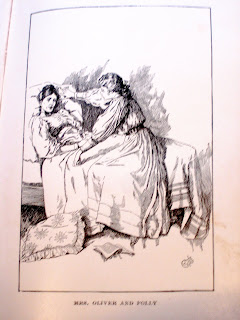
The book was machine printed in sixteenmo. The pages are 12cm x 17.5cm and are made of a firm but unremarkable stock typical of the turn of the century. It is bound in light gray buckram cloth, with blue border decorations and titling on the cover, spine, and back. Eight illustrative plates on a sturdy glossy stock appear throughout, depicting black-and-white line-drawings of scenes from the chapter in which they occur; these are not integral to the gatherings in which they appear. The frontispiece of Polly is guarded by a tissue sheet that is -- remarkably for a circulating juvenile library book -- fully intact. The contents consist of 212 pages of text in 18 chapters, plus 7 leaves of preliminaries and 2 blanks at the back.

Polly Oliver’s Problem was a sequel to Wiggin’s enormously popular young adult’s novel The Birds’ Christmas Carol (1887). The tale follows the adventures of the eponymous hero, whose endeavors to find employment brings her (like Wiggin herself) to California, where she ultimately finds rewarding employment reading to young children (again, like Wiggin). Though largely conventional in its form, Wiggin's book does make some interesting use of letters and other texts within the story. The book was somewhat successful, going through several editions (and still available in print today), but it was not a tremendous critical success. The review November 26, 1893 review in The New York Times was unimpressed by the narrative and writing style:
This little story by Mrs. Wiggin, while it possesses much of the characteristic charm of the graceful writer whose “Cathedral Courtship” and other delicately-humorous sketches have been so greatly admired, is rather strained and fine-spun and a little too artificial and pedantic to be a very popular tale with growing girls. We are afraid it will never be classes with the writings of Miss Alcott and Mrs. Whitney and the other mistresses of art of entertaining very young women. It is to be commended for its purity of tone and lack of cant. Polly is frequently a vivacious and entertaining heroine, but her nerves are a trifle overstrung, and something of the enervating influence of Southern California atmosphere, which a few of the many folks who go to the Pacific coast from the East complain of, permeates the story.
Polly is a poor, well-bred girl with ambitions for a “career”. She finds this career as a professional story teller for children. She begins in the hospitals, and there is perhaps a trifle too much of sickness and misery in the little volume to make it entirely agreeable reading, yet it is certainly not an unwholesome book, though it lacks the fresh charm and buoyancy of much of Mrs. Wiggin’s other work. The heroine’s mother dies after a spell of nervous prostration, and the symptoms in her case are set forth with admirable clearness.


This reviewer clearly suffers under delusions of his own cultural importance. First -- setting aside the condescending quotations marks around the word “career” in the first sentence of the second paragraph and the description of Wiggin's book as a "little story" -- there is an implied message that it is Polly’s “ambitions” that mark the book as too “pedantic to be a very popular tale with growing girls”. Books lauding “ambition” in young men at this time are rarely dismissed for being too “pedantic”. Second, there seems a distinct, almost willfulness ignorance about the value of realism in literature in this reviewer’s sniping suggestion that “there is perhaps a trifle too much of sickness and misery in the little volume to make it entirely agreeable reading”; one might point out that there is also a trifle too much of sickness and misery in life as well. The praise of Wiggin for “set[ting] forth with admirable clearness” the symptoms of nervous prostration is completely useless and marks the reviewer as utterly unclear on the concept of priorities in literary priorities. It’s a little like praising the chef at a restaurant for the way in which the napkins are folded.


My copy of this book is remarkably tight and clean for having once been part of the circulating collection in the juvenile section of a public library. Only one page bears a reader’s mark (a dog-eared corner to hold a place) and occasionally scattered throughout there are some stains and grubby finger marks. There is some discoloration on the spine and some pink stains on the cover. Otherwise, it is in very good condition. A letter “J” (for Juvenile) is penned on the spine and the recto of the front flyleaf bears the bookplate of the Egremont Free Library (Volume number 616, no shelf number) and a “Discarded” stamp. The stamp is repeated on the inside of the back cover, along with the remains of a removed card sleeve (too bad the card is missing -- it’s always interesting to see to whom and how often an old library book is checked out. With the exception of some penciled dealer’s marks, these are the only evidence that the volume has been used.


