Showing posts with label New York. Show all posts

Sunday, December 13, 2009

A Book from the Days When Titles Were Essentially Abstracts


This week’s book is a slightly worn copy of a mid-nineteenth century treatise on educating and raising a child. The wonderfully specific title, in full, is: On the Importance of an Early Correct Education of Children: Embracing the Mutual Obligation and Duties of Parent and Child; Also the Qualifications and Discipline of Teachers, With their Emolument, and a Plan Suggested Whereby All Our Common Schools Can Advantageously Be Made Free; The Whole Interspersed with Several Amusing, Chaste Anecdotes Growing Out of the Domestic and Scholastic Circle. To Which is Subjoined by way of an Appendix, the Declaration of Independence by the Thirteen North American Colonies, 4th July, 1776. The Constitution of the United States, with that of the States of New Jersey and New York, as Lately Adopted.


Written by Dr. William Euen, the book was also published for him privately by an unnamed New York firm in only one edition, two issues, in 1848. My copy is of the second issue (the first paginated to only 136, presumably because it lacked the New Jersey constitution, which runs pp. 137-152). It retailed, according to the title page, for sixty-nine cents (about $18.83 in today’s money). Its valuation to collectors today seems highly erratic: the second issue seems to be worth around $30 (the first apparently around $45), but at least one dealer is selling the second issue for a ridiculously inflated price around $340.


Dr. Euen was a resident of the town of Shawangunk in Ulster County, New York. His book is exactly what the title explains, using a fair amount of appeals to patriotism, civic planning, the Bible, and nineteenth-century pedagogical theory (including on the purchase of books, the use of writing paper, and the importance of using a goose quill and not resorting to those sinful "steel pens") to make its case.


Tracking down information about the man has been a bit difficult, but it seems that he was the same William Euen who had previously published A Short Exposé on Quackery (Philadelphia, 1840). Prior to that he was apparently residing in Newton, New Jersey (hence the inclusion of both the NY and NJ constitutions in his book) where, in February 1829, he renovated his home at 29 Liberty Street and converted it into the Euen School for Girls. It is possible that our author is the same man who ended up as the editor/co-publisher of the Weekly Prison City Item of Waupun, Wisconsin from 1860-June 1861 (the writing style of the two Euen’s is similar, though the topics they write on are rather different).


The book is bound in the publisher’s brown cloth with decorative blind tooling and gilt title on the cover. The pages measure 11.5cm x 18.5cm; pagination runs [i]-iv from the title page through the preface, [1]-152 for the contents of the book. The collation is rather peculiar; signatures are numeric and include an added asterisk to indicate a signature internal to a gathering (internal signatures are not used in the appendix gatherings). The format is another octavo in twelves (with the exception of the appendices, which were apparently printed separately in standard octavo format) and the formula may be expressed as 8o: [#2] [112]-412 58-88 [π]: $1, 5. In some places the printing was clearly a rushed job: type slips (for example, the “6” in the page number “86” is almost a full line lower than the “8”) and some of the ink has smeared or not been fulling applied to the type.


The condition is average: the last page is torn in half but still attached to the binding, the cover has some bumps and chipping, and there is some foxing and other paper stain damage (on which more below) throughout. The only owner’s marks are an apparently purposeful pencil mark next to a passage about the necessity of having a globe in the classroom and an owner’s pencil inscription inside the front cover on the pastedown: “H D Ryell, / Book”.


I chose this book for this week because the combination of child-rearing advice and New Jersey seemed an important coincidence for my family this month. But while I was leafing through it I came across another interesting feature. At first I thought I was looking at some severe staining caused by a liquid spill or moisture of some kind: mirror-image marks in the gutter of many openings, not unlike a Rorschach Test.


Eventually, however, I came across the dried, brown remains of a very old flower, pressed between two pages and, in another place, an explosion of dried, brilliantly red pollen; apparently some early owner (H. D. Ryell, perhaps?) decided that the most functional use for Euen’s treatise was as a tool for the highly popular nineteenth-century art of flower pressing. It would be interesting -- though beyond my capacity -- to try to identify the specific flowers that had been pressed in the book by researching their silhouettes. I began to reflect on the many different non-reading uses of books and came across this fantastic page with a range of highly artistic (and sometimes functional) alternative uses for books.


Try doing any of those -- or pressing flowers -- with a “Kindle”.

Sunday, November 15, 2009

A Family of Pioneering Educators and their Copy of the First American Edition of "Hudibras"


This week’s book offered me the intriguing opportunity to try to track down the physical movement of a copy as it traveled between owners. The book is titled Hudibras, in Three Parts: Written in the Time of the Late Wars...with Annotations and a Complete Index, an epic verse satire written by the royalist Anglican Samuel Butler during England’s civil war (1642-1660). The tale follows the misadventures of the ridiculously over-confident and under-skilled knight errant and his long-suffering squire. Like Don Quixote, Sir Hudibras encounters a series of mundane and everyday people and events and mistakes them for true chivalric conventions. Unlike Don Quixote, his screw ups and his inability to distinguish truth from fiction is not because of an overbearing sense of romanticized idealism but simply because he is an idiot.


The epic was first published in London in three parts in 1663, 1664, and 1678 (Charles II had been restored to the throne in 1660, making mockery of the Parliamentarians, including Cromwell, much more publicly acceptable by the time Butler published his satire). In addition to ridiculing the writer’s political foes and religious opponents (Puritans and Presbyterians), the work also pokes fun at ludicrously hyperbolic and stilted styles of poetry from the time.


My copy was printed and published in 1806 by the firm of Wright, Goodenow, and Stockwell, in Troy, New York, and was sold by the firm at their Rensselaer Book-Store (not associated with Troy’s Rensselaer Polytechnic Institute, which did not open until 1824). This makes my copy, as the title page claims in elaborate font, the “First American Edition”. The second American edition did not come out until 1812 (published F. Lucas Junior and P. H. Nicklin, of Baltimore). The work was very popular in England and Scotland, however, and it seems that Wright, Goodenow, and Stockwell, for their copy, simply reprinted one of the UK editions.


I have not been able to determine which one precisely was used, but they did reuse the prefatory material (a note “To the Reader” and “The Author’s Life”) and annotations originally provided by Zachary Grey in his edition of 1774 (which included illustrative plates by none other than William Hogarth). The publishers of my copy were evidently unaware that some of Grey’s claims had been modified more recently in John Bell’s Poets of Great Britain (published originally in 1777 and republished by the British Library in 1797).


The most substantive variation to the 1806 edition’s form was the decision to move all of Grey’s annotation from the back of the book to the foot of the page of text itself -- no doubt a concession to (American) readers for whom much of the epic’s dense and historically specific allusions and humor required a heightened degree of explanation. The editors also included some additional glossarial notes at the foot of pages and, in a few places, an explanation of a typographic error in their copy-text (see the final photo in this post).


The book is bound in soft brown sheep leather, with some faded decorative tooling and a dark leather title label on the spine (see the photo at the start of this post). In binding the book, the printer did an excellent job: aside from some splitting to the front hinge, the spine is very tight and strong. The pages measure 10cm x 17cm and are of a sturdy though not particularly expensive paper stock with no evident watermark. The pagination runs [i]-xi from the title page through the end of the “Author’s Life” and [1]-286 for the content; a 13-page unpaginated “Index” of important concepts and events written in comically implicit language, keyed to page and line number, concludes the book.


At the front there is a flyleaf, marbled on the recto (as is the pastedown) and blank on the verso, followed by two blanks; at the end there is a blank followed by a fly similarly marbled and conjugate to the final pastedown as the first. There are no catchwords and no variants to the running-titles. Signatures are alphabetic and appear on the first and third leaf of each gathering (the first leaf is signed with the sheet letter; with the exception of the final gathering, in which it is not signed, the third leaf of each is signed with the sheet letter followed by “2”). It may be collated as 12o: [#3] [A6]-Aa6 [π]. The type is a small pica throughout and is often so firmly impressed into the page that the bite has left a rippling, tangible texture to the paper (see the image below) -- a rich tactile reminder of the physical process by which the book was created. With the exception of a few pages, the type was fully inked.


As I mentioned at the start of this post, this copy of Hudibras afforded me the opportunity to sleuth out how an early nineteenth-century book moved around the young United States. There is little evidence of early readers within the content of the book itself, aside from an erased pencil note on the first page, an erased pencil doodle later in the preface, and some page corners that were clearly once dog-eared as place-holders. In the blanks, however, there is some more useful information.


My book is ex libris, bearing an erased pencil record of its (Library of Congress) catalog number. Inside the back cover there is a computer-printed label reading “A22901 059017” (accession number, perhaps?) and a label with the LoC number PR 3338 A7 1806. Typed in red on the label is the word “Vault”, suggesting the library kept the book in a special restricted-access area for rare books. Inside the front cover there is a bookplate indicating the library from which the book came: Springfield College, founded in 1885, in the city of Springfield, MA. According to the bookplate, it was given to the college library as part of the “Carolyn Doggett Memorial Collection”. The bookplate indicates that the college’s name at the time it was given was legally “International Y.M.C.A. College”, but the seal shows the name “Springfield College”, meaning the book must have been given (or the bookplate put in) after 1939 (when “Springfield College” was adopted as the institution’s public moniker) and before 1954 (when “International Y.M.C.A. College” was formally removed as the corporate name). It is only by finally coming to Springfield College and its history that I can begin to piece together the narrative of this book’s travels.


From 1896 to 1936, the President of Springfield College was Laurence L. Doggett. Laurence’s wife was his college sweetheart, Carolyn Doggett of Providence, Rhode Island; from 1898 to 1928, Carolyn provided what her husband called the “cultural background” he felt the College’s students needed in their comprehensive education; she taught classical and modern literature, art, and music for the duration of her husband’s tenure as President.


In his 1943 Man and a School: Pioneering in Higher Education at Springfield College (dedicated to his late wife, whom he terms his “Comrade in Pioneering”), Laurence explains a little about his family history -- and in the process helps illuminate the history of my copy of Hudibras. The Doggett family traces its roots in America back to Thomas Doggett, who arrived in Marshfield, Massachusetts in 1637. The family was always involved in educational “pioneering” -- they were involved with administration at Brown University and in 1796, Laurence’s great-grandfather Simeon founded Bristol Academy and was “the pioneer of liberal education in the old colony.” (He was also the subject of a brief biographical sketch, written in 1852). Laurence’s grandfather, Samuel Wales Doggett, started a school for women in South Carolina. When Samuel died, his widow (Laurence’s grandmother, Harriet Doggett) moved to Manchester, Iowa, where she lived until her death in 1892. Her son was Simeon Locke Doggett, who, after obtaining his law degree in Worcester, Massachusetts, returned to Manchester in 1856.


A blind impression stamp on one of the blanks at the start of the book reads “S. L. Doggett / Notary Seal / Iowa.”, and penciled on the recto of the blank before that is the large signature of “S. L. Doggett”. More faint is a penciled inscription in a different hand, running vertically on the verso of the flyleaf and facing the signed blank: “Samuel W. Dogg[ ]”. Beneath that is a second illegible inscription in the same hand. According to the 1878 History of Delaware County, Iowa, Simeon was first hired as a county clerk in 1860 and then served variously as clerk or justice of the peace (or both) through at least 1877 (when the record ends). In 1865 he drafted a petition to the state asking that the village of Manchester and the surrounding villages be incorporated into a town; the petition was approved by the county and then the state in 1866. In 1870, 1871, 1872, and 1876 he was elected mayor of the town. He also served as chair of the school board for many years.


His interest in Butler’s Hudibras, and in literature in general, is attested to by his involvement with the Manchester Select High School, which he and his wife, Mary, founded in 1858. There he was head of the classical department and taught the classes in literature (in his own memoir, his son recalls Simeon reading works “aloud with dramatic feeling”, including The Vicar of Wakefield, The Arabian Nights, and the works of Scott and Dickens, as well as, of course, the Bible). His younger sister, Gertrude was the school’s assistant and later “Preceptress” for a year; she is described as “a lady of rare native grace and of brilliant accomplishment”. Gertrude went on to teach literature and elocution, eventually becoming a Shakespearean actor in Chicago and mother of the novelists Charles Norris and Frank Norris.


In 1860, Simeon gave an address to the county’s first Teachers’ Institute, and while no record of what he said survives, he is described as “one of the pioneer teachers of the county”. The county marriage records show that he was still active as a notary there through at least October 1886; in June 1929, Mary provided music for the funeral of Susannah Coon, in Henderson, Iowa, at which Simeon served as pallbearer.


His son, Laurence (shown to the left, towards the end of his time at Springfield College), ended up attending Oberlin for theology, where he became active in the Young Men’s Christian Association. This eventually led to some time at the University of Berlin and in Leipzig (Carolyn also studied at both places with her husband), and finally his position as President of Springfield College. Presumably Laurence inherited his father’s books (including my copy of Hudibras). Because the book was given as part of a “Memorial” collection, he probably donated it to the College’s Library after 1943 (the date of Laurence’s memoir and its dedication to the memory of his late wife) but before 1953 (the last year the name “International Y.M.C.A. College” would appear on a bookplate for the College library). At some point between that date and 2007 it was deaccessioned from the collection for some reason, and it made its way up to Antiques at Deerfield in historic Deerfield, MA, where it was purchased to be added to Tarquin Tar’s Bookcase.


The book has gone from upstate New York to Massachusetts, South Carolina, Iowa, possibly Ohio and Germany, and then back to Springfield, Deerfield, and finally (for now) Leverett, Massachusetts. To say nothing of many possibly unrecorded trips between each temporary stop. When we look at our own books in the relatively immediate context of our own lives, they seem to be perpetually stationary -- sitting on their shelves, silently gathering dust. But when we look at them in the trajectory of history, our books are always moving -- far more, even, than any single one of their owners.


Sunday, October 4, 2009

Before Fodor's There Was Reverend Isaac Taylor...


On Friday I overheard some undergraduate students discussing the 2016 Olympics contention. One pointed out that Tokyo should be eliminated from the competition because “Beijing held an Olympics already, so Japan has had its chance.”


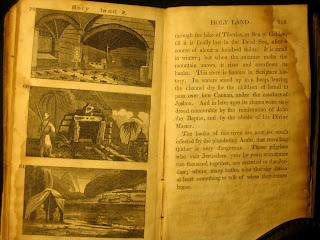
In that student’s honor, this week’s book is the second American edition of the Reverend Isaac Taylor’s Scenes in Asia: for the amusement and instruction of little tarry-at-home travellers. As the title implies, the book was meant for young students to read in order to gain an understanding (though a misleading one, on which more below, but see the photograph to the left for an example) of foreign cultures without leaving the comfort of their home.


My copy was published in 1830 by the celebrated Hartford, Connecticut publisher of Americana, history, biography, and law, Silas Andrus; it was printed in stereotype by John Conner of New York City. Taylor’s popular book, which was part of the series Books for Young People, was first published in 1819 by John Harris and Son of London; subsequent editions followed quickly from Harris in 1821, 1822, 1826, 1827, and 1829. Andrus’s first American edition appeared in 1826. Later American editions were published by Erastus Pease of Albany in 1843 and 1850. Despite this extensive print run, extant copies of these early editions are valued quite high on the market; interestingly, I can find no copies of the 1830 Andrus currently for sale.


The book is bound in pressed, bluish boards with a leather spine; gilt lettering and lines once decorated the spine, but my copy is so cracked and split that they are difficult now to discern. The paper is a soft, fairly cheap linen stock with mesh-lines but no watermarks; each page measures more or less 9cm x 14.5cm. Conner’s printing was workmanlike, but there is some evidence of complications during the stereotyping process. The book was printed in octavo; I’ll skip the collational formula, which is generally sound, though in some places short gatherings hint at problems with certain sheets. The pagination runs [i]-vi [1]-124. Within each chapter there are numbered sections about aspects of that nation or region's culture; the numbers refer to illustrations found on some of the facing pages. Because the book was printed by stereotype, the illustrative plates are conveniently integral to the gatherings in which they appear and did not have to be tipped in or inserted after printing. As noted, the condition is rather rough: the boards are scuffed and corners deeply bumped, pages are somewhat loose from the cracked binding and often water-stained, the leather spine is severely chipped, and some leaves are torn (some moderately and some, particularly engravings and the initial map, almost entirely gone).

There are no marginalia or reader’s marks in the copy, but the recto of the flyleaf does have a gift inscription written in watery copper ink and a nineteenth-century hand:


William W Burnham

Presented to his cousin

Hubert North


I’ve been unable to located Burnham with any confidence, though in the 1868 Manual of the corporation of the city of New York there is a “William W. Burnham” listed as clerk to the Collector of City Revenues. Working from the fact that Andrus was located in Hartford (though my copy may have retailed and subsequently traveled anywhere), I tried to find a contemporary Connecticuter with the name of Hubert North. The only man of this name I can find lived in New Britain, Connecticut in the 1870s and was the “Son” in the wire, ring, clasp, and hook-manufacturing firm “Alvin North & Son”, located at the corner of East Main and Stanley Streets since 1812. I have no idea if this is the man who owned my copy, but it is not impossible. For reasons I cannot fathom (accident? page-marker?) an old, bent steel nail has been pressed into the gutter of the final opening, between the last page of content and the rear pastedown.


The book begins with a fold-out map of Asia (unfortunately mostly torn out in my copy), on which a line traces the route the book takes through various countries. A doggerel verse at the start introduces the reader to the book’s objective. The narrator then moves from region to region and country to country, covering a region encompassing the Middle East, Turkey, China, Japan, India, and Indonesia, giving a subjective, often grossly inaccurate account of local customs, peoples, and sites, as well as citing stories from ancient history. All is written in a simple, sometimes amusing style. Interspersed throughout the book are illustrative plates (drawn from imagination, not from life), engraved by Taylor himself and occasionally short summative poems that put the chapters’ main points into memorizable verse.


The book ends with a concluding verse mocking and decrying the “pagan” religions of the people of Asia and thanking God for Britain, Jesus, and the Bible. Taylor was, after all, a reverend as well as a writer and engraver, so it should come as no surprise that the bulk of his book is concerned with (ill-)reporting Asian religions and rituals and making local traditions sound as gruesome, barbaric, and crude as he possibly can. (Google Books has scanned the full text of the 1826 fourth edition; the contents are largely the same as that in my 1830 copy and giving them a quick scan will give you a good idea of what I mean.)


The life of Isaac Taylor has been adequately detailed by his descendant, Robin Taylor Gilbert, in the Oxford Dictionary of National Biography:


Isaac Taylor (1759–1829), engraver and educationist, was born in London on 30 January 1759, the second son of Isaac Taylor (1730–1807), engraver, and his wife, Sarah Hackshaw, née Jefferys (1733–1809). He spent his early years at Shenfield, Essex, and was first educated locally, probably at Sir Anthony Browne's School in Brentwood, before briefly attending a school in the City of London. Like his brother Charles Taylor (1756–1823) he was apprenticed to his father as an engraver and may later have become a pupil of Francesco Bartolozzi.


One of Taylor's first commissions was to oversee the preparation of the plates for Abraham Rees's revised edition of the Cyclopaedia of Ephraim Chambers. This work and Taylor's many discussions with Rees were, by his own account, what first filled him with a thirst for knowledge. In 1777 and in 1780 he exhibited landscapes and drawings at the Incorporated Society of Artists, of which his father was secretary. From an early age Taylor became a committed member of the Fetter Lane Independent congregation in London and was prevented from seeking ordination as a young man only by severe illness. Throughout his life he rose early and spent the first hour of every day, and usually the last also, in prayer.


On 18 April 1781 Taylor married Ann Martin (1757–1830); three sons and three daughters of the marriage survived to adulthood. The couple first set up house in Islington. Taylor's capital was £30, supplemented by Ann's dowry from her grandfather of £100 and his own income of half a guinea a week for three days' work for his brother Charles, together with whatever he could earn for himself in the other three days.


Taylor used Ann's dowry to commission Robert Smirke to produce four circular paintings representing morning, noon, evening, and night, which he then engraved and sold. Between 1783 and 1787 he was engaged with his brothers and with several painters, including Smirke, in an enterprise to produce illustrations to Shakespeare's plays, The Picturesque Beauties of Shakespeare (1783–7). The success of this enterprise prefigured the later, larger project of John Boydell, in which Taylor was a leading participant (he received 500 guineas for an engraving of Henry VIII's First Sight of Anne Boleyn, 1802, after Thomas Stothard). It certainly drew Taylor to the attention of Boydell and won him the lucrative commission (250 guineas) to engrave The Assassination of Rizzio by John Opie; this work was awarded the gold palette of the Society of Arts for the best engraving of the year in 1790.


Taylor's success as an engraver lay in his great technical skill combined with a flair for design, qualities which he also demonstrated as a painter of portraits and landscapes. One of his finest achievements was Specimens of Gothic Ornament (1796), a series of engravings illustrating architectural details of the parish church of St Peter and St Paul in Lavenham, Suffolk. Later in his career he engraved the illustrations for Josiah Boydell's Illustrations of Holy Writ (1813–15), the designs for which were accounted the finest artistic work of his son Isaac Taylor (1787–1865). Thereafter his published engraving was confined to illustrations of books by members of the family.


In 1783 the Taylors moved to Holborn but the annual rent of £20 was high and the environment injurious to the health of a growing family, almost all of whom were prone to illness. In 1786 Taylor made the decision to move to the country and, after characteristically diligent enquiry about prices and amenities, rented for £6 per annum a large house, Cooke's House, in Shilling Street, Lavenham, Suffolk. There his two eldest children, Ann and Jane, and his business, flourished.


Taylor's sketchbooks from his time in Lavenham contain many fine drawings and watercolour portraits of family members and of local acquaintances. The garden at Lavenham also provided the setting for his best-known portrait in oils (1792; NPG), that of his daughters Ann Gilbert (1782–1866) and Jane Taylor (1783–1824). In 1792, however, the Taylors' landlord gave them notice to quit and Taylor bought, for £250, the house next door, which was then in a ruinous condition. Its renovation (interrupted by Taylor's contracting typhoid, which nearly killed him) cost a further £250, but his careful and imaginative planning transformed house and garden from dereliction to delight.


Taylor had become a deacon of the Independent congregation in Lavenham and was closely involved in the founding of a Sunday school there. In 1794 he might have become minister, had the congregation not shrunk from the appointment of one of its own number. In late 1795 Taylor, who was gaining a reputation as a preacher, was invited to become minister of the Bucklersbury Lane Independent congregation in Colchester. In January 1796, having accepted the call, Taylor and his family moved to Colchester, where they rented a house in Angel Lane (now West Stockwell Street). On 21 April 1796 Isaac Taylor was ordained.


The move to Colchester coincided with a period of high inflation and the collapse of the art market in the wake of the war with France. Taylor suffered ‘a grievous reverse of fortune’ (Autobiography, ed. Gilbert, 1.100) and was reduced to engraving dog collars. Taylor wanted his daughters to be able to earn their own living; as soon as they were old enough all the children were employed to assist in the engraving business. The boys, Isaac (1787–1865), Martin (1788–1867), and Jefferys Taylor (1792–1853), were formally apprenticed, but his daughters, who were both to become published writers, were tolerated, rather than encouraged, in their literary vocation.


In Lavenham, Taylor's successive workrooms had doubled as schoolrooms for his own children and later for those of neighbours too, Taylor giving instruction from his engraving stool as he worked. This practice continued in Colchester, providing a welcome supplementary source of income. Taylor's object was ‘to give them a taste for every branch of knowledge that [could] well be made the subject of early instruction’ (Family Pen, 126) and he believed that ‘a principal object of education [is] to prevent the formation of a narrow and exclusive taste for particular pursuits, by exciting very early a lively interest in subjects of every kind’ (ibid., 113). His teaching methods were original and he made much use of carefully drawn visual aids, in the preparation of which his older children assisted. In late 1798 he began a series of monthly lectures for young people, delivered free of charge in the parlour of his own house; these proved extremely popular and the programme continued for several years.


Later in life Taylor wrote, and illustrated with engravings, a large number of very successful educational books, including the Scenes series (‘for the Amusement and Instruction of Little Tarry-at-Home Travellers’), and two volumes, The Mine (1829) and The Ship (1830), for the popular Little Library series published by John Harris. He also produced a number of books for the young, of a religious and improving nature, including The Child's Birthday (1811), possibly originally written for his youngest child, Jemima (1798–1886), Advice to the Teens (1818)—the first recorded use of the word to denote young people—and Bunyan Explained to a Child (2 vols., 1824–5). The preface to this last book is revealing of Taylor's approach to education and to religion, warning parents against expecting their children to read ‘all the many hours a wet Sabbath presents’, lest they ‘make that day hated, which ought to be loved’ (p. iv).


In June 1810 Taylor, exasperated by the apparently ineradicable antinomian tendencies of many in his congregation, announced his resignation from his pastorate in Colchester. A year later he accepted a call from the congregation at Ongar, where he remained for the rest of his life, rejuvenating and expanding the congregation, stimulating the intellectual life of the small town, and earning the respect even of the Anglican clergy. He instituted weekly lectures and prayer meetings, restarted the Sunday school, and played a leading part in a thriving book society—the while continuing to exercise his profession as an engraver and producing more than twenty books. He rented, first, Castle House and then New House Farm, just outside the town, and finally, in 1822, he bought a house at what is now 10 Castle Street.


Taylor, who had a stocky frame and an appearance usually of rude health, was described as ‘a genial portly figure … his cheek ruddy with apple tints’ (Autobiography, ed. Gilbert, 2.94). However, his life was punctuated by serious illnesses, including a three-year period in his late fifties, during which he almost succumbed to successive bouts of rheumatic fever. For almost a decade thereafter he maintained a pace of life that eventually proved too much for his constitution. On 12 December 1829, after a short illness, he died at his home. He was buried on the 19th in the Independent chapel's burial-ground; his grave now lies under the vestry floor of the United Reformed church, beside those of his wife and of his daughter Jane.

Sunday, July 5, 2009

A Contemporary Account of America's Civil War


It’s the Fourth of July weekend -- an unfortunate time to discover the paucity of Americana in my collection. Still, I think that this book -- which I unearthed at an antiques store with a fairly good book section in nearby Deerfield -- speaks to a crucial moment in our nation’s history that, while not dating all the way back to our founding, still centers on what has come to be known as the last real battle of the American Revolution.


The book is The Great Rebellion; A History of the Civil War in the United States, written by New Yorker Joel Tyler Headley (1813-1897) and published by the American Publishing Company (APC) through their headquarters in Hartford, Connecticut, as well as their branch office in Columbus, Ohio, and their affiliate R. C. Treat in Chicago. On the title page, APC claims that the book was sold “by subscription only”, meaning it was retailed directly from the publisher to buyers who had seen it advertised and pre-paid for their copy. This copy is of the 1866 edition and includes two volumes sold as one book. Volume I was originally published by the firm of Hurlbut, Williams, & Company in 1862 (only two years into the war, making the use of the term “History” in the title slightly optative). About the 1862 edition of Volume I, Bisonscat Books notes:


At this volume’s publication Volume II was still being fought on the battlefields. According to the Publisher's Notice before the Preface, "Volume I contains a history of the origin of the war and its progress during a period of eighteen months, up to the last of the June, 1862. Volume II completing the history and containing valuable statistics, will be prepared as fast as the receipt of authentic material by the author will permit, and be issued within six months after the close of the war, or sooner if practicable and deemed expedient." This notice was dated Nov. 1st 1862, between the battles of Antietam and Fredericksburg. You get the impression they did not think the war would last another two and a half years.


There is, unsurprisingly, no publisher’s notice before Volume I of the 1866 edition. Subsequent editions of Volume I, published again by Hurlbut, appeared in 1863 and 1864. An independent edition of Volume II first appeared in 1866, designed to accompany the 1864 edition of Volume I. Simultaneously, the two-volumes-in-one 1866 edition (to which my copy belongs) appeared. Many later reprints followed, from various publishers. Headley’s work was evidently to the satisfaction of his readers because it was followed by similar works, from various other publishers, in the ensuing thirty years (Heroes and Battles of the War, 1861-1865; Our Navy in the Great Rebellion; Our Army in the Great Rebellion; Farragut, and Our Naval Commanders; Grant and Sherman; etc.).


While Volume I of the 1866 dual edition lacks the publisher’s notice Bisonscat speaks of, there is one at the start of Volume II, in which APC delineates its patriotic vision for the book, speaks with extravagant praise of their product, allude to its publication delay (and ensuing cost overruns), and dismiss the competition. The notice is long, but worth quoting in full:


It is with no ordinary satisfaction and confidence that we issue this Second Volume of the History of the Great Rebellion. No other History of this mighty and memorable conflict, has won so large a favor from the American people. Mr. Headley's genius has here found a subject worthy of, and demanding its amplest resources; and he has successfully risen to the height of the great occasion. He here completes a historic record, that will be read with amazement and the deepest interest by present and future generations—the record of the sacrifices and successes of a people, sacredly cherishing the traditions and legacies of the Fathers and Founders of their Republic, and shrinking from no cost of treasure and blood necessary to subdue the most causeless and criminal insurrection against human rights and human freedom, that ever challenged a nation to the bitter and bloody arbitration of the battle field.


Ours is no dry and dreary compilation, which, even if read, can be of little profit, save to a few minds. It is not the speculations of the political theorist or philosopher, upon the causes and obscure agencies culminating in this atrocious conspiracy against the best human Government. But, it is the vivid and faithful portraiture—by an author of surpassing genius for historic delineation—of all the important events in our Civil War. From it may be got the clearest and most adequate idea of the spirit of the nation, and of the sweep and shock of its armies during these four eventful years of heroism and glory. It is a splendid and faithful panorama of a great people in arms, inspired with a sublime enthusiasm for Law and Liberty. It shows the prominent actors in the Tragedy which has held the gaze of the civilized world—some of them incompetent or unfaithful and disappearing in defeat or dishonor—others grand, heroic, moving to victory or honorable death, blessed with the prayers and love of all true patriots, and crowned with their gratitude and homage.


The delay in the completion of the work, though a pecuniary detriment to us, will however be compensated by important advantages to our subscribers. If it had been issued at the close of the conflict, it must have been written, as were some other Histories, without the aid of the official reports of Generals Grant and Sherman—the only reliable sources of information respecting the last, great and decisive campaigns of the War.


No History can possess perfect accuracy. Authorities of apparently equal claims for credence often differ, and time not infrequently makes disclosures that modify statements and judgments once regarded correct. Special effort has been made to authenticate the statements of this work by a comparison with every accessible authority, and we are confident that it has no superior, and, we think, no equal in fidelity of historical narration.


The official reports of Generals Grant and Sherman are documents of such national and enduring interest and value, that every reader of this History will desire to have them in a permanent form. We have thought that such would be grateful to us for furnishing them, and fitly associating them with the concluding part of the History of a War, which these able Chieftains by their strategy and leadership brought to a glorious end.


We have employed the very best Artists in the production of the fine steel engravings which embellish this volume, and though these have been executed during the period of high prices, no expense has been spared to secure in them the highest degree of excellence. The engravings of the two volumes taken together constitute a series of elegant and varied illustrations unequaled in any other History of the War.


In view of its size, its valuable portraits and other illustrations, its elegant typography, and the general excellence of its mechanical execution, we are conscious of having more than fulfilled the pledges made to our subscribers, and in anticipation of their entire satisfaction, send forth this work.


The 1864 edition of Volume I -- which was bound directly into the 1866 dual edition -- also included a statement of the publisher’s intentions for the venture, but this was in the form of an advertisement and series of testimonials (similar to the blurbs on modern book-jackets, but these much longer and less diplomatically vague) that appeared on the last printed leaf of the book (interestingly paginated as the first leaf of Volume II in the 1866 dual edition). The endorsements come from newspapers across the northeast (especially New York) and also include words of praise from Reverend C. B. Crane and Reverend Dr. M. B. Anderson (president of Rochester University). Again, because of the details it offers about the book’s goals and value (as advertised by the publisher), its implied view of historiographic procedure (reduction, clarification, comprehensiveness [which is apparently not considered at odds with reduction or clarification], proximity, and evocation) and the importance of what we today would call the “embedded” reporter, and, finally, some telling words about the printing history itself (including, for example, its simultaneous publication in a foreign language to ensure accessibility to one of the largest immigrant demographics in the northeast at the time), I believe the advertisement also bears quoting in full:


The magnitude of the subject of the present work -- the Great Rebellion in the United States -- being not only the Great Event in American History, but the most fearful tragedy of modern times, is of itself calculated to render this book one of the most exciting and interesting ever offered to the public. The publishers, fortunately, have been enabled to enlist the eminent and splendid talents of the Hon. J. T. Headley, who is well known to the public as the most brilliant and popular writer of Military History of modern times. In depicting the numerous battles and warlike scenes of the present contest, his power of vigorous and stirring description finds full scope. His great and remarkable talent for condensation by which he is enabled to render his narratives vivid, comprehensive, and full, in fewer words than almost any other writer, is invaluable in disposing of the immense mass of materials relating to the present subject. To more fully qualify himself for the work, he passed several months with our armies and obtained valuable information through his acquaintance with many of the most distinguished officers of the Army and Navy.


The work will embrace a comprehensive account of the whole contest, neatly printed from a beautiful, clear, new type, on good paper, and will be illustrated with numerous fine Steel Engravings, representing the most important and exciting scenes in the war, from original Designs by Darley and other eminent artists, together with life-like Portraits of leading actors on both sides; engraved expressly for this work, at great expense. It will contain over one thousand pages, royal octavo, handsomely bound in two volumes, and be furnished to order, only through our authorized traveling Agents.


To meet the wants of a portion of the public the publishers have prepared an edition of the work in the German language, which will be issued in the same style as the English.


In view of the above facts, the undersigned offer the present work, believing that they are thus rendering an important and valuable service to a discerning public. Confident that it will secure a patronage in some degree commensurate with its merits, they offer to intelligent, energetic agents, who will engage in its sale, a very profitable and useful employment.


The advertisement is signed by Hurlbut, Williams, & Co. of Hartford and E. B. & R. C. Treat of Chicago. I find the final paragraph’s commingling of nationalistic duty with a profit-guarantee to the firm’s booksellers an appropriately American touch.


The man in whom Hurlbut & Co. invested so much praise was a native New Yorker and the son of a Presbyterian preacher. Headley (shown to the right) followed in his father’s footsteps at first, graduating from Union College in 1839 and enrolling at Auburn Theological Seminary, where he was eventually ordained. His attempts to provide devotional leadership to a congregation in Stockbridge, Massachusetts, however, ended up inducing a nervous disorder and gave up the occupation to travel in Europe in 1842. Upon his return, he took up his pen and began to write history books about America and New York in particular, and he ended up as associate editor of the New York Tribune (a job he secured through the abolitionist who would later write a competitive account of the Civil War, Horace Greeley). In October, 1850, his book Sacred Mountains was famously skewered by Edgar Allen Poe in a rather cruel review in the Southern Literary Messenger that took issue, most of all, with the author’s religious credentials and their influence upon his writing:


THE Reverend MR. HEADLEY — (why will he not put his full title in his title-pages?) has in his "Sacred Mountains" been reversing the facts of the old fable about the mountains that brought forth the mouse — parturiunt montes nascetur ridiculus mus — for in this instance it appears to be the mouse — the little ridiculus mus — that has been bringing forth the "Mountains," and a great litter of them, too. The epithet, funny, however, is perhaps the only one which can be considered as thoroughly applicable to the book. We say that a book is a "funny" book, and nothing else, when it spreads over two hundred pages an amount of matter which could be conveniently presented in twenty of a magazine: that a book is a "funny" book — "only this and nothing more" — when it is written in that kind of phraseology, in which John Philpot Curran, when drunk, would have made a speech at a public dinner: and, moreover, we do say, emphatically, that a book is a "funny" book, and nothing but a funny book, whenever it happens to be penned by Mr. Headley.   


    We should like to give some account of "The Sacred Mountains," if the thing were only possible — but we cannot conceive that it is. Mr. Headley belongs to that numerous class of authors, who must be read to be understood, and who, for that reason, very seldom are as thoroughly comprehended as they should be. Let us endeavor, however, to give some general idea of the work. "The design," says the author, in his preface, "is to render more familiar and life-like, some of the scenes of the Bible." Here, in the very first sentence of his preface, we suspect the Reverend Mr. Headley of fibbing: for his design, as it appears to ordinary apprehension, is merely that of making a little money by selling a little book. 


....


"Quack" is a word that sounds well only in the mouth of a duck; and upon our honor we feel a scruple in using it: — nevertheless the truth should be told; and the simple fact is, that the author of the "Sacred Mountains" is the Autocrat of all the Quacks. In saying this, we beg not to be misunderstood. We mean no disparagement to Mr. Headley. We admire that gentleman as much as any individual ever did except that gentleman himself. He looks remarkably well at all points — although perhaps best, EXAS — at a distance — as the lying Pindar says he saw Archilochus, who died ages before the vagabond was born: — the reader will excuse the digression; but talking of one great man is very apt to put us in mind of another. We were saying — were we not? — that Mr. Headley is by no means to be sneered at as a quack. This might be justifiable, indeed, were he only a quack in a small way — a quack doing business by retail. But the wholesale dealer is entitled to respect. Besides, the Reverend author of "Napoleon and his Marshals" was a quack to some purpose. He knows what he is about. We like perfection wherever we see it. We readily forgive a man for being a fool if he only be a perfect fool — and this is a particular in which we cannot put our hands upon our hearts and say that Mr. Headley is deficient. He acts upon the principle that if a thing is worth doing at all it is worth doing well: — and the thing that he "does" especially well is the public. [zing!]


In 1855 Headley took a break from writing and began a career in politics as a member of the New York State Assembly, leading to his appointment as New York’s Secretary of State from 1856 to 1857. Upon leaving politics, Headley returned to the writing that had given him so much comfort after his stressful days as a preacher, and he took up a medical practice in Linn County, Iowa. It is from this period that his account of the Civil War dates and many of the accounts that are given in his Great Rebellion first appeared in newspapers and serial publications of the 1860s, including many in Harper’s Magazine. Up until his death in 1897, Headley apparently also travelled around the country, delivering lectures on historical and religious topics (on April 10, 1896 he gave an address titled “The Sunny Side of Life” at a high school commencement in Greenfield, Indiana; it was, according to the town history, “not very kindly received by a great many people” and letters protesting the speech continued to appear in the local paper up to two years after the event).


As every bibliophile knows, the appearance of a book is only part of its appeal: a truly desirable volume has something to offer, also, to the senses of touch and smell. My copy of Headley’s Great Rebellion certainly satisfies those criteria; it is pleasingly hefty but tightly bound in a full sheep leather that has become, with age, remarkably soft and smooth, and its odor is one of antique authority, that musty exhalation of paper and ink that is more than a century old. Black morocco labels and thin gold bands hug the spine, with the title and author in all majuscules.


The pages measure 15.5cm x 23cm, and while the publisher’s advertisement may have stipulated that the book would be printed on “good paper”, the stock used was evidently highly acidic (nearly every copy for which I can find a description -- including mine -- is plagued by a high degree of foxing throughout) and particularly prone to adverse reactions from the steel-plate engravings (though the usual sheet of tissue paper was bound in between the illustrations and the facing page of text, the chemicals from the engraving were so strong that they have seeped through multiple pages, both before and after the plate, resulting often in ghostly images of the war haunting some of the pages like persistent specters).


The signatures of the gatherings are expressed numerically. Not counting the illustrative plates, which have been inserted at various places within and between gatherings, the book may be collated as 8o royal: [#2] [18]-[318] 328-746; $1. Two blank fly-leaves, an initial and final, are also present, conjugate to the front and back paste-downs. The unsigned middle gathering (gathering 31) is the initial gathering of Volume II. The sequential signatures reveal that the book, though following the previous editions of both volumes for its copy, was printed as a whole in one volume as one job. The printer maintained the pagination of the original two separate volumes, however, with the first running from [1]-506, inclusive of the blank # gathering and the preliminaries, and the second running [1]-702, inclusive of the publisher’s advertisement between the two volumes. 


The 74 illustrations (36 in Volume I, 38 in Volume II) may have been newly engraved for the book, as the publisher proclaims, but they were based on a number of various works of art, some well known and some very obscure. The engraver was George E. Perine of New York, a fairly prolific steel-engraver of the nineteenth century who seems to have specialized in historic scenes and portraits. The sources of Perine’s engravings range from German-born landscape painter, lithographer, and newspaper and book illustrator William Momberger to Bostonian portrait engraver and banknote designer Oliver Pelton, amongst a host of others (lending the book's illustrations a slightly disconnected feel in terms of style). Approximately two-thirds of the plates present portraits of generals, officers, and politicians connected to the conflict (Union and “Rebel” -- Headley scrupulously avoids the term “Confederate”, captioning the portrait of Jefferson Davis as “President of the so called ‘Confederate States’”), the remainder showing key battles and gatherings of troops, such as the Battle of Ball’s Bluff, the Bombardment of Fort Sumter, the Battle between the Monitor and the Merrimac (“First Conflict between Iron-Clad Vessels”), Antietam, Gettysburg, Vicksburg, and the entrance of the Fifty-Fifth Massachusetts Regiment (“Colored”) into Charleston (shown at the top of this post). The frontispiece of Volume I is a portrait of Abraham Lincoln; the frontispiece of Volume II is a portrait of his Vice President, and subsequently President following Lincoln’s assassination (thus, President when Volume II was completed and published), Andrew Johnson.


As noted above, the text-block of the book is tight and the binding sound, though there is foxing throughout. Besides this, there is no damage to the pages at all. The front board is beginning to come slightly loose and the cords are beginning to show from the inside. The cover has the usual chipping and the spine has a few small tears in the leather. The sole reader’s mark in the book is a contemporary-hand inked “The” on the upper outer corner of the inside front cover. However, an early reader did leave a make-shift bookmark -- a scrap of fabric with a blue and red pattern printed on it -- stuffed between pages 202 and 203 of Volume I (the Union’s capture of the fort during the battle of Belmont).


The book itself follows a detailed chronological structure in relating the events of the War. Thoughout, the account is extremely biased, showing an unquestioned loyalty to the Union cause (as well as Headley's propensity, loathed by Poe, to be overly-florid and hyperbolically poetic -- consider his account of Lincoln's assassination, shown below), even though Headley apparently harbored some racist sympathies of his own (during his time in office he was a member of what was called, at the time, the American Party, a group founded originally as the “Know Nothing Party”, whose principal platform planks centered on instituting state-sanctioned Protestantism, protecting “middle-class values”, promoting nativism, anti-Catholicism, and anti-immigration legislation, and banning alcohol; the party fractured over the issue of slavery, with many devout Protestants unable to reconcile their faith’s disapproval of the practice with the party’s claims of white supremacy).


The chapters are each broken into small sections explicating the specific events that occurred on the dates for that chapter. Volume I consists of 39 chapters covering the events before 1861 that led to the War up to McClellan’s assault on Richmond in June, 1862. The volume begins with the author’s four page preface on the horrors of civil war and a summary of what led to the conflict (“Those make a great mistake who suppose it grew out of a desire merely to perpetuate slavery. Slavery was used as a means to an end -- a bugbear to frighten the timid into obedience, and a rallying cry for the ignorant, deluded masses. The accursed lust of power lay at the bottom of it.... The great, moving cause was the desire of power--slavery the platform on which they worked their diabolical machinery.”) At the end there is an appendix on the agreement regarding the exchange of prisoners, reached by General Dix (Union) and General Hill (Confederate) at Haxall’s Landing on July 22, 1862. 


Volume II spans 42 chapters, resuming the narrative in June, 1862 with the events leading up to the Battle of Gaines’ Mill and ending in May, 1865, just after the assassination of Lincoln and with the return of Grant and Sherman’s armies to Washington and the issuance of Secretary Stanton’s armistice order. The volume concludes with several appendices, including a chart detailing -- for purposes of the impending Reconstruction -- the national debt as of February 1, 1866 (a gross amount of $2.7 billion, but a net of only $107 million after the nation’s coin and currency reserves were factored in), Grant’s official 49-page report of July 22, 1865 on the events of the War’s final years (including copies of correspondence between generals on both sides), Sherman’s official January 1, 1865 report on his extremely controversial campaigns in Georgia and the Carolinas, and a chart giving the total number of men committed to the Union army by each state since April 1, 1861, helpfully broken down into columns showing the appropriate number furnished on the date of each of the 11 calls-to-arms issued by the government (in total, New York tops the list at 381,686 and “Dakota” is at the bottom with 181; Massachusetts  ranks sixth with 123,844).


Headley's work was not the only one to claim a comprehensive account of the War, but it was certainly among the most popular and, to his credit, probably the most comprehensive and thoroughly documented of its time. Its closest competitors in the year after the fighting ended would have been Thomas Kettell’s History of the Great Rebellion (also issued with steel engravings and with maps, which Headley’s book lacks) published in Hartford by L. Stebbins in 1865 and of course Horace Greeley’s enormously influential The American Conflict (which looked beyond the military and political events of interest to Headley and Kettell and included a substantial, damning “moral” study of the “drift and progress of American opinion respecting Human Slavery from 1776 to the close of the War for the Union), published also in Hartford (!) by O. D. Case in 1866. If there were time -- or if I were so inclined -- it may be of interest to put some of the events of the War, as presented in these three books, side-by-side for comparison’s sake...though, of course, since all three books were written by “the winners” (as the cliche goes about the writing of history) and since all three drew from the same documentary sources, I presume they will be mostly concordant in their details.


Very often when we seek historical information about an important event, we turn for convenience’s sake to the secondary sources of modern scholarship; while these can be illuminating and can help put things into perspective, there is nothing quite as rewarding as returning to a primary source, like Headley’s account of the Civil War, or those of Kettell and Greeley -- books written, not just in the aftermath of the conflict, but actually in the midst of it.