Showing posts with label binding. Show all posts

Sunday, August 22, 2010

Over One-Hundred Years on the Shelf


Just off the road from a trip down to New Jersey to visit my brother, doctor-in-law, and their beautiful baby girl, I’m going to have to keep this week’s post brief. Here’s a short write-up on a beautiful early twentieth-century book that was part of my haul at the estate auction that we attended last month.


The book is a nearly mint-condition copy of Emerson: Poet and Thinker, written by famed New York art and literature critic Elisabeth Luther Cary (1867-1936). Her biography and literary study of Emerson was part of a series of well-received similar books she wrote on Tennyson (1898), Browning (1899), the Rossettis (1900), William Morris (1902), and Henry James (1905). In 1905 the prolific Cary began to focus more on art criticism and scholarship, eventually attracting the attention of Adolph Ochs, publisher of The New York Times, who hired her as a critic and columnist for the paper. Over the nearly three-decades that she wrote for the paper, she gained a reputation in the New York art scene and beyond for fairness, diplomacy, extremely good taste in art, and a keen eye for both talent and dross.


Cary finished writing Emerson in early October 1904 and the book was published in November 1904 by G. P. Putnam’s Sons of New York and printed by the Knickerbocker Press (at its founding in 1874, Knickerbocker was an office of G. P. Putnam’s Sons, but it split off as its own independent business in 1889 and moved out of New York City to the landmark Knickerbocker Building in New Rochelle). It retailed for the substantial sum of $3.50 (about $85 in today's currency). In advertising the book, G. P. Putnam's Sons indicated that


[t]he author has endeavored to present Emerson as he appears to the generation following his own, and to connect his writings with his mental and spiritual characteristics and the quiet round of his direct interests. The book is addressed not to the student but to the general reader.


The book is bound in pebbled green leather with decorative marbling on the front and back boards and six compartments on the spine, with gilded titling (the spine is slightly faded in comparison to the boards, indicating that it was kept on a shelf exposed to sunlight for a long period of time). I suspect that this is a rebinding; according to most dealers’ listings of the book, it was originally sold in blue cloth boards with a grape-and-leaf pattern (and included four pages of ads, which my copy lacks). The top edge of the leaves is gilt and a white satin book ribbon marks a page that it appears to have been holding for many, many years now (the start of Chapter Two, at page 18).


The pages are 16.5cm x 24cm and are of a very firm, machined stock, bearing decoratively ragged fore-edges (known as “deckling”). It was printed in royal octavo format, comprising 18 gatherings of eight leaves (with the exception of the final gathering, which has only six).


The book includes twenty black-and-white illustrative plates, from a variety of engravings, drawings, photographs, and prints, printed on sturdy art stock (oddly, most other copies listed online only indicate the presence of nineteen plates); intact tissue bearing a descriptive caption in red ink protects each plate from any acid in the facing page of text. (Neither the tissue sheets nor the plates they protect are integral to the gatherings in which they occur.) In addition to this art, the printer has included some beautiful decorative ornaments at the top and tail of each chapter and uses a gothic font for the running titles that causes them to really pop off the page.


The contents of the preliminaries run as follows: blue and gold marbled pastedown conjugate to marbled front flyleaf; two blanks; frontispiece plate of an older Emerson from a drawing by George T. Tobin and accompanying tissue; title-page on glossy stock, with maroon decorations and with copyright on verso; dedication (to Cary’s father), [i]; preface, iii-iv; contents, v; illustrations, vii-viii; half-title.


The book’s main contents include thirteen chapters tracing Emerson’s life and career, as well as an appendix of the tables of contents for The Dial, a transcendentalist publication Emerson co-founded with Margaret Fuller, assigning authorship to all of the anonymous pieces published in the journal for its first four years (1840-1844). The main contents run 284 pages (including the index); two blanks conclude the book, along with another marbled flyleaf and pastedown.


There is no marginalia or readers’ marks (with the exception of a couple of dealer’s pencil marks in the corners of a few of the blanks); the spine is tight and there is no chipping, bumping, pulling, foxing, tearing, folding, or any of the other usual signs of wear typically found on or in a book that’s over 100 years old.


The pristine condition, combined with the beautiful binding that some owner evidently had made for the book, makes me suspect that this copy of Cary’s Emerson was a show-piece. That is, it was displayed on a prominent bookshelf as a piece of decoration, meant to show off the erudition and taste of its owner. Suspicion of this fact tempts me to end its streak of “un-readness” and, on this brisk and windy New England summer evening, crack it open and enjoy the company of Emerson, Thoreau, Carlyle and the rest of that tribe...but I’d be afraid to damage its near mint condition.


Ah, the sad ironies of beautiful books!

Sunday, March 15, 2009

Mary Godolphin's 19th century children's book "Evenings at Home, in Words of One Syllable"


Like most other men, when it comes to giving gifts to my significant other I frequently find myself giving her something that is perhaps more indicative of my interests than hers. Because her interests are towards early childhood education, particularly literacy education and music (a conjunction neatly encapsulated in the material conditions of this week's book...as you will see below), I’ve noticed recently that the gifts I give her are often antiquarian or rare children’s books. A happy medium, I hope, between her interests and mine.


This is one of those books (I suppose technically it does not come from one of my bookshelves--as the intention statement of this blog professes--but I’m sure she won’t mind). The title is Evenings at Home, In Words of One Syllable written by “Mary Godolphin” and published by George Routledge & Sons of 9 Lafayette Place, New York. No date is given, but there is an early owner’s inscription dated 1883. The first edition of the book appeared in 1869 but the book from which it derives dates back to the previous century. That first edition had a blue cloth binding, color illustrations, and 161 pages (plus 4 pages of publisher’s advertisements), which tells me that this isn’t a copy of that first edition.


Given the popularity of this book, it isn’t surprising Routledge re-published it between 1869 and 1883, but I haven’t been able to find any precise data as to the date of the subsequent edition. This book adapts a previous collection of stories, Evenings at Home, written by John Aikin and his sister Anna Laetitia Barbauld between 1792 and 1796; Anna belonged to a movement of early evangelical Christian English women at the end of the 18th century who wrote children’s books designed to instill morals and to improve the character of their readers.


The book was part of a number of monosyllabic adaptations designed for early literacy learners (similar adaptations from Routledge included Robinson Crusoe, The Swiss Family Robinson, The Pilgrim’s Progress, Sandford and Merton, and Aesop’s Fables). A preface at the start states that, “The great success which has attended the writer’s former efforts has induced her to translate another popular work into words of one syllable. It is hoped that, no less than her other books of the same character, the present volume may be of some assistance to those who are interested in the education of the young.”


The premise of the collection is that Mr. and Mrs. Howe, who dwell in the country, keep a box in their parlor, into which guests are asked to leave short stories and tales in verse; periodically, the Howe’s children would be allowed to select one at random and it would be read aloud to the entire family. “This was a source of so much fun, that to please those who were not there, the tales have been set forth in this book.” The ensuing 31 tales are all in prose (though some are written in a dramatic format) and are each headed--like a juvenescent Arabian Nights--“Night 1”, “Night 2”, etc. The book contains black and white print illustrations throughout. It is clearly designed for children’s use as evidenced by certain format features (frequent illustrations, very large font, safely rounded corners of both the paper and the cover boards, and a sturdy paper stock for the pages).


It is worth noting that the title and preface claim of using only single-syllable words in the book is not wholly true; the abbreviations “Mr.” and “Mrs.” are used, but if one were to read the book out loud (as it most certainly was), these would both be two syllables. A similar problem crops up with, of course, the title: “Evenings” is trisyllabic (or, in some cases, disyllabic) and “Syllable” is also trisyllabic. Other multisyllabic words in the book include "dollars" and "Alfred".


Whether or not single-syllable reading is still a viable or accepted means of teaching children or non-English speakers to read I leave open to those more qualified to speak on the subject. I can’t help but wonder, however, if there is an affinity between this segmentizing approach to literacy education and the modern emphasis upon phonemic awareness and pronunciation. Author, children’s literature specialist, and academic librarian, Peter Sieurta has an excellent blog on the subject of children’s literature, which includes a great, detailed post about some other single-syllable adaptations by “Godolphin” and others of the time (Sieurta also points out some that fail to live up to their monosyllable-only goal).


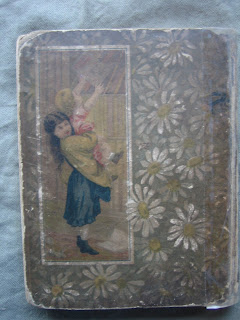
The pages of this book measure 14cm x 18.5cm. Oddly, the running titles are inconsistently laid out; occasionally the book’s title, “Evenings at Home.”, appears on the recto and the story’s title appears on the verso, but in other places this reverses. There’s no consistency to these changes, but I imagine they were a byproduct of the printing process (being post-1850, I presume the book was printed on a machine press--something I confess to know little about). There are no signatures, but the split binding (more on this below) shows 11 gatherings of 8 leaves apiece, suggesting the full sheets were folded in octavo when it was assembled. The cover has a color image of three children reading from a book; the back shows a young girl lifting a toddler up to grab a book from a shelf. The colors in both illustrations have faded considerably.


While there is no marginalia in the content of the book (with the exception of some meaningless pencil squiggles on the last page), there are three interesting features of note. The first is the inscription noted above. It appears on the recto of the first blank flyleaf and reads (in very elegant cursive): “Presented to Andrew Ritter, / by his Aunt, Kate Wright. / Dec. 25th 1883.” I’ve found numerous Andrew Ritters who would have been young boys at the time Aunt Kate gave this book as a Christmas gift, but there’s no way to know who (if any of them) might have owned this book. Regardless of which Andrew Ritter it was, he took fairly good care of it.


This is the second interesting feature, in fact: antiquarian children’s books are not hard to find--they were mass-produced in cheap formats on cheap paper; however, this very cheapness, combined with the often brutal (though loving) treatment they received from their intended owners, means most are in heavily marked-up and damaged condition. The only reader’s marks in this copy, however, are grubby fingerprints on almost every page. Also, the spine has split away, resulting in some looseness in the pages and a previous owner’s decision to use tape to hold the two boards on. 


But this splitting of the spine has resulted in the third interesting feature of the book’s physical character: when the book was bound, scrap paper from other publications was used (as was customary) to provide a core in the spine to which the book’s gatherings could be pasted. In this case, Routledge’s printer used two different stocks of scrap paper to bind “Godolphin’s” Evenings at Home, in Words of One Syllable. The outer layer is a discarded page from a hymnal (how would the pious Anna Barbauld feel about that?), the inner layer contains a scrap from a publisher’s advertisement, listing two books (one apparently an antebellum guide to the south and the other a travel guide to Manhatten Island).


No doubt by now the more astute reader of this blog (that is, both of the readers of this blog...) will have noticed that I have twice set the author’s name in quotation marks: “Mary Godolphin”. This is because the name is actually a pseudonym. The true author of not only this book but also the other single-syllable works published by Routledge noted above was Lucy Aikin (1781-1864), the daughter of John Aikin and niece of Anna Barbauld. Lucy obtained fame at the turn of the century as an author and an historian, her works spanning genres from children’s literature to English monarchical history and from French translations to contemporary biography (including biographies of her father and her aunt). She began writing for magazines and assisting her father on his magazine editing work when she was 17. Under the guidance of her father and her aunt (who was herself an outspoken education activist), Lucy read widely and deeply, becoming fluent in French, Italian, and Latin at an early age.


Between 1801 and 1870 she published 23 works, including 7 under the name of “Mary Godolphin” (all of these were her single-syllable adaptions). While she professed that her principle interest was in early education, the works for which she gained fame were her biographical studies of English monarchs Elizabeth I (1818), James I (1822), and Charles I (1833). She lived her entire life in Hampstead, England, where she was known as a highly proficient essayist, letter-writer, and debater; like the rest of her family, she was a devout Christian, worshipped in the Unitarian congregation, and was a great bibliophile, collecting a substantial library of her own. I can’t help but wonder, though, how Lucy Aikin would feel about seeing her Evenings at Home, in Words of One Syllable sitting idly behind a glass door on the shelf of a collector, rather than in the hands of a child.

Sunday, March 1, 2009

From a 91 BC Chinese manuscript to a 1759 London drama to a 2009 bibliophile's blog.


While attending a professional conference in Boston this weekend I paid my first visit to the Brattle Book Shop, which has been operating as a bookstore in Boston since 1825 and has been owned by the Gross family for the last sixty years. The Brattle has a terrific collection of affordable used books packed onto discount carts in the lot next to the building. Inside there are two floors of more higher-end used books and on the third floor one will find thousands of rare, antiquarian, and collectible volumes. The selection was eclectic and broad (which I love) and--on the third floor--priced within the assessed value range for most of the books (which I don’t love...what can I say, I’m cheap).


Among the books I picked up is this second edition of Arthur Murphy’s mid-18th century tragedy The Orphan of China, which 

was staged at the Theatre Royal in Drury Lane, London in 1759. The role of Zamti, “a Mandarine”, was played by the legendary Shakespearean actor David Garrick. Murphy’s play was popular enough to go through two editions in one year, both published by Paul Vaillant, whose shop was on the Strand near Southampton Street. The book sold for 1 shilling, 6 pence (the equivalent of $13 in today’s money; its actual assessed value today is $50-$100). The play was revived in 1772 and Vaillant released a third edition to coincide with the performance run; a fourth edition was published by W. Gilbert and H. Chamberlaine in 1787.


The pages of the book measure 13cm x 20cm with vertical chain-lines space approximately 3cm apart. There are no errors in pagination ([1]-88 on B1-G4 verso), though the running-titles occasionally read “The Orphan of China:” instead of the more frequent “The Orphan of China.” suggesting at least two skeleton-formes were used for the printing. The title page (A1) is unsigned, as is the second page of the dedication (A3) and the Epilogue (A4). While gathering A contains only 4 leaves, gatherings B through F are of 8 leaves (signed on the recto of the first four of each, with the exception of F3, which is unsigned). The final gathering (G) is only four leaves. Often the preliminary matter in plays (the title page, dedication, dramatis personae, etc.) was printed last -- after the body of the play had been printed; perhaps the four leaves signed as A in the book are actually the absent four leaves from G.


The contents of my copy include a blank modern flyleaf, followed by: the title page (A1) with a blank verso; the dedication (dated April 30, 1759, Lincoln’s Inn) to John, Earl of Bute, Groom of the Stole to his Royal Highness the Prince of Wales (A2-A3 recto; paginated “iv” on A2 verso and “v” on A3 recto); the Prologue (A3 verso) and Epilogue (A4 recto), written by Poet Laureate William Whitehead; the dramatis personae list and location identification (A4 verso); the play proper (B1-G4); and a blank modern flyleaf at the end. A Latin quotation from Virgil’s Aeneid (IX.v.474-8) appears on the title page. Fancy tiny figures are arranged in careful geometric patterns at key places in the book (at the start of the play proper, for example, between acts and at the end); they give the text a very exotic feel that corresponds to the exotic narrative and setting of the play itself (and to the “Orientalism” fad that was sweeping 18th century England). The only marginalia in my copy is an inked “5” at the center top of the title page (suggesting that the copy had once been bound fifth into a collection of other plays; the same ink may be responsible for the accidental spotting on the title page) and, in what might be the same hand, a series of (accurate) sums written in pencil in the outer margin of A3 recto. Aside from some tears in the margins of a few pages (none affecting the text) the copy is in excellent shape.


The play itself is, like most Georgian English tragedies, is sensationalist in plot and rhetorically florid in dialogue; the drama revolves around a fantastic dispossession and vengeance plot, coupled with sword fights, royal power struggles, and staged deaths. Murphy based his Orphan of China on a French translation (by Joseph Henri Marie de Prémare) of a Yuan Dynasty-era play published in a French work (Jean-Baptiste Du Halde’s 1735 Description géographique, historique...de l’empire de la Chine). The play, Tchao chi con ell (“The little orphan of the family of Tchao”) was also used by Voltaire for his 1755 Orphelin de la Chine and is generally recognized to be the first Chinese play staged in Europe (the Chinese original--The Great Revenge of the Orphan of Zhao Family--was itself based on an episode from The Records of the Grand Historian, also known simply as Shiji. Shiji is the first continuous historiographic narrative of China, an epic recounting of Chinese history from the age of the Yellow Emperor (ca. 2600 BC) through the age of the work’s author (Sima Qian) around 91 BC.


Though Voltaire and Murphy came to the drama from the same source (Prémare’s translation), there are many significant differences between Murphy’s version and Voltaire’s dramatization (Murphy actually wrote a letter to Voltaire after the French production and before staging his own).


Born in Ireland, Murphy (1727-1805) was a celebrated legal mind--as a lawyer, writer, and law review editor--who shaped many important cases in late 18th century London. He also wrote three biographies (of Samuel Johnson, Henry Fielding, and David Garrick), eighteen plays (of which The Orphan of China was his third), and numerous essays and poems (sometimes under the pseudonym of “Charles Ranger”).


Before I conclude this entry, I wanted to share a lesson that I learned from buying this book at Brattle: it's the old cliche about not judging a book by its cover. While browsing the shelves on the third floor I spent most of my time looking for “old” bindings (vellum, faded leather, etc.). But this book--in a very tight, immaculately plain full-calf with very simple gold embossed lines on the spine--is a reminder that, frequently, old texts are to be found in newer bindings; indeed, old texts that are very well taken care of are more likely to be in newer bindings. Just a cautionary tale for those browsers out there: don’t skip over the shiny spines for the decayed volumes with the boards pulling apart. You never know what you might miss.