Showing posts with label German. Show all posts

Sunday, June 28, 2009

Dr. Spitta's Contribution to One of the Longest Running Book Series Ever


Not too long ago my sister-in-law was on a professional trip to Zurich, Switzerland and, knowing of my bibliophilia, returned with a few gifts to add to Tarquin Tar’s Bookcase. This week’s book is one of those items.


Published in 1912 in Berlin and Leipzig by G. J. Göschen, the book is Das Deutsche Kirchenlied in seinen charactteristeschen Erscheinungen {German Church Music in Representative Examples} by University of Strasbourg professor of theology Dr. Friedrich Spitta (1852-1924), a noted Protestant preacher and scholar of Jewish descent. This particular copy is of volume one of Spitta’s study: “Mittelalter und Reformationszeit” {“Middle Ages and Reformation”}. Because the book was mass-produced as part of an educational series (see below), the title is not exceptionally rare, though I do notice that all of the dealers currently offering it for sale are located in Germany, so I suspect it is somewhat uncommon here in the United States.


The book is volume 602 in the prodigious Sammlung Göschen {Göschen Collection}, a series of pocket-sized books that was launched by the firm founded by the then-deceased publisher Viscount George Joachim Göschen (1752-1828) in 1889 for the express purpose of offering highly quality, durable books of German texts, edited by leading scholars of the day, and sold at a price (80 cents) that made them accessible for school use across Germany. The first ten volumes in the series focused on classic works of the German enlightenment; volume eleven introduced science to the mix (on astronomy, by A. F. Möbius, the mathematician who lent his name to the famed Möbius Strip geometric form) and the next year the popular series expanded to include a variety of fields, such as education, geology, psychology, mythology, and logic.


After the turn of the century, the series changed its mission from school use to use in the universities and the number of titles it offered increased exponentially, reaching 500 in 1910 and 1000 in 1931. After the turn of the century the series was acquired by publisher Walter de Gruyter (though the series name did not change) and continued to be issued into the mid-1990s. With an active production of new titles for over a century, the Sammlung Göschen is one of the longest-running scholarly series of books of the modern age. The series mission statement, as it appeared in volumes throughout the twentieth century (including this one), reads:


To present our current knowledge in short, clear, universally understood monographs. The purpose and objective of the Göschen Collection is to provide, in individual examples, a clear, easily understandable, and concise introduction to all areas of science and technology and to give, through close examination on a strictly scientific basis and taking into account the latest research, the most reliable information possible. Each topic is discrete, but all volumes possess an inner relationship with each other, so it is expected that the whole thing, when completed, will exist as a uniform, systematic presentation of all of our entire knowledge. 


Designed for the convenience of the student reader, the book is a slim volume, bound in durable tan cloth with inked titles, borders, and publisher’s device (an eagle standing over the letters “GJG”) on the cover. Its corners are rounded slightly, but this is from wear and not part of the book’s deliberate production. The pages measure 10cm x 15cm and are of a dull gloss, lightweight stock. As with most continental books, the signatures are numeric rather than (as they are in England and America) alphabetical. The collational formula may be expressed as 8o: [#] 18-98 [π]: $2 with the exception of gathering 1 in which the first leaf is not signed. The second leaf of each is signed with an asterisk (*) after the gathering number. On the inner lower corner of the initial page of each gathering is the name of the author and volume title -- something that, as I’ve noted previously, was no doubt meant as an aid to the printer in keeping sheets from multiple volumes in the same series from being confused.

This indicates, of course, that the printer was employed on more than one title at a time (which would probably have been necessitated by the series’ rapid dissemination of new titles). The initial leaf and ultimate leaf are conjugate directly with the endpapers pasted down inside the front and back covers respectively; the ultimate leaf is a blank fly and the initial is a catalog list advertising other related volumes in the series (the front cover’s paste-down has the series mission statement). Pages 128 and 129 have split apart somewhat, revealing that the gatherings were bound together with iron staples which have started to rust slightly and then were pasted down along their edge into the binding. Beginning with the title page [11r] the pagination runs throughout the book as [1] through 141 (on [97r]) with only p. 140 unmarked.

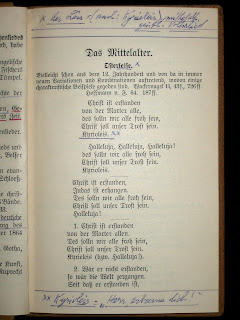
As the title indicates, the book is a collection of hymns and devotional songs of the early German church. Following a four page introduction in which Spitta summarizes the history of the use of music in German religious services, there is a chapter of 29 Catholic hymns from the Middle Ages. After this is the section on the Reformation hymnodists, which begins with a chapter presenting 20 hymns by Martin Luther, followed by chapters containing 42 hymns from 19 other German theologians and musicians as well as from several different traditions (including “The Könisberger Songs” and “Mart Gras Songs”). Several of the Catholic hymns are in Latin; all of the Protestant hymns are in German. Throughout, Spitta provides brief explanatory remarks before some of the verses to set them into their context and brief biographical paragraphs on the writers; he also frequently cites other scholarly works (including his own) for further reading. At the end there is an index of hymns by first lines.


One of the reasons my sister-in-law thought I’d like this book is because of my interest in marginalia. My copy has been closely read and used for its scholarly purposes by a very conscientious reader. Up until p. 57 nearly every page has been carefully marked with either red ink or blue ink (or both) to underline or box in specific passages. The same reader has used a system of “x” marks within the text (or “xx” on pages with more than one annotation) to refer to marginal glosses he or she has added. These glosses provide German translations of specific Latin words with which the reader was evidently unfamiliar and, in some cases, suggests cross-references to other hymns or composers in the book. What strikes me most about this marginalia is its intense precision; usually readers marking in a book tend to be casual (they’re readers, after all, not writers) and even when making notations to aid future readings they’re often only leisurely about aligning their marks (especially if they are college students). This reader, though, uses a tidy system of notation and clearly used a straight-edge for all the underlining and boxing.


There is even a deliberate switch between blue and red ink in the markings: based on how the two colors line up when they are used it is clear that they were both added by one reader and at one time, which meant the reader had a particular reason (indiscernible to me, alas) for using blue ink or red ink in marking the text at particular places. The only place where both inks underline a phrase is the first two words of Luther’s “Der Glaube zu deutsch” {The Faith of the German”} on page 50, of which the first line reads “Wir glauben all an einen Gott” {“We all believe in one God”}. Likewise, some of the marks used to draw attention to various passages differ from single underlines to double underlines, single marginal lines to double marginal lines, and in some places text boxes.


Of course, this is one of the reasons I enjoy browsing through old books -- they don’t only provide evidence of how their authors wrote or their makers printed but they are also our best (and often only) real evidence of how readers before us read, thought about, and responded to the ideas they contain. But, as the Deutsche Kirchenlied reader’s switching between red ink and blue or his seemingly arbitrary use of underlining in some places and text boxes in others reminds me, no matter how much evidence these readers’ marks offer up, their system of codes and their purposeful selectivity always leave incredible gaps. These silences compel us to accept that we and our readerly forerunners have only this miniscule connection -- as thin and fragile as the sheets of paper on which the book is printed -- and we will never have, nor should we worry ourselves too much in trying to find, all the answers about the readers who have come before us. We, too, will someday be mysteries to those who in a hundred years read the same books that we have read -- people who, like us, will struggle to catch just a fleeting glimpse of their predecessors in the margins of our books.


Sunday, May 17, 2009

Learning to Speak Proper English...Goldsmith-Style


As mentioned in a previous posting, one of my favorite bookstores in the Amherst area is Valley Books. According to the local paper, Valley Books will, after 34 years, be closing its store in July and switching entirely to online sales only. I understand the economic necessity of this, but will miss having the chance to wander aimlessly through their stacks, coming away with a small haul of treasures for myself and family members. Wandering stores that sell new books is sterile compared to wandering used book stores (and I say this as someone who has worked as a manager in a new book store); the nearly infinite range of opportunities, of stumbling across a neglected treasure, of purely random browsing rely upon having a store like Valley Books -- not in a searchable online format, but in the real, material sense.


One of the most important changes in our society as we shift to digital, web-based retail services is that we’ve become increasingly close-minded in understanding our own wants. I say “close-minded” not in the sense of “ignorance” but in the sense of being blind to associative connections between objects and the possibility of unregulated discovery. Some website features, such as Amazon’s “Customers who bought this also bought....” box, attempt to emulate the feeling of browsing in a store, but these are, ironically, restrictive in their universality, suggesting that my individual tastes as a reader are identical to everyone else’s or that I would like them to be identical (though I suppose that by commodifying our tastes like this, corporations can more easily manipulate our consumer demands); perhaps the closest things to random discovery online is the StumbleUpon application, but even this is -- like ads on Google, Facebook, or Hulu -- tailored to the user’s “preferences” and relies upon user feedback for its site aggregation and hierarchization. Paradoxically, while the Internet opens up access to a world’s-worth of information and materials, it demands that we move linearly, orderly, and teleologically in order to realize that access 


This is on top of the fact that random browsing -- truly random browsing and not the carefully cued consumer manipulation of the “Customers who bought this...” box -- works upon the premise of the unknown (as opposed to web-searches, which, again ironically, work strictly upon the premise of the exactly known). And from that sense of the unknown, that sense of the possibility of completely unique discovery, comes the joy of browsing a used books store.


But now to contradict my curmudgeonly digression... For this week’s book I’m going to take a look at a volume that I purchased through that den of bibliographical risk: eBay.


This book is Irish essayist, physician, poet, dramatist, and novelist Oliver Goldsmith’s classic sentamentalist tale The Vicar of Wakefield, “The First Edition. With Accents.” That period after “Edition” is misleading because, of course, this is not the true first edition (which appeared in 1766, four years after Goldsmith finished writing it). This edition was published in Halle, Germany in 1787 and includes accent markings (not unlike the pronunciation markings I’ve written on previously) intended to help a reader share the work aloud. Several other sites online, including libraries and dealers, confuse the word “Halle” on the book’s title page with the name of the publisher and wrongly ascribe the publication location to London, probably because the book is in English and the true first edition was published in that city by Francis Newbery; this error is significant if my theory on the reason for the inclusion of accent marks (below) is true. The book was printed and sold by Friedrich Daniel Francke. Its assessed value is between $100 and $150.


As the title page claims, this is the “first edition” of the novel to use accents, but this is somewhat misleading as it was also the only edition to do so. I can find no information as to why Francke published the book “with accents” or who supplied the markings, but given that it was published in Germany it seems likely that the intention was for readers to use the book as a language development tool. Native German speakers who were acquiring a proficiency in English could use the book as a guide to inflections, with the added benefit of reading and becoming familiar with one of the most popular novels in England at the time. My suspicions may be confirmed by the intriguing marginalia in my copy (on which more below).


The book is bound in half-brown leather with brown paper pasted over the boards; on the spine there are five raised bands, the title, and some elegant floral tooling, all of which has faded considerably. As usual, the top edge of the spine is flaring a bit from being pulled from the shelf over the last 220 years. In addition, the paper on the boards is heavily worn away, particularly in the spots along the front edge where a reader’s hand would hold the volume open. This is just one piece of evidence, amongst many, that reveals that this particular book was much used in its day. There are a total of 164 leaves in the book; its collational formula may be expressed as 8o: [#][a1]-[a6]A1-[U4][ϗ]; $5. Some dealers online list the book as 12o, which is incorrect. The catchwords across the sheets and the pagination are consistent, which suggests Francke’s shop was competent in its craftsmanship; the use of “a” for the initial gathering’s signature, followed by “A” for the second gathering, shows that -- as was usual practice -- the first gathering of preliminaries for the book was printed last. The lack of the final two leaves of gathering “a”, combined with the presence of a cancellans stub between [a6] and A1 suggests that leaf [#] was actually part of sheet “a” (leaf a7 or a8). Each leaf measures 4in x 7in, with four vertical chain-lines separated by 1in each; the paper is rag linen typical of the period, with no evident watermarks. The final leaf is evidently an insertion as the paper is substantively different from the rest of the book and the six chain-lines run horizontally, separated by 1in; the edge of an unidentifiable watermark is just visible along the outer edge of the page.


 The book begins with an initial flyleaf blank on the recto and with a print, on the verso, of the vicar, Dr. Primrose, coming across a rural couple making out on a pile of hay. Gathering “a” is paginated as [I]-XII. The unsigned a1 presents the title page on the recto (with a rather dramatic print of Burchell rescuing Sophia from drowning); a2r-v is the author’s “Advertisement”, which lacks the accents used in the rest of the book; a3-[a6] provide the “Contents” of the chapters (again, without accents). The novel itself runs from A1-[U4] and is paginated 1-312; the bottom portion of U4v contains a daunting paragraph of “Errata”, nearly all of which correct errors in the placement or style of accents rather than actual readings in the book, indicating that the volume was carefully proofed at the print-shop by whoever it was that added the accents (a dashed pen mark through the errata list shows that a reader knew to read it first and take its instructions into account before or while reading the book; the mark was made as a reminder to the reader that he or she had checked the passages listed and, indeed, an inspection of the words cited in the errata list shows that, throughout the book, the same ink that made the dashed line has quietly made all the corrections called for by the list). The final leaf ([ϗ]) is blank on both sides and, as noted above, was an addition to the volume prior to binding.


Goldsmith's novel is in the manner of a fictitious memoir (hence the subtitle, “A Tale, Supposed to be written by Himself”) and was one of the most popular novels of the early nineteenth century. It was particularly influential amongst other writers, many of whom either directly or indirectly referenced it in their own novels (Jane Austen, Charles Dickens, George Eliot, Mary Shelley, Charlotte Brontë, Louisa May Alcott, and Johann Wolfgang van Goethe all mention it in their works). While the plot is likely to strike many modern readers as romantic melodrama typical of the period, there is a heavy undercurrent of satiric humor that casual readers often overlook; in addition, Goldsmith innovated in his use of non-narrative literary forms within the book in order to expand beyond the limitations occasioned by the book’s first-person point-of-view (these include devices such as poems and sermons).


According to Washington Irving’s Oliver Goldsmith: a Biography, Goldsmith (1730-1774; shown here) had no intention of publishing the work but, having been arrested by his landlady for failure to pay his rent, he eventually gave the manuscript to his friend Dr. Samuel Johnson, who on his behalf sold it to a stationer for sixty pounds. (Interesting side note: the stationer was Francis Newbery, whose uncle, John, is credited with first making children’s literature a sustainable part of the English book trade and after whom the famed Newbery Medal is named.)


As noted above, this copy has been well-read: the peeling and wearing of the paper on the boards corresponds to where a hand would hold it open, there are an abundance of fingerprints and grubby smudges on many of the pages, page-corners in places show creases from having been turned-down, and there is marginalia from several different hands throughout.


On the inside of the front cover a thick brown ink has written:


G.C.M. 1790

29t. Nov


Below that the same ink and hand has scribbled “36” and a series of carefully scribed letters in gothic black letter that seem to read “H Smith”. Running perpendicular beneath this, in carefully formed pencil, are another set of gothic letters that seem to spell the same thing. An owner previous to this also used the inside of the front cover for a set of mathematic figures. A fainter ink, and different hand, has written “Grey” (“Greof”? “Gres”?) here as well.


There are at least three, or possibly four, hands that occur throughout the book. One of these is incredibly faint, in pale pencil, and can barely be seen making illegible marginal and interlinear annotations only occasionally; it was also used to signal readerly boredom in some places, tracing and shading letters faintly on some pages (including the word “Wakefield” on the title page). It first appears in the form of an illegible caption written beneath the illustration facing the title page. In other places it has underlined a word and offered a (now illegible) note in the margin, usually of about one word in length and thus suggesting a translation or synonymic gloss.


Another hand is in a darker ink and first appears with the inscription “Henry and Mariae von” beneath the title page illustration. This ink (or one similar to it) appears frequently in the book (mostly within the first 120 pages), marking crosses next to passages (perhaps place-holders; some of them include the word “Hier”, which is German for “here”), underlining words, and making notes in the margins. Most of these notes appear to be vocabulary-related, providing synonymic glosses for some words and, in many cases, German equivalents for Goldsmith’s words (it took me some time to figure out why I couldn’t understand any of the transcriptions I was making from the annotations; only after I returned to write up the book’s publication origin -- noted above -- did it occur to me that the language was not English). The same hand appears doing the same thing, but in a lighter ink, in many passages (some of the same ones where the darker ink was used).


Another hand appears only once in the book (as far as I can tell) and suggests that, if the volume was indeed in Germany in the last decade of the eighteenth century, it was possibly in this country approximately a century later. In the upper margin of page 25, a cursive English hand has written in pencil: “John Smith April 6th 1893”. Perhaps John was related to the “H Smith” whose name appears on the inside of the front cover. Given the Anglicized name and the use of the American date format, I suspect that by the last decade of the nineteenth the book had made its way to the United States (or, at least, into the hands of an American owner).


Needless to say, the name “John Smith” is a ridiculously difficult one to trace historically, and so the knowable provenance of this particular book will have to end where I began this post: in the muddled world of online book sales, from whence -- via “Father Landson” of Texas -- it has come to reside in Tarquin Tar’s Bookcase.