Showing posts with label marginalia. Show all posts

Sunday, August 29, 2010

Breaking the Rules in Buckfield, Maine


One of the three cornerstones for evaluating the worth of a collectible book is condition (the other two being scarcity and importance). As I’ve written quite often in this blog, the idea of “condition” means different things to different collectors; for someone interested in owning the ideal original form of the book in pristine condition, any mark whatsoever instantly devalues the book (with the possible exception of association value from the author’s signature). For someone -- like me -- interested in the life of a book (that is, in the way it has been used and abused in the years after its appearance in it original form) markings in a book, while taking it down a notch in “condition”, actually increase its value. They connect us with real people, past owners and readers, through the indirect experience of seeing how they saw the book in our hands.


Children’s books are often short-lived material objects; those that do survive tend to bear extremely vigorous wear, tear, damage, and markings (I hesitate to call these markings “marginalia”). As my fiancée gets ready for the start of the school year this weekend and prepares her new first-grade classroom, this week’s book seems appropriate.


The book is a heavily used copy of The Heath Readers Primer, published by D. C. Heath & Company of Boston (Heath, a leading publisher of educational materials since the late nineteenth century, was acquired by Houghton Mifflin in 1995). The first twelve pages of the book -- including the title-page -- have been torn out (as well as several internal pages and the last twenty-two pages), but using Google Books I was able to find a whole copy of the book. It was published as the first part of Heath’s “Readers” series of schoolbooks in 1903; the rest of the series included readers for first through sixth grades.


Sentence-based primers such as the Heath Readers appeared in the early 1880s and remained popular into the 1920s. They were seen as a useful tool in promoting silent reading opportunities that helped students make connections between the words they were encountering and the meaning of those words (prior to the 1880s, early school readers emphasized individual words and sounds in isolation). A leading proponent of the new system, with its emphasis upon sentences and stories, was Harvard President Charles Eliot (whom we have met, previously, in my post on his famous “Five Foot Shelf” of literature). For a clear and well-illustrated guide to the history of early educational literature in America (1640-1925), visit the Monaghan Collection and University of Kansas 2001 joint-project Young American Readers.


Each page of the Primer contains a series of simple sentences using repeated syntactical structures and words. The content of each sentence is often linked to those around it, creating a network of parallelisms, antitheses, and pseudo-narratives that provide a window into the kinds of popular and epistemological ideologies that were being promoted through the turn-of-the-century American school. Consider, for example, the non-negotiable gender instructions on p. 22 (“Girls like to play with dolls. Boys like to fly kites.”) and on p. 90 (after Fred lands a fish and drops his line again over the side of the boat, we are told simply, “Nell does not care to fish.”). On p. 88 the duty of the boy to protect the girl is made explicit (“The little girl is May.... Is it safe for her to be alone? She will not be alone long. Fred is coming to her.”). Much of the book is concerned with the activities of Fred and Nell, who are brother and sister; their content emphasizes cooperation, sharing, and kindness.


It was intended (or at least, assumed) by the writers of the book that boys would make up its main readership: “Have you a little sister?” the disembodied voice of the narrator asks, “Are you kind to her?” (p. 32) Some of the text seems a little too figurative at times; I would think that passages such as “This is Fred’s horse and wagon. Fred’s horse is a goat. The goat makes a good horse.” (p. 87) might be a tad risky for children still working to master “I am a big boy. My name is Fred.” (p. 22) Also, as a new dog owner, I’m not sure I can condone the way Fred encourages his dog, Dash, to beg for meat (pp. 37-8). What kind of lesson does that teach the dog, let alone the child reading the book?


The book is bound in cardboard boards in cloth; a colored illustration (now faded and over-written) decorates the front cover. The cover of my copy is intensely damaged and the spine is essentially gone. The pages are 13.5 cm x 19.5 cm and are of an unexceptional machined stock. It was printed in octavo format. Beside the text of the sentences, most pages also include black-and-white illustrations relevant to the content on that page; in the latter half of the book, the illustrations are often replaced with photographs that provide intriguing vignettes and glimpses into the early twentieth-century context in which these children grew up (livestock, hoops, blacksmiths, etc.). Several of the pages have (or rather, had) color illustrations; most of these have been torn out of my copy. Some of the black-and-white art has been subsequently colored-in (rather imaginatively) by past readers (such as the blue and yellow cows on p. 80).


Two other aspects of the text bear noting. Some of the early pages (again, many that have been torn from my copy) introduce the subjects of the ensuing pages with a page providing color illustrations immediately next to text in cursive font (the font on the other pages is block printing). Also, to help the reader focus on key words, a series of three or four words appears along the bottom of each page; these footer words are from the text and are essentially the learning objectives for that page.


As I’ve mentioned, my copy of this book has been heavily used in its time. Simply saying “heavily read” would be insufficient: the pages are torn and worn from being turned over, but throughout there are scribbles that indicate how the student(s) who used this book approached the task of learning how to read and write.


These marks mainly take one of three forms. First, some of the footer words are underlined, suggesting that they were used like a check-list: once the student had found that word in the text and learned how to use it properly, they put a line under it in the foot. A similar system of marks in the text itself appears on some pages, with certain words underlined as if to draw attention to them, and even a few broken into syllables by vertical lines. Second, wave-like squiggles cross many pages, often interlined between the text; these are attempts at linked cursive minims -- essentially, the student is mimicking the motion of a writer that he or she is watching (suggesting that the book was being used in the presence of a teacher or some other adult who was modeling how to write). Finally, there are a number of places where the student has copied the printed text (more or less successfully) into one of the blank spaces on the page, usually between the lines.


There is, of course, an abundance of other markings in the book. Some are in pencil, some in pen, and some in crayon. They range from single “orphan” words that seem to be unrelated to the printed book to attempts to copy out the whole alphabet (including a complete set of cursive majuscules and minuscules in pencil inside the back cover) to the usual doodles and nonsensical scribbles made by all bored students, of all ages.


This copy was part of the school library in the small Maine town of Buckfield, located in Oxford County, about ten miles north of Lewiston-Auburn. I was amused to find that Buckfield’s town slogan is the vaguely threatening, “Where Good People Live”. What happens to the bad people?


Pasted inside the front cover are a list of “Rules” (printed by Lee and Shepard of Boston) for the use of library books, including the usual warnings about lending items (and a reminder that the town imposes a ten-dollar fine on parents of children who damage school buildings by inscribing “obscene pictures, language, marks, or descriptions” on them). One of the rules concerns the problem of damaging the book:


Any writing in, marking upon, or otherwise defacing of a book, will be considered a material injury, for which such book must be replaced or paid for.


The use of the phrase “material injury” personifies the book and implies that damaging it would be like harming a person. But, of course, the intended readers of this book are unlikely to read -- or, at least, read and understand -- the tiny print legalese on this pasted label. They’re still working on


Look at my feet. I swim with my feet. Look at the chicken’s feet. They are not like my feet. Chickens cannot swim.


So it’s not surprising that a healthy dose of scribbling, ink spills, and doodles have been scrawled across the inside of the front cover. Including across the “Rules”. So much for the town slogan.


Sunday, June 28, 2009

Dr. Spitta's Contribution to One of the Longest Running Book Series Ever


Not too long ago my sister-in-law was on a professional trip to Zurich, Switzerland and, knowing of my bibliophilia, returned with a few gifts to add to Tarquin Tar’s Bookcase. This week’s book is one of those items.


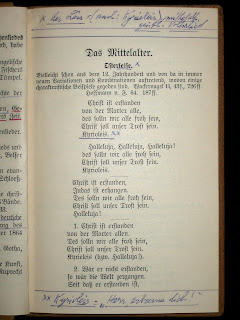
Published in 1912 in Berlin and Leipzig by G. J. Göschen, the book is Das Deutsche Kirchenlied in seinen charactteristeschen Erscheinungen {German Church Music in Representative Examples} by University of Strasbourg professor of theology Dr. Friedrich Spitta (1852-1924), a noted Protestant preacher and scholar of Jewish descent. This particular copy is of volume one of Spitta’s study: “Mittelalter und Reformationszeit” {“Middle Ages and Reformation”}. Because the book was mass-produced as part of an educational series (see below), the title is not exceptionally rare, though I do notice that all of the dealers currently offering it for sale are located in Germany, so I suspect it is somewhat uncommon here in the United States.


The book is volume 602 in the prodigious Sammlung Göschen {Göschen Collection}, a series of pocket-sized books that was launched by the firm founded by the then-deceased publisher Viscount George Joachim Göschen (1752-1828) in 1889 for the express purpose of offering highly quality, durable books of German texts, edited by leading scholars of the day, and sold at a price (80 cents) that made them accessible for school use across Germany. The first ten volumes in the series focused on classic works of the German enlightenment; volume eleven introduced science to the mix (on astronomy, by A. F. Möbius, the mathematician who lent his name to the famed Möbius Strip geometric form) and the next year the popular series expanded to include a variety of fields, such as education, geology, psychology, mythology, and logic.


After the turn of the century, the series changed its mission from school use to use in the universities and the number of titles it offered increased exponentially, reaching 500 in 1910 and 1000 in 1931. After the turn of the century the series was acquired by publisher Walter de Gruyter (though the series name did not change) and continued to be issued into the mid-1990s. With an active production of new titles for over a century, the Sammlung Göschen is one of the longest-running scholarly series of books of the modern age. The series mission statement, as it appeared in volumes throughout the twentieth century (including this one), reads:


To present our current knowledge in short, clear, universally understood monographs. The purpose and objective of the Göschen Collection is to provide, in individual examples, a clear, easily understandable, and concise introduction to all areas of science and technology and to give, through close examination on a strictly scientific basis and taking into account the latest research, the most reliable information possible. Each topic is discrete, but all volumes possess an inner relationship with each other, so it is expected that the whole thing, when completed, will exist as a uniform, systematic presentation of all of our entire knowledge. 


Designed for the convenience of the student reader, the book is a slim volume, bound in durable tan cloth with inked titles, borders, and publisher’s device (an eagle standing over the letters “GJG”) on the cover. Its corners are rounded slightly, but this is from wear and not part of the book’s deliberate production. The pages measure 10cm x 15cm and are of a dull gloss, lightweight stock. As with most continental books, the signatures are numeric rather than (as they are in England and America) alphabetical. The collational formula may be expressed as 8o: [#] 18-98 [π]: $2 with the exception of gathering 1 in which the first leaf is not signed. The second leaf of each is signed with an asterisk (*) after the gathering number. On the inner lower corner of the initial page of each gathering is the name of the author and volume title -- something that, as I’ve noted previously, was no doubt meant as an aid to the printer in keeping sheets from multiple volumes in the same series from being confused.

This indicates, of course, that the printer was employed on more than one title at a time (which would probably have been necessitated by the series’ rapid dissemination of new titles). The initial leaf and ultimate leaf are conjugate directly with the endpapers pasted down inside the front and back covers respectively; the ultimate leaf is a blank fly and the initial is a catalog list advertising other related volumes in the series (the front cover’s paste-down has the series mission statement). Pages 128 and 129 have split apart somewhat, revealing that the gatherings were bound together with iron staples which have started to rust slightly and then were pasted down along their edge into the binding. Beginning with the title page [11r] the pagination runs throughout the book as [1] through 141 (on [97r]) with only p. 140 unmarked.


As the title indicates, the book is a collection of hymns and devotional songs of the early German church. Following a four page introduction in which Spitta summarizes the history of the use of music in German religious services, there is a chapter of 29 Catholic hymns from the Middle Ages. After this is the section on the Reformation hymnodists, which begins with a chapter presenting 20 hymns by Martin Luther, followed by chapters containing 42 hymns from 19 other German theologians and musicians as well as from several different traditions (including “The Könisberger Songs” and “Mart Gras Songs”). Several of the Catholic hymns are in Latin; all of the Protestant hymns are in German. Throughout, Spitta provides brief explanatory remarks before some of the verses to set them into their context and brief biographical paragraphs on the writers; he also frequently cites other scholarly works (including his own) for further reading. At the end there is an index of hymns by first lines.


One of the reasons my sister-in-law thought I’d like this book is because of my interest in marginalia. My copy has been closely read and used for its scholarly purposes by a very conscientious reader. Up until p. 57 nearly every page has been carefully marked with either red ink or blue ink (or both) to underline or box in specific passages. The same reader has used a system of “x” marks within the text (or “xx” on pages with more than one annotation) to refer to marginal glosses he or she has added. These glosses provide German translations of specific Latin words with which the reader was evidently unfamiliar and, in some cases, suggests cross-references to other hymns or composers in the book. What strikes me most about this marginalia is its intense precision; usually readers marking in a book tend to be casual (they’re readers, after all, not writers) and even when making notations to aid future readings they’re often only leisurely about aligning their marks (especially if they are college students). This reader, though, uses a tidy system of notation and clearly used a straight-edge for all the underlining and boxing.


There is even a deliberate switch between blue and red ink in the markings: based on how the two colors line up when they are used it is clear that they were both added by one reader and at one time, which meant the reader had a particular reason (indiscernible to me, alas) for using blue ink or red ink in marking the text at particular places. The only place where both inks underline a phrase is the first two words of Luther’s “Der Glaube zu deutsch” {The Faith of the German”} on page 50, of which the first line reads “Wir glauben all an einen Gott” {“We all believe in one God”}. Likewise, some of the marks used to draw attention to various passages differ from single underlines to double underlines, single marginal lines to double marginal lines, and in some places text boxes.


Of course, this is one of the reasons I enjoy browsing through old books -- they don’t only provide evidence of how their authors wrote or their makers printed but they are also our best (and often only) real evidence of how readers before us read, thought about, and responded to the ideas they contain. But, as the Deutsche Kirchenlied reader’s switching between red ink and blue or his seemingly arbitrary use of underlining in some places and text boxes in others reminds me, no matter how much evidence these readers’ marks offer up, their system of codes and their purposeful selectivity always leave incredible gaps. These silences compel us to accept that we and our readerly forerunners have only this miniscule connection -- as thin and fragile as the sheets of paper on which the book is printed -- and we will never have, nor should we worry ourselves too much in trying to find, all the answers about the readers who have come before us. We, too, will someday be mysteries to those who in a hundred years read the same books that we have read -- people who, like us, will struggle to catch just a fleeting glimpse of their predecessors in the margins of our books.


Sunday, May 17, 2009

Learning to Speak Proper English...Goldsmith-Style


As mentioned in a previous posting, one of my favorite bookstores in the Amherst area is Valley Books. According to the local paper, Valley Books will, after 34 years, be closing its store in July and switching entirely to online sales only. I understand the economic necessity of this, but will miss having the chance to wander aimlessly through their stacks, coming away with a small haul of treasures for myself and family members. Wandering stores that sell new books is sterile compared to wandering used book stores (and I say this as someone who has worked as a manager in a new book store); the nearly infinite range of opportunities, of stumbling across a neglected treasure, of purely random browsing rely upon having a store like Valley Books -- not in a searchable online format, but in the real, material sense.


One of the most important changes in our society as we shift to digital, web-based retail services is that we’ve become increasingly close-minded in understanding our own wants. I say “close-minded” not in the sense of “ignorance” but in the sense of being blind to associative connections between objects and the possibility of unregulated discovery. Some website features, such as Amazon’s “Customers who bought this also bought....” box, attempt to emulate the feeling of browsing in a store, but these are, ironically, restrictive in their universality, suggesting that my individual tastes as a reader are identical to everyone else’s or that I would like them to be identical (though I suppose that by commodifying our tastes like this, corporations can more easily manipulate our consumer demands); perhaps the closest things to random discovery online is the StumbleUpon application, but even this is -- like ads on Google, Facebook, or Hulu -- tailored to the user’s “preferences” and relies upon user feedback for its site aggregation and hierarchization. Paradoxically, while the Internet opens up access to a world’s-worth of information and materials, it demands that we move linearly, orderly, and teleologically in order to realize that access 


This is on top of the fact that random browsing -- truly random browsing and not the carefully cued consumer manipulation of the “Customers who bought this...” box -- works upon the premise of the unknown (as opposed to web-searches, which, again ironically, work strictly upon the premise of the exactly known). And from that sense of the unknown, that sense of the possibility of completely unique discovery, comes the joy of browsing a used books store.


But now to contradict my curmudgeonly digression... For this week’s book I’m going to take a look at a volume that I purchased through that den of bibliographical risk: eBay.


This book is Irish essayist, physician, poet, dramatist, and novelist Oliver Goldsmith’s classic sentamentalist tale The Vicar of Wakefield, “The First Edition. With Accents.” That period after “Edition” is misleading because, of course, this is not the true first edition (which appeared in 1766, four years after Goldsmith finished writing it). This edition was published in Halle, Germany in 1787 and includes accent markings (not unlike the pronunciation markings I’ve written on previously) intended to help a reader share the work aloud. Several other sites online, including libraries and dealers, confuse the word “Halle” on the book’s title page with the name of the publisher and wrongly ascribe the publication location to London, probably because the book is in English and the true first edition was published in that city by Francis Newbery; this error is significant if my theory on the reason for the inclusion of accent marks (below) is true. The book was printed and sold by Friedrich Daniel Francke. Its assessed value is between $100 and $150.


As the title page claims, this is the “first edition” of the novel to use accents, but this is somewhat misleading as it was also the only edition to do so. I can find no information as to why Francke published the book “with accents” or who supplied the markings, but given that it was published in Germany it seems likely that the intention was for readers to use the book as a language development tool. Native German speakers who were acquiring a proficiency in English could use the book as a guide to inflections, with the added benefit of reading and becoming familiar with one of the most popular novels in England at the time. My suspicions may be confirmed by the intriguing marginalia in my copy (on which more below).


The book is bound in half-brown leather with brown paper pasted over the boards; on the spine there are five raised bands, the title, and some elegant floral tooling, all of which has faded considerably. As usual, the top edge of the spine is flaring a bit from being pulled from the shelf over the last 220 years. In addition, the paper on the boards is heavily worn away, particularly in the spots along the front edge where a reader’s hand would hold the volume open. This is just one piece of evidence, amongst many, that reveals that this particular book was much used in its day. There are a total of 164 leaves in the book; its collational formula may be expressed as 8o: [#][a1]-[a6]A1-[U4][ϗ]; $5. Some dealers online list the book as 12o, which is incorrect. The catchwords across the sheets and the pagination are consistent, which suggests Francke’s shop was competent in its craftsmanship; the use of “a” for the initial gathering’s signature, followed by “A” for the second gathering, shows that -- as was usual practice -- the first gathering of preliminaries for the book was printed last. The lack of the final two leaves of gathering “a”, combined with the presence of a cancellans stub between [a6] and A1 suggests that leaf [#] was actually part of sheet “a” (leaf a7 or a8). Each leaf measures 4in x 7in, with four vertical chain-lines separated by 1in each; the paper is rag linen typical of the period, with no evident watermarks. The final leaf is evidently an insertion as the paper is substantively different from the rest of the book and the six chain-lines run horizontally, separated by 1in; the edge of an unidentifiable watermark is just visible along the outer edge of the page.


 The book begins with an initial flyleaf blank on the recto and with a print, on the verso, of the vicar, Dr. Primrose, coming across a rural couple making out on a pile of hay. Gathering “a” is paginated as [I]-XII. The unsigned a1 presents the title page on the recto (with a rather dramatic print of Burchell rescuing Sophia from drowning); a2r-v is the author’s “Advertisement”, which lacks the accents used in the rest of the book; a3-[a6] provide the “Contents” of the chapters (again, without accents). The novel itself runs from A1-[U4] and is paginated 1-312; the bottom portion of U4v contains a daunting paragraph of “Errata”, nearly all of which correct errors in the placement or style of accents rather than actual readings in the book, indicating that the volume was carefully proofed at the print-shop by whoever it was that added the accents (a dashed pen mark through the errata list shows that a reader knew to read it first and take its instructions into account before or while reading the book; the mark was made as a reminder to the reader that he or she had checked the passages listed and, indeed, an inspection of the words cited in the errata list shows that, throughout the book, the same ink that made the dashed line has quietly made all the corrections called for by the list). The final leaf ([ϗ]) is blank on both sides and, as noted above, was an addition to the volume prior to binding.


Goldsmith's novel is in the manner of a fictitious memoir (hence the subtitle, “A Tale, Supposed to be written by Himself”) and was one of the most popular novels of the early nineteenth century. It was particularly influential amongst other writers, many of whom either directly or indirectly referenced it in their own novels (Jane Austen, Charles Dickens, George Eliot, Mary Shelley, Charlotte Brontë, Louisa May Alcott, and Johann Wolfgang van Goethe all mention it in their works). While the plot is likely to strike many modern readers as romantic melodrama typical of the period, there is a heavy undercurrent of satiric humor that casual readers often overlook; in addition, Goldsmith innovated in his use of non-narrative literary forms within the book in order to expand beyond the limitations occasioned by the book’s first-person point-of-view (these include devices such as poems and sermons).


According to Washington Irving’s Oliver Goldsmith: a Biography, Goldsmith (1730-1774; shown here) had no intention of publishing the work but, having been arrested by his landlady for failure to pay his rent, he eventually gave the manuscript to his friend Dr. Samuel Johnson, who on his behalf sold it to a stationer for sixty pounds. (Interesting side note: the stationer was Francis Newbery, whose uncle, John, is credited with first making children’s literature a sustainable part of the English book trade and after whom the famed Newbery Medal is named.)


As noted above, this copy has been well-read: the peeling and wearing of the paper on the boards corresponds to where a hand would hold it open, there are an abundance of fingerprints and grubby smudges on many of the pages, page-corners in places show creases from having been turned-down, and there is marginalia from several different hands throughout.


On the inside of the front cover a thick brown ink has written:


G.C.M. 1790

29t. Nov


Below that the same ink and hand has scribbled “36” and a series of carefully scribed letters in gothic black letter that seem to read “H Smith”. Running perpendicular beneath this, in carefully formed pencil, are another set of gothic letters that seem to spell the same thing. An owner previous to this also used the inside of the front cover for a set of mathematic figures. A fainter ink, and different hand, has written “Grey” (“Greof”? “Gres”?) here as well.


There are at least three, or possibly four, hands that occur throughout the book. One of these is incredibly faint, in pale pencil, and can barely be seen making illegible marginal and interlinear annotations only occasionally; it was also used to signal readerly boredom in some places, tracing and shading letters faintly on some pages (including the word “Wakefield” on the title page). It first appears in the form of an illegible caption written beneath the illustration facing the title page. In other places it has underlined a word and offered a (now illegible) note in the margin, usually of about one word in length and thus suggesting a translation or synonymic gloss.


Another hand is in a darker ink and first appears with the inscription “Henry and Mariae von” beneath the title page illustration. This ink (or one similar to it) appears frequently in the book (mostly within the first 120 pages), marking crosses next to passages (perhaps place-holders; some of them include the word “Hier”, which is German for “here”), underlining words, and making notes in the margins. Most of these notes appear to be vocabulary-related, providing synonymic glosses for some words and, in many cases, German equivalents for Goldsmith’s words (it took me some time to figure out why I couldn’t understand any of the transcriptions I was making from the annotations; only after I returned to write up the book’s publication origin -- noted above -- did it occur to me that the language was not English). The same hand appears doing the same thing, but in a lighter ink, in many passages (some of the same ones where the darker ink was used).


Another hand appears only once in the book (as far as I can tell) and suggests that, if the volume was indeed in Germany in the last decade of the eighteenth century, it was possibly in this country approximately a century later. In the upper margin of page 25, a cursive English hand has written in pencil: “John Smith April 6th 1893”. Perhaps John was related to the “H Smith” whose name appears on the inside of the front cover. Given the Anglicized name and the use of the American date format, I suspect that by the last decade of the nineteenth the book had made its way to the United States (or, at least, into the hands of an American owner).


Needless to say, the name “John Smith” is a ridiculously difficult one to trace historically, and so the knowable provenance of this particular book will have to end where I began this post: in the muddled world of online book sales, from whence -- via “Father Landson” of Texas -- it has come to reside in Tarquin Tar’s Bookcase.


Sunday, April 12, 2009

A Nineteenth Century Latin Textbook and a Look Inside a Bored Adolescent Girl's Mind


Any true bibliophile knows that stalking the shelves of a bookstore with a fellow-shopper who is both educated in the ways of books and informed in your own particular tastes is much more fun and productive than browsing alone. It helps to have that extra pair of eyes skimming the spines and to have another intelligent opinion with which to discuss potential finds. I’m quite fortunate to have both of those qualities in one person: my twin brother.


Recently he and I were browsing at Gabriel Books in Northampton, MA and he came across this little item. Most book-collectors would pass over it because the title is not particularly collectible and the cover is a bit beaten up, but my brother knew of my interest in marginalia and thought I’d enjoy adding this to my collection.


Many collectors can be quite close-minded about marginalia, feeling that unless the markings have associative value related to the book (for example, the signature of the author, or proof markings by a reviser preparing a subsequent edition, or notes written by a notable or famous owner) reader's markings actually devalue a volume. I'm not terribly impressed by these kinds of collectors: their interests are purely pecuniary, thus they lack both the inductive imagination and the intuitive curiosity that are the hallmarks of a true bibliophile. In some ways I'm glad for that, though; it means more of these great finds for those collectors who can best appreciate the stories they have to tell.


The book is a first edition of the textbook A Latin Grammar for Beginners, written William Henry Waddell, Professor of Ancient Languages at the University of Georgia, Athens. The book was published in February, 1871 by Harper & Brothers of Franklin Square, New York and is listed in the Editor’s Literary Record & Review of the November 1871 issue of Harper’s Magazine. Harper published a subsequent edition in 1873 which is much more common; the 1871 edition is rare and valued at approximately $20-$30.


The pages measure 11cm x 18.5cm; the book was printed in duodecimo, in eight gatherings signed [A1], A2-D2. Each initial gathering (A1, B1, C1, D1) has four leaves, each ultimate gathering (A2, B2, C2, D2) has eight leaves. The initial leaf of A1 is a blank flyleaf; two additional blank leaves (not part of D2) end the volume. The pagination runs [1-9], 10-86; the final five leaves are publisher’s advertisements, paginated [1]-2, [1]-[4], [1]-[4]. The binding is a soft red leather on light cardboard boards, with gold impressed title on the front, impressed double-line border on front and back, and impressed publisher’s monogram on the back; the page edges are inked red all around. The binding is worn slightly and the corners (particularly the lower, outer corner on the front) a bit beaten up. Inside the front cover my copy has a yellow bookstore sticker for “Leary, Booksellers” of 5th & Walnut, Philadelphia, a landmark of Philadelphia’s book trade from 1849 through its closure in 1968 (when it closed it was the largest used bookstore in the U.S.; its stock was so large that in the process of clearing it out for closure an original Dunlap printing of the Declaration of Independence was found and sold for $400,000).


A preface by Waddell presents the book as a companion to his previous Greek Grammar for Beginners (published by Harper in 1869) and explains that its target audience is the high school or “the lower classes in our American colleges”. Perhaps most intimidating is his suggestion that the book “be committed to memory, from cover to cover, the first time the pupil goes over it”.


As might be expected, the contents of the book are organized along an old-fashioned linear pedagogical course of Latin language education, starting with a section on orthography, moving through an extensive series on etymology (noun declensions, verbal conjugations, etc.), and ending with two brief sections on syntax and prosody (which uses Horace for a case study).


The advertisements at the end of the book (which run 10 pages--the same amount of space as is dedicated to the prosody section and five times as much as space as is dedicated to the orthography section) are for other classical textbooks published by Harper. These include Waddell’s Greek Grammar, Harper’s Greek and Latin Texts series of classical text editions, Harper’s New Classical Library series, Willson’s School and Family Readers, and Loomis’s Mathematical Series. As with most publisher’s advertisements from this period, these list basic physical features of the books (size, price, pagination), copious endorsement quotations from reviewers and scholars, features that make them educationally useful, and in the case of Harper’s Greek and Latin Texts a listing of professors who currently use the books, 


The Waddell family was a fixture at the University of Georgia in the turbulent years leading up to, during, and after the Civil War. William Henry (shown below) was the son of Moses Waddell, who had served as the fifth president of the University from 1819 through 1839. He was probably also related to James P. Waddell, tutor at the University from 1822 to 1824 and full Professor of Ancient Language from 1836 to 1856. Another James Waddell (different man) also completed his undergraduate studies at the University around this time and went on to become a lawyer and member of the Georgia state legislature. A John Waddell, also a lawyer apparently, was issued an honorary degree by the University in 1864.


William Henry had been a student at the University from 1848-1852 and a member of the campus branch of Phi Beta Kappa. His wife was Mary Bumby Sue Waddell.  According to the University’s Catalogue of the trustees, officers, and alumni, Waddell began teaching as a tutor at the University in 1853, moved up to adjunct in 1858 and was promoted to lecturer two years later; he was elected full professor in 1872, and resigned in 1878. During his tenure as professor, he was one of 11 faculty members at the University (including the Chancellor, Patrick Hughes Mell).  


Waddell was thus a lecturer during the years of the Civil War, at a time when the University granted permission to the Confederate government of the state to use part of the campus as an “ophthalmic” hospital. On June 19, 1864, Waddell expressed concern that the college would be unable to reopen that September because “the Dormitories [are] full of blind soldiers and Refugees.” According to a survey completed for the University’s Centennial Alumni Catalogue in 1901, Waddell died in 1880. His family name lives on as a street name near the campus and in the (misspelled) Waddel Hall, home of the University’s Rusk Center for International Law.


The advertisement in Waddell’s Latin Grammar promoting Harper’s Greek and Latin Texts notes that, “The volumes are handsomely printed in a good plain type, and on a firm fine paper, capable of receiving writing ink for notes...” These books were meant for practical purposes, meaning that many old textbooks often have interesting marginalia recording how their student-owners used them (or neglected to use them). This copy is no exception, though the markings suggest the original owner was less interested in the Latin lessons assigned to her and more interested in the schoolteacher assigning them.


The copious writing in the book appears to be from two or three owners, in multiple media (black ink, pencil, blue pencil, purple ink), but one late nineteenth-century hand dominates: Miss Jennie Venable


Jennie covered her book in many ramblings, very few of which are related to the content of the textbook, many of which are in verse, most of which center around her romantic fascination with “Mr. Willie Davis”, a man who, from the context, seems to have been her high school Latin teacher. The first several pages of the book are covered with flirtatious notes and poems about how handsome Mr. Davis is and how she hopes he will not forget her (some of the writing is in pencil and has been, perhaps in the interests of delicacy, erased). “Mr. Willie Davis is very handsome”, “Willie Davis is so handsome and dashing”, is a constant refrain.


When Jennie does attend to her Latin it is to scribble the word “amo” (I love) in various permutations and conjugations. Markings directly related to the content of the book (usually ticks and crosses by various lessons) vanish after page 39 (the second conjugation, subjunctive mood), suggesting either Jennie gave up on the Latin language for the second half of the school year or else the course did not proceed beyond that point (on the inside back cover an erased pencil note reads “<   > wish I could go home home home”). She does write some other remarks unrelated to the course or Mr. Davis (“Let virtue be your guiding star”, for example). 


Two verses on the verso of the front flyleaf are in different hands and are both addressed to, rather than written by, Jennie:


May happiness around thee shine

While germs of joy thy brow entwine

May lifes bright river gently flow

And all thy fortune brightly glow.

Laura

Forget me not I only ask

This simple boon of thee

And may it be an easy task

Sometimes to think of me

To Jennie

from Florence


An unsigned penciled verse on the verso of the title page is possibly in Jennie’s hand:


You I love and will forever,

You may change but I will never.

If separation be our lot,

Dearest one forget me not.


On the recto of the final flyleaf, another friend has inscribed a touching verse to Jennie:


Remember me when far away

Remember me when awake

Remember me on thy wedding day

And send to me a piece of cake.

The best wishes of a friend

Hattie Strickey

To Jennie Venable Miss.


A version of this poem--though slightly different--appears to have been written on the bottom of the flyleaf verso (beneath Florence’s poem) but subsequently erased. The name of Strickey appears elsewhere in the pages of the book as well.


A change in Jennie’s affections for Mr. Davis seems to have struck sometime over the course of the school year, by the time the class reached page 25 in the textbook (in the middle of the lesson on comparative adjectives). On this page she expresses her interest in “Cousin Newton Harrold”, who is “the sweetest sweetheart so he is”. On p. 27 this budding crush is reiterated more confidently: “I love cousin Newton so I do.”


On the recto of the penultimate leaf, Jennie provides a lengthy meditation on her incestuous plight:


Well I do love cousin Newton ofcourse [sic] it is to be expected

I would love my dear cousin my darling little Newton

my little genius, how could I help it. I do not

Harm any one for loving him except it does make

me jealous for any one to love cousin ofcourse I

love him only as a dear fond cousin + nothing

else on earth, but he is powerful sweet, yes he

grins so prettily + shows his beautiful pearly

white teehh teeth, I wish cousin Newt- loved

me. If he loved me like I loved him

his knife can cut our love in two.


Perpendicular to this, in pencil along the bottom margin of the page, is the somewhat histrionic exclamation:


Oh! Dear me what will be my f<   > [fate?]


But, alas, the heart of a young lady is ever fickle: yet another crush is expounded upon on the verso of this leaf as two different hands engage in dialogic note-writing back and forth.


Wallis D is much handsomer

than G------ I think.

Well he was called a

fool I don’t think in

my soul that he is

as big a fool as some

body else in Bridville.


The name of this bigger fool was apparently written below the comment but has been judiciously scratched out. (I haven’t been able to find a “Bridville”, but it may be a misspelling of “Bridgeville”, which is the name of a town in Delaware and a town in Pennsylvania, which may explain how the book ended up at Leary’s in Philadelphia.) This writing is then followed by an illegible, erased comment about Mr. Davis. Below that is another cryptic inscription, once again in Jennie’s hand and written in pencil:


I think Mr. Willie Davis is

handsome, but I think somebody

else a great deal handsomer.


As I finish transcribing these melodramatic lines, I can only wonder what Professor William Henry Waddell would think of his textbook being used as an outlet for such adolescent outbursts. And my eye is drawn to what is perhaps the most coincidental of the scribblings in this book pulled from the shelf for me by my twin brother. Written in Jennie’s ornate, purple-ink hand on the recto of the front flyleaf, is a random jotting that seems clearly to read: “Your Twin find.”