Showing posts with label hymns. Show all posts

Sunday, June 28, 2009

Dr. Spitta's Contribution to One of the Longest Running Book Series Ever


Not too long ago my sister-in-law was on a professional trip to Zurich, Switzerland and, knowing of my bibliophilia, returned with a few gifts to add to Tarquin Tar’s Bookcase. This week’s book is one of those items.


Published in 1912 in Berlin and Leipzig by G. J. Göschen, the book is Das Deutsche Kirchenlied in seinen charactteristeschen Erscheinungen {German Church Music in Representative Examples} by University of Strasbourg professor of theology Dr. Friedrich Spitta (1852-1924), a noted Protestant preacher and scholar of Jewish descent. This particular copy is of volume one of Spitta’s study: “Mittelalter und Reformationszeit” {“Middle Ages and Reformation”}. Because the book was mass-produced as part of an educational series (see below), the title is not exceptionally rare, though I do notice that all of the dealers currently offering it for sale are located in Germany, so I suspect it is somewhat uncommon here in the United States.


The book is volume 602 in the prodigious Sammlung Göschen {Göschen Collection}, a series of pocket-sized books that was launched by the firm founded by the then-deceased publisher Viscount George Joachim Göschen (1752-1828) in 1889 for the express purpose of offering highly quality, durable books of German texts, edited by leading scholars of the day, and sold at a price (80 cents) that made them accessible for school use across Germany. The first ten volumes in the series focused on classic works of the German enlightenment; volume eleven introduced science to the mix (on astronomy, by A. F. Möbius, the mathematician who lent his name to the famed Möbius Strip geometric form) and the next year the popular series expanded to include a variety of fields, such as education, geology, psychology, mythology, and logic.


After the turn of the century, the series changed its mission from school use to use in the universities and the number of titles it offered increased exponentially, reaching 500 in 1910 and 1000 in 1931. After the turn of the century the series was acquired by publisher Walter de Gruyter (though the series name did not change) and continued to be issued into the mid-1990s. With an active production of new titles for over a century, the Sammlung Göschen is one of the longest-running scholarly series of books of the modern age. The series mission statement, as it appeared in volumes throughout the twentieth century (including this one), reads:


To present our current knowledge in short, clear, universally understood monographs. The purpose and objective of the Göschen Collection is to provide, in individual examples, a clear, easily understandable, and concise introduction to all areas of science and technology and to give, through close examination on a strictly scientific basis and taking into account the latest research, the most reliable information possible. Each topic is discrete, but all volumes possess an inner relationship with each other, so it is expected that the whole thing, when completed, will exist as a uniform, systematic presentation of all of our entire knowledge. 


Designed for the convenience of the student reader, the book is a slim volume, bound in durable tan cloth with inked titles, borders, and publisher’s device (an eagle standing over the letters “GJG”) on the cover. Its corners are rounded slightly, but this is from wear and not part of the book’s deliberate production. The pages measure 10cm x 15cm and are of a dull gloss, lightweight stock. As with most continental books, the signatures are numeric rather than (as they are in England and America) alphabetical. The collational formula may be expressed as 8o: [#] 18-98 [π]: $2 with the exception of gathering 1 in which the first leaf is not signed. The second leaf of each is signed with an asterisk (*) after the gathering number. On the inner lower corner of the initial page of each gathering is the name of the author and volume title -- something that, as I’ve noted previously, was no doubt meant as an aid to the printer in keeping sheets from multiple volumes in the same series from being confused.

This indicates, of course, that the printer was employed on more than one title at a time (which would probably have been necessitated by the series’ rapid dissemination of new titles). The initial leaf and ultimate leaf are conjugate directly with the endpapers pasted down inside the front and back covers respectively; the ultimate leaf is a blank fly and the initial is a catalog list advertising other related volumes in the series (the front cover’s paste-down has the series mission statement). Pages 128 and 129 have split apart somewhat, revealing that the gatherings were bound together with iron staples which have started to rust slightly and then were pasted down along their edge into the binding. Beginning with the title page [11r] the pagination runs throughout the book as [1] through 141 (on [97r]) with only p. 140 unmarked.

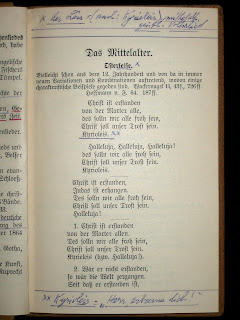
As the title indicates, the book is a collection of hymns and devotional songs of the early German church. Following a four page introduction in which Spitta summarizes the history of the use of music in German religious services, there is a chapter of 29 Catholic hymns from the Middle Ages. After this is the section on the Reformation hymnodists, which begins with a chapter presenting 20 hymns by Martin Luther, followed by chapters containing 42 hymns from 19 other German theologians and musicians as well as from several different traditions (including “The Könisberger Songs” and “Mart Gras Songs”). Several of the Catholic hymns are in Latin; all of the Protestant hymns are in German. Throughout, Spitta provides brief explanatory remarks before some of the verses to set them into their context and brief biographical paragraphs on the writers; he also frequently cites other scholarly works (including his own) for further reading. At the end there is an index of hymns by first lines.


One of the reasons my sister-in-law thought I’d like this book is because of my interest in marginalia. My copy has been closely read and used for its scholarly purposes by a very conscientious reader. Up until p. 57 nearly every page has been carefully marked with either red ink or blue ink (or both) to underline or box in specific passages. The same reader has used a system of “x” marks within the text (or “xx” on pages with more than one annotation) to refer to marginal glosses he or she has added. These glosses provide German translations of specific Latin words with which the reader was evidently unfamiliar and, in some cases, suggests cross-references to other hymns or composers in the book. What strikes me most about this marginalia is its intense precision; usually readers marking in a book tend to be casual (they’re readers, after all, not writers) and even when making notations to aid future readings they’re often only leisurely about aligning their marks (especially if they are college students). This reader, though, uses a tidy system of notation and clearly used a straight-edge for all the underlining and boxing.


There is even a deliberate switch between blue and red ink in the markings: based on how the two colors line up when they are used it is clear that they were both added by one reader and at one time, which meant the reader had a particular reason (indiscernible to me, alas) for using blue ink or red ink in marking the text at particular places. The only place where both inks underline a phrase is the first two words of Luther’s “Der Glaube zu deutsch” {The Faith of the German”} on page 50, of which the first line reads “Wir glauben all an einen Gott” {“We all believe in one God”}. Likewise, some of the marks used to draw attention to various passages differ from single underlines to double underlines, single marginal lines to double marginal lines, and in some places text boxes.


Of course, this is one of the reasons I enjoy browsing through old books -- they don’t only provide evidence of how their authors wrote or their makers printed but they are also our best (and often only) real evidence of how readers before us read, thought about, and responded to the ideas they contain. But, as the Deutsche Kirchenlied reader’s switching between red ink and blue or his seemingly arbitrary use of underlining in some places and text boxes in others reminds me, no matter how much evidence these readers’ marks offer up, their system of codes and their purposeful selectivity always leave incredible gaps. These silences compel us to accept that we and our readerly forerunners have only this miniscule connection -- as thin and fragile as the sheets of paper on which the book is printed -- and we will never have, nor should we worry ourselves too much in trying to find, all the answers about the readers who have come before us. We, too, will someday be mysteries to those who in a hundred years read the same books that we have read -- people who, like us, will struggle to catch just a fleeting glimpse of their predecessors in the margins of our books.


Monday, March 23, 2009

Fugues: Music of the Devil?


“Beware you be not swallowed up in books!”


So cautioned English evangelist John Wesley, founder of the Anglican revivalist faith that became known as Methodism and which was formally organized into the Methodist Episcopal Church of the United States in 1784 (today part of the United Methodist Church). Wesley's warning often haunts me in both the metaphorical sense (for example, when I take a break from reading for my graduate studies by doing some research on my books for this blog) and sometimes in the physical sense (ever been to Derby Square Books in Salem, MA?).


This week’s book is a Methodist devotional songbook with the typically over-precise title The Methodist Harmonist, containing A Great Variety of Tunes Collected from the Best Authors, Adapted to All the Various Metres in the Methodist Hymn-Book, and Designed for the Use of the Methodist Episcopal Church in the United States. To Which is Added a Choice Selection of Anthems and Pieces, for Particular Occasions. The book had its copyright registered by the original publishers N. Bangs and T. Mason, under the hand of James Dill, Clerk of the Southern District of New York. The manuscript of the book was completed on October 23, 1821 and published in 1822, representing a year-long effort by a four-man committee (John M. Smith, Daniel Ayres, John D. Myers, and G. P. Disosway) specifically convened by the 1820 Methodist Episcopal General Conference. As far as I can determine, subsequent editions appeared in 1827, 1831, 1833, and 1841. The second and third editions were largely reprints of the first, but the 1833 edition changed the notation to shape-note and the 1841 edition greatly expanded the contents.


The book’s popularity can be attributed to the large niche it occupied in both the Church’s service and social life; hymnals at the time provided lyrics but no musical notation to indicate the tune to which the song should be sung. The Methodist Harmonist not only provided congregations with the correct melodies but also supplies harmony lines for all of the songs included (for those more ambitious or simply more musically-gifted assemblies, I suppose). The 1822 first edition is extremely rare (estimated assessed value is around $500); this edition (the third) is valued at approximately $100-$150 and came to my collection from my grandfather's collection. While books in houses of worship are often treated with reverence, the sheer volume of use to which they are subjected over the years (and which necessitated their constant replacement through the publication of later editions) means that it is often difficult to find extant copies that are in good or excellent condition. These were books that (like children’s books or school books) were truly practical objects, meant to be used over and over again and not simply read once and then stored away on the shelf.


The book was published by J. Emory and B. Waugh of New York and printed by J. Collord in 1831. The imprint notes also that it is “to be had of the Methodist preachers in the cities and country”, an interesting variation on the usual retail distribution rhetoric to be found in imprints of the period. Throughout the 1830s and 1840s Collord printed numerous other works for the Methodist Church including The Life of Rev. Henry Martyn, Missionary to India (1837), Bible Stories for Children (1846), and numerous Sabbath school history and text books. Emory and Waugh, both of whom may have been abolitionists (a defining feature of many evangelical Christian churches, including the Methodist Episcopalians), often published in partnership for the Church, including hymnals, Bibles, New Testaments, and didactic works.


L. Moore provides the following comments (the website also provides MIDI synthesized recordings of the songs in the Harmonist):


Sacred Harp singers with a taste for research may first encounter The Methodist Harmonist on the Web in its later shaped note incarnation, as printed beginning in 1833. I have read mild deprecations of it as a four-shape book because it doesn't contain many New England or Western tunes. But this is calling the glass half empty: we should instead rejoice that Billings, Read, Timothy Swan, Lewis Edson and Amos Bull have places made for them alongside John Cole of Baltimore, the anonymous American composer of "Forest" and English Dissenter or West Gallery composers like James Leach, Thomas Clark of Canterbury, William Arnold of Portsea and Thomas Walker, as well as a host of other--at the time--well-known English composers (Boyce, Randall, Shoel, Costellow, Harwood, and so on.)


The Methodist Harmonist was assembled by a four person committee, John M. Smith, Daniel Ayres, John D. Myers and G. P. Disosway. Only Gabriel P. Disosway (1799-1868) has other bibliographic attributions--he authored a book of children's sermons in 1864, another about the earliest churches of New York in 1865, and an essay about Huguenots in America included in a larger book by Samuel Smiles, The Self Help Man, in 1867. I have not seen evidence that any of the four were composers, or that they themselves altered or arranged the tunes and anthems included in the book. Most tunes included are printed in 3- or 4-part arrangements, although a handful of tenor-bass tunes are inserted here and there. The committee made excellent choices overall: in a relatively small collection (247 pages of music) they allowed in very few dull tunes. The book was planned for use in worship, not as a singing-master's textbook. As was customary throughout the period, most tunes have only one stanza of text provided, the expectation being that the singers (either as a choir or singing society) would balance tunebook and hymnbook on their knees or laps in order to sing the rest of a hymn, or a metrical alternative to the text attached to the tune.


The book is bound neatly in marbled paper-covered boards with a brown leather spine (what looks like faded residue from a sticker's glue remains on the front cover); at the front of the book there is a blank pastedown and blank flyleaf; at the back there is one blank flyleaf and the torn remains of a second, along with a blank pastedown. It was printed in octavo with 135 leaves measuring 13cm x 21.5cm each. These oblong measurements suggest the sheets were originally ledger or tabloid size paper; the type for the pages would have been set twice in the forme--one setting above the other--and each sheet, after printing and perfecting, would then be cut in half down the middle. Coincidentally, this practice was also followed by the U.S. military during World War II to mass produce paperback novels for servicemen overseas (something that, according to the New York Times, the military experimented with again in 2002).


As noted above, the book is in good condition, with only one of the back flyleaves torn out. Some of the page corners are turned down (perhaps inadvertently) and there is foxing throughout. Someone has taken a pencil rather aggressively to the blank flyleaves and pastedowns; most of the marks thus made are vigorous but meaningless scribbles across the page, but the name “Wightman” appears penciled very faintly on the recto of the front flyleaf.


After the title page, the book is followed by a preface relating the importance of “the science of sacred music” to the service and faith of the Methodist Episcopal church, along with the report of the committee assigned to assemble the book explaining their objectives: they purposefully selected tunes easily sung by the whole congregation, they have cross-referenced the Harmonist to the approved service hymn-book, they attempted to draw songs from a diverse geographic range both within the United States and abroad, and because “of that clause of our discipline which disapproves of fugue tunes [they] passed by those distinguished by that peculiarity.” I have no idea what it is precisely about the fugue that the Methodists found objectionable, but it was apparently felt to be corruptive enough to be the only genre of music specifically banned in the denomination’s devotional music.


Following the preface there are eight pages of “A Brief Introduction to the Science of Music”, meant to assist those members of the congregation for whom music is a new pursuit. This section covers the basics of reading musical notation, including sections on clefs, notes and rests, musical “characters” (that is, markings), timing, keys (including both major and minor, as well as how to transpose), a series of four exercises, and a brief glossary of terms. The conclusion of this Introduction, however, reminds the reader that all of the “scientific” knowledge of music in the world won’t help if one isn’t moved by the spirit: “We cannot attain the true pleasure of Sacred Music unless we feel a genuine spirit of devotion...”


The songs in the book (approximately two hundred in number) are almost all presented in the same fashion, with the name of the congregational community or geographic region from which it originates, the appropriate hymn number, the name of the composer, and usually the number of syllables contained in each line. In addition to the hymns, the book includes a selection of twelve “anthems and pieces”, or non-hymn songs, appropriate for various church occasions. These twelve are presented with more notational complexity, including often parts for multiple voices and more detailed instructions in the way of dynamics, tempo, and tone. At the back of the book there is an index of songs listed alphabetically by congregational community or geographic region, as well as an index listing songs by their metrical identity.


For those of you (both of you) who are musically inclined, there may be some interest in the different terms used for elements of musical notation at this time. Here are some from the Methodist Harmonist, with their modern equivalents (interestingly, a number of the older terms are still used for musical notation in the United Kingdom):


Ledger lines = Bar lines

Cliff = Clef

Counter Cliff = C-Clef

Semibreve = Whole-note

Minim = Half-note

Crotchet = Quarter-note

Quaver = Eighth-note

Semi-quaver = Sixteenth-note

Demi-semi-quaver = Thirty-second-note


In addition, the bass clef symbol looks like an inverted C, the repeat bar is replaced with a column of four dots in each space on the staff, the end bar is made of two thick bars backed by a short bar centered on the staff, and the notation sometimes uses a squiggly mark over a note (called a “direct”) to indicate the placement of the previous note. They also have terms for things such as notes held over a bar line (“driving notes”) and for notation to indicate that the singer should choose one of the notes presented to sing (“choice notes”, which sounds like a recipe for choral anarchy to me). Grace notes are referred to, rather gracefully, as appogioaturas. The different timing marks have between two and four different “moods”, indicated by the time signature, with each mood slightly changing how the beats are emphasized in each measure.


From the fifteenth century up until the switch to machine printing in the 1850s, the printing of music was a specialized trade (just like printing books in non-Roman alphabets) that demanded specially trained compositors and proofers, as well as unique type pieces. I always enjoy lingering over the pages of a hand-press period music book, such as The Methodist Harmonist, and noting how the craftsmen employed their specialized knowledge with care and precision in order to ensure that the harmonious rhythms of the printing process resulted ultimately in a harmoniously sounded piece of music.