Showing posts with label Reformation. Show all posts

Saturday, November 27, 2010

From Manuscript to Print (to Manuscript to Print) and Back


Whenever a new information medium appears, prognosticators love to predict the imminent demise of the old medium. Every time they’ve done this, they’ve been wrong.


Socrates famously predicted (wrongly) that the new invention “writing” would result in the demise of mankind’s ability to remember anything.


A whole chorus of opponents decried the arrival of the printing press in Europe in the fifteenth century, ranging from religious hostility that feared (rightly as it turned out) that printing would hasten the spread of Reformation theologies that undermined the authority of the Catholic Church to economic hostility from scribes, illuminators, and others who had built their livelihoods and, indeed, entire industries around the copying and circulation of manuscript codices.


In 1927, Jack Warner (of Warner Brothers) shrugged off the then-new fad for movies with accompanying audio tracks: “Who the hell wants to hear actors talk?” he infamously, and incorrectly, quipped.


The advent of the computer and digital communication were supposed to send material documents to the recycling bin of history...but, as Abigail Sellen and Richard Harper famously revealed in their The Myth of the Paperless Office, precisely the opposite has happened: we use more paper than ever before; indeed, the use of email alone has caused a 40 percent increase in paper use in the average office setting over the last two decades.


And, of course, e-books -- such as the unfortunately named Amazon Kindle -- are widely forecasted (by forecasters eager to sell their books, magazines, and newspapers) to lay to rest the traditional printed codex. But, as the Guardian pointed out in 2007, such hysterics are often divorced from any version of current reality as we know it: books remain popular, tactile, emotional, visceral, historical, and communal in ways that digital books never can be. As the Guardian op-ed points out, video games have not yet put to death sports in the “real world”. Visions of a book-less world have been around since at least 1894.


Of course, the common thread running through these misjudgments -- the thread that unites, for example, all of the blog-posts and editorials that salivate at the hip “new” idea of the death of books -- is the dualist misconception that one media necessarily replaces another. This error is particularly easy to buy into in a commercial, capitalist society -- a setting in which we are trained to think that the market can only support one media, one product, one company, and that competition is a zero-sum game.

This insipid view may explain, say, car or shoe sales. But it has been proven insufficient for describing information media for over three thousand years.


New forms of information media transform the old ones and coexist with them, but they rarely fully displace them. People continued to remember things after the invention of writing; people continued to use handwritten manuscripts (and the Catholic Church survived) after the invention of print; people continued to use paper documents after the digital revolution. Even silent films -- though no longer a common form of film themselves -- shaped the principle (often taken for granted as a “given”) that movies are meant to be primarily visual storytelling devices.


The assumption that the new eliminates the old also relies upon the misconception of a teleological arch in the development of media; that is, that every new form is an improvement of the old and that it thus moves us further along some (artificial) linear pathway towards an idealized end-point. Thus commentators, pontificators, and other bloviators -- eager to position themselves as part of and even contributors to the demise of the old and hence the rise of the (profitable) new -- perpetuate the mythology.


This week’s book is a beautiful reminder of the pluralism of information media, and that forms of text, such as print and manuscript, do not merely coexist but that they also inform one another in a circular (rather than linear) relationship.


The book is Devoir des Vierges Chrestiennes (“The Duties of Christian Virgins”) and it is entirely handwritten. This particular manuscript is a “fair copy” of a printed book translated from English by the prolific French theologian Ambroise Paccori (1649-1730) and which appeared in its first French edition in octavo format published by Lottin of Paris in 1727 (a subsequent edition was published by an unknown stationer in 1736 and a third, in duodecimo format, followed from Butard of Paris in 1766).


Though born into a lower-class family, Paccori rose to prominence in the French church through his learning. For eighteen years, Paccori served a deacon and principal of the college of Ceauce, near Orleans in Normandy (surviving an attempted poisoning by a student in 1684) and he wrote some scholarly religious works in the late 1680s and into the 1690s. He retired from teaching in 1706, moved to a suburb of Paris, and embarked upon a full-time, late-life writing career, churning out dozens of influential theological and ascetic books, articles, chapters, and essays over the last three decades of his life.


The scribe, who is not identified in the book, has dated this copy Paris, 1738; his or her only addition to the text was a relieved “Fin 1738” on the final page.


It runs 559 pages, though there is one unpaginated title page leaf and four unpaginated leaves at the end (three for the table of contents and one blank). The binding is the original leather, now cracking slightly and with some looseness in the hinges, but otherwise intact; a gilded title (“Devoir des Vierge”) appears on the spine. The book includes a green silk ribbon page-marker attached to the spine. The page edges are red; the pages themselves are 10cm x 15.5cm and are of a conventional paper with 2cm vertical chain-lines.


The handwriting used in the book is an elegant and careful cursive (right-handed); plenty of space is left between lines for ascenders and descenders and the kerning is measured and consistent. Sometimes the lines drift a bit, but never severely. Throughout the book, the scribe has used brown ink, which varies little -- suggesting that it was mostly written in a short period of time. There are very few copying errors, and those that do appear are very quietly fixed with squiggled but clean overwriting. The tightness of the binding and the shallowness of the gutter suggests that the book was written on loose pages which were then bound into codex form (the apparent lack of gatherings seems to confirm this).


The scribe has in some ways scrupulously followed the printed version, including features relevant to the printing (footnotes and a transcription of De Villiers’s license, dated March 15, 1726) while skipping those parts not relevant to the purposes of copying out a manuscript version (no transcription of the full title-page of the printed version, no catchwords, no running titles). We’re used to thinking of a codex as a printed book, almost by default, but this book underscores the fact that very frequently codices are handwritten volumes (think of modern diaries and journals, for example).


The contents of the book use scriptural and patristic sources to delineate a highly elaborate code of conduct for Christians choosing “to live in chastity and acquire perfection”. Accompanying my copy is a typewritten translation of the table of contents (the table in the book is unpaginated and appears, as was typical in the time, at the end of the book), describing the topic of each of the twenty-seven chapters.


An owner’s inscription inside the front cover reveals both the provenance of the book and how it came into my collection: Stanley Dell. An earlier, ink note in the upper corner of the same page records a sequence or acquisition number (41)


This unique copy of Devoirs des Vierges Chrestiennes is a reminder that the boundary between print and manuscript, between the machine-made and the chirographic, is permeable and that textual media are fluid rather than distinct and absolute categories. The author of the original English version would have written the first version of the book as a manuscript; then it was printed; then Paccori would have written his translation as a manuscript; then it was printed; then an anonymous scribe copied out a manuscript transcription. And now, it (sort of) enters the new medium of digital information as this week's featured book on Tarquin Tar's Bookcase.

Sunday, June 28, 2009

Dr. Spitta's Contribution to One of the Longest Running Book Series Ever


Not too long ago my sister-in-law was on a professional trip to Zurich, Switzerland and, knowing of my bibliophilia, returned with a few gifts to add to Tarquin Tar’s Bookcase. This week’s book is one of those items.


Published in 1912 in Berlin and Leipzig by G. J. Göschen, the book is Das Deutsche Kirchenlied in seinen charactteristeschen Erscheinungen {German Church Music in Representative Examples} by University of Strasbourg professor of theology Dr. Friedrich Spitta (1852-1924), a noted Protestant preacher and scholar of Jewish descent. This particular copy is of volume one of Spitta’s study: “Mittelalter und Reformationszeit” {“Middle Ages and Reformation”}. Because the book was mass-produced as part of an educational series (see below), the title is not exceptionally rare, though I do notice that all of the dealers currently offering it for sale are located in Germany, so I suspect it is somewhat uncommon here in the United States.


The book is volume 602 in the prodigious Sammlung Göschen {Göschen Collection}, a series of pocket-sized books that was launched by the firm founded by the then-deceased publisher Viscount George Joachim Göschen (1752-1828) in 1889 for the express purpose of offering highly quality, durable books of German texts, edited by leading scholars of the day, and sold at a price (80 cents) that made them accessible for school use across Germany. The first ten volumes in the series focused on classic works of the German enlightenment; volume eleven introduced science to the mix (on astronomy, by A. F. Möbius, the mathematician who lent his name to the famed Möbius Strip geometric form) and the next year the popular series expanded to include a variety of fields, such as education, geology, psychology, mythology, and logic.


After the turn of the century, the series changed its mission from school use to use in the universities and the number of titles it offered increased exponentially, reaching 500 in 1910 and 1000 in 1931. After the turn of the century the series was acquired by publisher Walter de Gruyter (though the series name did not change) and continued to be issued into the mid-1990s. With an active production of new titles for over a century, the Sammlung Göschen is one of the longest-running scholarly series of books of the modern age. The series mission statement, as it appeared in volumes throughout the twentieth century (including this one), reads:


To present our current knowledge in short, clear, universally understood monographs. The purpose and objective of the Göschen Collection is to provide, in individual examples, a clear, easily understandable, and concise introduction to all areas of science and technology and to give, through close examination on a strictly scientific basis and taking into account the latest research, the most reliable information possible. Each topic is discrete, but all volumes possess an inner relationship with each other, so it is expected that the whole thing, when completed, will exist as a uniform, systematic presentation of all of our entire knowledge. 


Designed for the convenience of the student reader, the book is a slim volume, bound in durable tan cloth with inked titles, borders, and publisher’s device (an eagle standing over the letters “GJG”) on the cover. Its corners are rounded slightly, but this is from wear and not part of the book’s deliberate production. The pages measure 10cm x 15cm and are of a dull gloss, lightweight stock. As with most continental books, the signatures are numeric rather than (as they are in England and America) alphabetical. The collational formula may be expressed as 8o: [#] 18-98 [π]: $2 with the exception of gathering 1 in which the first leaf is not signed. The second leaf of each is signed with an asterisk (*) after the gathering number. On the inner lower corner of the initial page of each gathering is the name of the author and volume title -- something that, as I’ve noted previously, was no doubt meant as an aid to the printer in keeping sheets from multiple volumes in the same series from being confused.

This indicates, of course, that the printer was employed on more than one title at a time (which would probably have been necessitated by the series’ rapid dissemination of new titles). The initial leaf and ultimate leaf are conjugate directly with the endpapers pasted down inside the front and back covers respectively; the ultimate leaf is a blank fly and the initial is a catalog list advertising other related volumes in the series (the front cover’s paste-down has the series mission statement). Pages 128 and 129 have split apart somewhat, revealing that the gatherings were bound together with iron staples which have started to rust slightly and then were pasted down along their edge into the binding. Beginning with the title page [11r] the pagination runs throughout the book as [1] through 141 (on [97r]) with only p. 140 unmarked.


As the title indicates, the book is a collection of hymns and devotional songs of the early German church. Following a four page introduction in which Spitta summarizes the history of the use of music in German religious services, there is a chapter of 29 Catholic hymns from the Middle Ages. After this is the section on the Reformation hymnodists, which begins with a chapter presenting 20 hymns by Martin Luther, followed by chapters containing 42 hymns from 19 other German theologians and musicians as well as from several different traditions (including “The Könisberger Songs” and “Mart Gras Songs”). Several of the Catholic hymns are in Latin; all of the Protestant hymns are in German. Throughout, Spitta provides brief explanatory remarks before some of the verses to set them into their context and brief biographical paragraphs on the writers; he also frequently cites other scholarly works (including his own) for further reading. At the end there is an index of hymns by first lines.


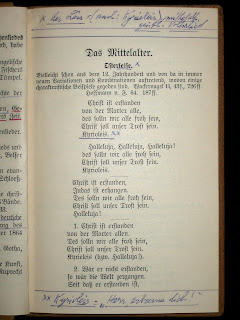
One of the reasons my sister-in-law thought I’d like this book is because of my interest in marginalia. My copy has been closely read and used for its scholarly purposes by a very conscientious reader. Up until p. 57 nearly every page has been carefully marked with either red ink or blue ink (or both) to underline or box in specific passages. The same reader has used a system of “x” marks within the text (or “xx” on pages with more than one annotation) to refer to marginal glosses he or she has added. These glosses provide German translations of specific Latin words with which the reader was evidently unfamiliar and, in some cases, suggests cross-references to other hymns or composers in the book. What strikes me most about this marginalia is its intense precision; usually readers marking in a book tend to be casual (they’re readers, after all, not writers) and even when making notations to aid future readings they’re often only leisurely about aligning their marks (especially if they are college students). This reader, though, uses a tidy system of notation and clearly used a straight-edge for all the underlining and boxing.


There is even a deliberate switch between blue and red ink in the markings: based on how the two colors line up when they are used it is clear that they were both added by one reader and at one time, which meant the reader had a particular reason (indiscernible to me, alas) for using blue ink or red ink in marking the text at particular places. The only place where both inks underline a phrase is the first two words of Luther’s “Der Glaube zu deutsch” {The Faith of the German”} on page 50, of which the first line reads “Wir glauben all an einen Gott” {“We all believe in one God”}. Likewise, some of the marks used to draw attention to various passages differ from single underlines to double underlines, single marginal lines to double marginal lines, and in some places text boxes.


Of course, this is one of the reasons I enjoy browsing through old books -- they don’t only provide evidence of how their authors wrote or their makers printed but they are also our best (and often only) real evidence of how readers before us read, thought about, and responded to the ideas they contain. But, as the Deutsche Kirchenlied reader’s switching between red ink and blue or his seemingly arbitrary use of underlining in some places and text boxes in others reminds me, no matter how much evidence these readers’ marks offer up, their system of codes and their purposeful selectivity always leave incredible gaps. These silences compel us to accept that we and our readerly forerunners have only this miniscule connection -- as thin and fragile as the sheets of paper on which the book is printed -- and we will never have, nor should we worry ourselves too much in trying to find, all the answers about the readers who have come before us. We, too, will someday be mysteries to those who in a hundred years read the same books that we have read -- people who, like us, will struggle to catch just a fleeting glimpse of their predecessors in the margins of our books.